If you want to hire a Laravel developer who can take a feature from database schema to production without three handoffs along the way, here’s what that actually looks like. I’m Faisal Nadeem, a full-stack engineer with 6+ years shipping production SaaS platforms on Laravel — from the database layer up through Vue and React frontends — working remotely with teams across the EU, US, and Pakistan, where I’m based in Lahore.
I hold an MCS from the University of Management and Technology (UMT) Lahore and a BSc from the University of the Punjab. Since 2022 I’ve worked at a senior and lead level at Tech Scale, with earlier roles at Cityscape Technology Corporation and at Seers, a GDPR-compliance SaaS platform. Laravel has been the backbone of most of the production SaaS products I’ve shipped, because it gets out of the way and lets you focus on actual business logic instead of re-solving authentication, queues, and database migrations from scratch.
If you’re here, you’re probably in one of a few situations: you need an MVP built on Laravel fast and correctly the first time, you’ve inherited a Laravel codebase where every page fires a few hundred queries nobody ever profiled, your queued jobs fail silently and you find out from an angry customer instead of a monitoring dashboard, or you need someone to wire up Stripe or Reepay billing without the classic double-charge bug. Below you’ll find what a Laravel developer should actually build, how I work, real case studies, what it costs, and answers to the questions I get asked most on discovery calls.
Table of Contents
What a Laravel Developer Should Actually Build
“Laravel developer” covers a wide range of actual work, and the label alone doesn’t tell you much about whether someone can do the job well. Here’s what falls under it in practice when you hire a Laravel developer for real production work.
RESTful APIs & Backend Services (Sanctum & Passport)
Most Laravel work today is building an API that a Vue, React, or mobile client consumes — not server-rendered Blade pages. That means getting authentication right from the start: Sanctum for first-party SPAs and mobile apps, Passport when you need full OAuth2 support for third-party API consumers. I design the resource layer with Eloquent API Resources so the API contract stays stable even as the underlying database schema evolves.
Eloquent ORM & Database Architecture
Eloquent is easy to use and easy to misuse. The most common production issue I fix in inherited Laravel codebases is the N+1 query problem — a dashboard that looks fine in development with ten rows of seed data and then fires four hundred queries in production with real data. Eager loading, correct database indexing, and knowing when to drop down to the query builder or raw SQL for a reporting query are basic hygiene, not advanced techniques.
Queue & Background Job Processing (Horizon)
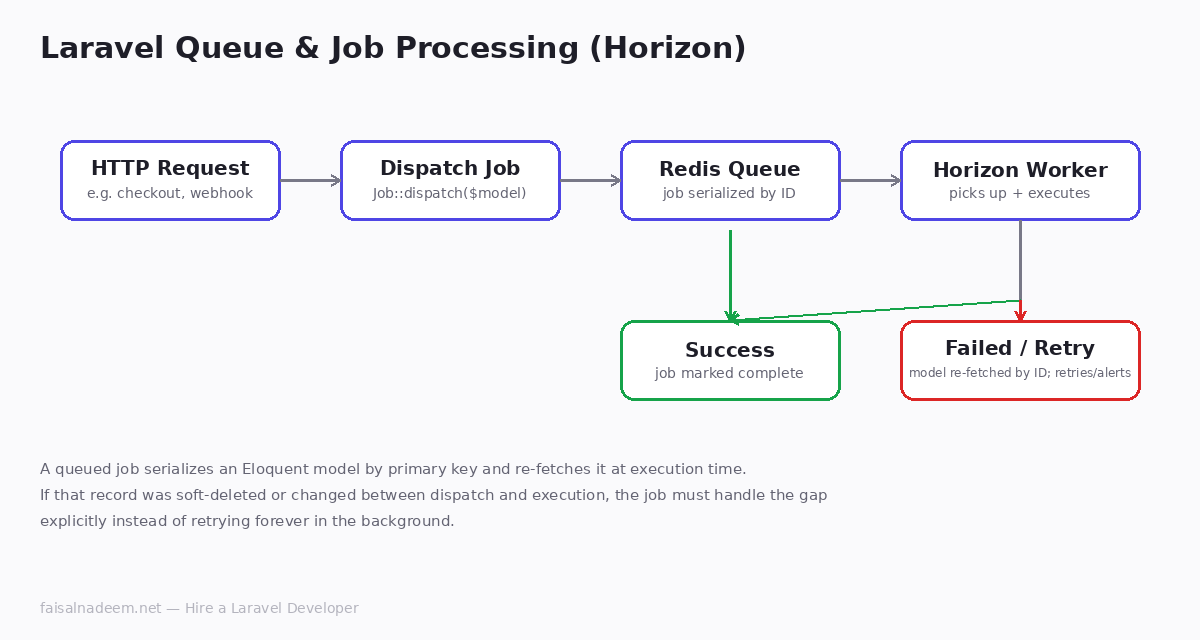
Anything that shouldn’t block a user-facing request — sending an email, generating a PDF, calling a slow third-party API — belongs in a queue, and I run Horizon on Redis for visibility into failed jobs. There’s a specific Laravel gotcha worth knowing about if you’re hiring for this: a queued job that references an Eloquent model serializes that model by its primary key through the SerializesModels trait, then re-fetches it from the database when the job actually runs.
If that record was soft-deleted or changed in the gap between dispatch and execution, the job either throws a ModelNotFoundException in a retry loop or silently works on stale data. I design jobs to handle that gap explicitly — checking for existence, wrapping state-mutating jobs in database transactions, and alerting on repeated failures instead of letting them retry forever in the background.
Third-Party & Payment Integrations
Stripe, Reepay, Twilio, and similar APIs are where a lot of real client requirements live, and where sloppy work costs actual money. Webhook handlers need signature verification and idempotency — a webhook can be delivered more than once by design, and a handler that isn’t written to be safely re-run will eventually double-charge or double-provision something.
Laravel for AI & LLM Backends
Laravel is a perfectly reasonable place to run AI-assisted workflows: a queued job that calls an LLM API, streams a response back over a broadcast channel, and stores the result — the same queue and broadcasting infrastructure you’d already use for anything else. I build RAG pipelines and AI agent backends on Laravel when a client’s existing stack is already Laravel, rather than bolting on a separate Python service out of habit.
Multi-Tenant SaaS Architecture
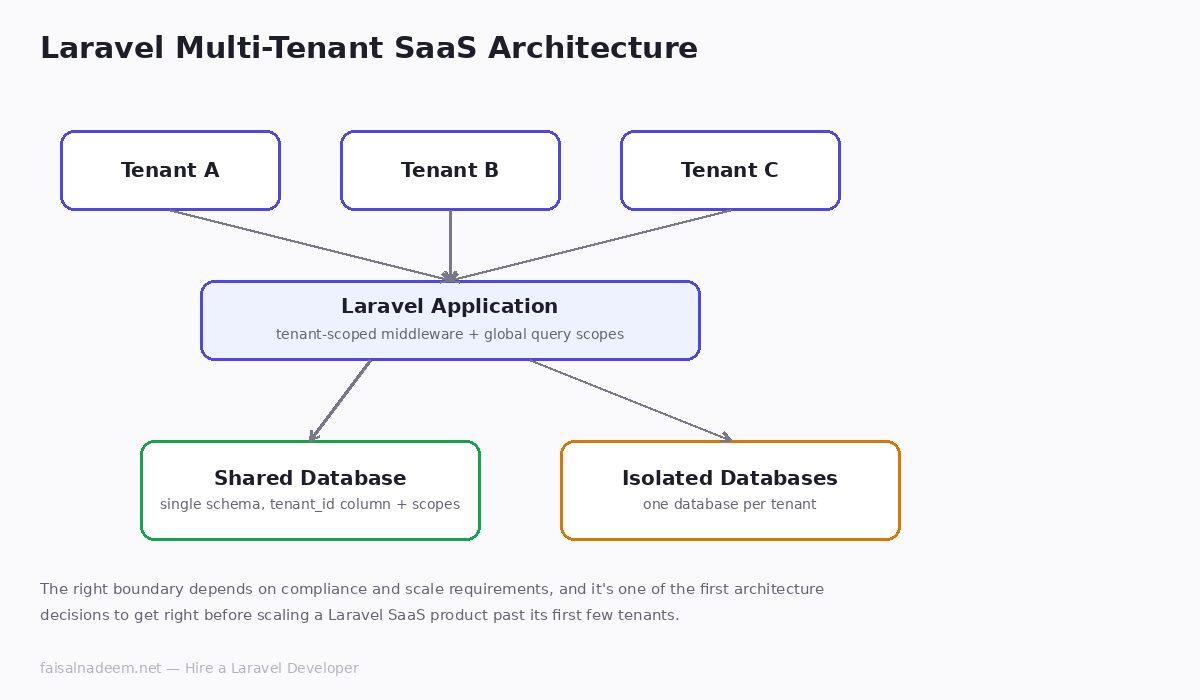
Most of the Laravel SaaS products I’ve built are multi-tenant at some level — a shared database with tenant scoping, or fully isolated databases per tenant, depending on the compliance and scale requirements. Getting the tenant boundary right early avoids a painful migration later, and it’s one of the first architecture decisions I walk through with a new SaaS client.
Hiring a Laravel Developer for Your SaaS Product
Custimoo and WingWarranty both use Laravel as the application core, and both are SaaS products where a mistake in the backend has a real, visible consequence for an end customer — not just a bug ticket. On WingWarranty, a car-insurance SaaS platform built around recurring subscription billing, Laravel manages the subscription and billing state alongside Reepay integration, with the billing database treated as the single source of truth so a webhook retry can never result in a lapsed policy showing as active or a customer being billed twice.
On Custimoo, a sports-apparel customization platform, Laravel and MySQL own the product, order, and customer data model while Vue handles the real-time customization UI, and the two systems stay in sync through a backend that’s explicit about which side owns which piece of state.
If you’re building or scaling a SaaS product on Laravel, this is what matters more than raw feature velocity: does the person building it understand which system owns which piece of state, and have they actually shipped a billing integration that survives a retried webhook. For more on how I approach this end to end, see my Laravel SaaS development page.
Why a Full-Stack Engineer for Laravel Work
A lot of Laravel shops split backend and frontend across two people or two teams, which works fine until a feature needs both sides to agree on something non-trivial — pagination shape, real-time updates over a broadcast channel, or how validation errors get surfaced in the UI. I build both the Laravel backend and the Vue or React frontend, which means the API contract and the UI that consumes it are designed together instead of negotiated after the fact through a shared Postman collection and some frustration.
Laravel vs Other Backends — When It’s the Right Choice
I also work in Node.js and ASP.NET Core, so this isn’t a pitch for Laravel over everything else — it’s a real comparison.
Laravel vs Node.js. Laravel wins when the project is CRUD-and-business-logic heavy with a relational data model — Eloquent, migrations, and the built-in queue and auth systems save real time. Node tends to win when the workload is genuinely I/O-heavy and concurrent, like high-throughput WebSocket connections, or a service that’s mostly proxying and orchestrating calls to other APIs rather than owning complex business logic itself.
Laravel vs ASP.NET Core. ASP.NET Core makes sense when a client is already inside the Microsoft ecosystem — Azure AD for identity, an existing .NET codebase, or an enterprise requirement that specifies it. Outside of that constraint, Laravel is usually faster to build and iterate on for a small-to-mid-size team, with a lower operational footprint.
For a client who isn’t locked into an existing stack or a specific enterprise requirement, Laravel is usually my default recommendation for a new SaaS backend, precisely because so much of the undifferentiated work — auth, queues, migrations, validation — is already solved well.
Proof
WingWarranty. A car-insurance SaaS platform built around recurring subscription billing, where a missed or mishandled payment is a lapse in someone’s actual coverage, not just a failed charge. I built the system on Laravel, Vue, and Node, with Reepay handling subscription billing. Getting the Reepay integration right meant treating billing state as the source of truth on the backend, with webhook handling built to be idempotent so a delayed or retried event could never result in a customer being double-billed or a lapsed policy showing as active.
Custimoo. A sports-apparel customization platform that put unusual pressure on the frontend: customers needed a fluid, real-time customization experience while the backend tracked exactly what was being ordered so payment and fulfillment stayed accurate. Laravel and MySQL owned the product, order, and customer data model, Vue handled a customization UI that needed to update instantly, and Node handled the more integration-heavy pieces of the payment flow. The hardest part was keeping customization state cleanly separated from order state, so a browser refresh or abandoned session couldn’t corrupt what reached fulfillment.
How Engagements Work
- Discovery call. Understanding the actual product, current stack if one already exists, and what “done” looks like.
- Scope & architecture. I outline the database schema, API contract, and job/queue structure before writing implementation code, and share that with you before building on top of it.
- Build in short, demoable cycles. You see working software regularly, not a black box for six weeks.
- Deploy with monitoring and a post-launch plan. Docker on AWS or a similar target, CI/CD, and a plan for who’s watching for issues after go-live.
What It Costs to Hire a Laravel Developer
Laravel developer rates on the open market run roughly $25–$85 per hour depending on seniority, region, and whether you’re hiring a specialist or a generalist who also owns the frontend. I don’t publish a fixed rate card, because the honest answer depends entirely on scope, and a number without scope attached is close to meaningless. Most clients start with a free scoping call, and I give a specific estimate — hourly or fixed-price — once I understand what you’re actually building.
Engagement Models
Fixed-scope. Works well when the scope is genuinely well-defined. I only quote fixed-price after a scoping conversation thorough enough that both of us are confident the scope won’t shift.
Hourly. Right for genuinely fluid scope — early-stage products, ongoing feature work, or legacy rescue diagnostics where the actual size of the problem isn’t known yet.
Retainer. For companies wanting a dedicated Laravel developer integrated into their existing team on an ongoing basis.
If your project needs more than Laravel — a Node.js service for a specific integration, or a .NET backend because of an existing Azure requirement — see my Node.js development and ASP.NET Core development pages, or my senior full-stack developer page if you want one person owning the whole stack. For more on how I approach API design specifically, see Laravel API development, and for authentication specifically, see Sanctum vs Passport. For the official framework reference, see the Laravel documentation.
Ready to talk through your project?
FAQs
Do you actually have production experience with Laravel, or is this a skills list to look good when someone wants to hire a Laravel developer?
All of it is production experience. WingWarranty and Custimoo both run on Laravel in production today, handling real billing and order data, not demo data.
Can I hire a Laravel developer from you for just the API, or do you need to build the frontend too?
Either. Backend-only engagements are common, especially when a client already has a frontend team. I’ll design the API contract clearly enough that your existing team can consume it without back-and-forth.
What’s a typical project timeline when I hire a Laravel developer for an MVP?
Depends heavily on scope. A focused MVP typically runs a small number of months from discovery to launch. I’ll give you a specific estimate after the scoping call.
Do you fix N+1 queries and other performance issues in an existing Laravel app?
Yes, this is a regular part of the work. The first step is always profiling to find the actual bottleneck rather than guessing.
Can you set up Laravel Horizon and queues from scratch?
Yes, including designing which work should be queued, how retries and failures are handled, and monitoring so failures surface as alerts instead of silent data loss.
Do you handle Stripe or Reepay integrations?
Yes. WingWarranty runs on Reepay for subscription billing, and I’ve built Stripe integrations on other projects, in both cases with idempotent webhook handling as a non-negotiable.
What industries have you built Laravel SaaS products for?
Insurance (WingWarranty) and e-commerce/apparel customization (Custimoo), plus broader full-stack work spanning retail, GDPR-compliance SaaS, and mental health applications.
Can you work alongside our existing team, or only as a solo contractor?
Both. My work at Tech Scale since 2022 has been at a senior and lead level, including working alongside other engineers.
Can you rescue a legacy Laravel codebase?
Yes, this is a regular part of my work. The first step is always an honest assessment — which parts are load-bearing and stable, which parts are actively dangerous — before committing to an approach.
Do you build AI features into Laravel applications?
Yes, when a project calls for it — AI-assisted workflows, content generation, or RAG pipelines layered onto an existing Laravel backend using the same queue and broadcasting infrastructure already in place.
How does a technical scoping call actually work?
Speak to what the product does, whether anything is already built, your rough timeline, and any hard constraints. You don’t need a full technical spec walking in.
What’s the real difference between fixed-price and hourly when I hire a Laravel developer through you?
Fixed-price means the scope is locked in before development starts. Hourly means the scope can flex as we learn more.
Do you work with startups, or mainly established companies?
Both. WingWarranty and Custimoo were built more from the ground up, while other engagements have involved established teams with existing codebases.
What if I only need Laravel backend work, not the full stack?
That’s fine — I take on backend-only engagements regularly, and I’m equally comfortable handing off to your existing frontend team.
How much does it cost to hire a Laravel developer on a project basis?
It depends on scope — see the Engagement Models section above. Most clients who hire a Laravel developer through me start with a free scoping call so the estimate is based on real requirements, not a generic rate card.
Can I hire a Laravel developer for a short, focused engagement?
Yes — plenty of clients hire a Laravel developer for a specific audit, a bug fix, or a scoped feature rather than a long-term build. Both hourly and fixed-price options are available depending on the shape of the work.
What’s the difference between hiring a Laravel developer as a freelancer versus an agency?
When you hire a Laravel developer directly, you work with the person actually writing the code, with no account-manager layer in between. Agencies can be right for larger teams, but hiring a dedicated Laravel developer as an independent contractor typically means faster communication and more accountability for the outcome.
How do I know if I need to hire a Laravel developer versus a specialist?
If your project is built on Laravel, or you’re choosing a backend for a new SaaS product and don’t have a hard reason to pick something else, that’s exactly when it makes sense to hire a Laravel developer. If you need deep expertise in one narrow, unrelated area, a specialist may be a better fit — this gets discussed honestly on the scoping call.
What happens after I hire a Laravel developer for my project?
The engagement starts with a discovery call, followed by a written scope and estimate. Most clients see visible progress within the first week, not a six-week black box before anything is shown.
Do you offer a trial period before I fully commit to hiring you?
Yes — many clients hire a Laravel developer for a small paid pilot task first, like a scoped feature or an audit, before committing to a larger engagement.
Frequently Asked Questions
Do you only work in Laravel, or other backends too?
Laravel is my primary backend for new SaaS work, but I also build in Node.js and ASP.NET Core when a client’s stack or constraints call for it.
Can one dedicated Laravel hire really replace a small team?
For many early and mid-stage products, yes — one senior generalist who owns the Laravel backend, the frontend, and deployment can move faster than coordinating several specialists, especially before the codebase and team are large enough to need role specialization.
Do you work full-time, part-time, or project-based?
All three. Engagements can be structured as a dedicated full-time hire, a part-time ongoing arrangement, or a fixed-scope project, depending on what the work requires.
Can you add AI or LLM features to an existing Laravel product?
Yes, I build RAG pipelines, AI agents, and LLM integrations as part of Laravel work, so AI features can be added without bringing in a separate AI specialist or a separate service just to run them.
How quickly can you get up to speed on an existing Laravel codebase?
With 6+ years of experience across 50+ projects in Laravel, Node, Vue, React, and .NET, I can generally review an existing codebase, identify its structure and pain points, and start contributing within the first one to two weeks after you hire a Laravel developer through me.
How do we get started?
Book a free consultation to walk through your product, team, and goals, and I’ll follow up with a proposal covering scope, timeline, and cost.
About Faisal Nadeem
Faisal Nadeem is a skilled Full-Stack Developer with over 6+ years of experience building robust web and mobile applications. He specializes in Laravel, Vue.js, React, Node.js, and .NET, delivering scalable solutions with a focus on performance, usability, and client satisfaction.
