If you want to hire a senior full stack developer who owns both ends of the stack, here’s exactly what that looks like in practice. I’m Faisal Nadeem, a full-stack engineer with 6+ years building and shipping SaaS products end to end — backend architecture, frontend, database design, and deployment. I hold an MCS from the University of Management and Technology (UMT) Lahore and a BSc from the University of the Punjab, and I’ve spent my career since then writing production code rather than sitting in meetings about it.
I work across three backend stacks — Laravel, Node.js, and ASP.NET Core — and two frontend frameworks — Vue and React — which means I can match the stack to the project instead of forcing every project into the one framework I happen to know. That range came from real client work at Tech Scale, where I’ve operated at a senior and lead level since 2022, plus earlier roles at Cityscape Technology Corporation and at Seers, a GDPR-compliance SaaS platform where data handling and audit trails weren’t optional extras.
If you’re here, you’re probably in one of a few situations: you need an MVP built fast and correctly the first time, you’ve inherited a codebase nobody wants to touch, your app is starting to buckle under real user load, or you need someone who can wire together payments, third-party APIs, and background jobs without three different specialists losing days to handoffs. Below you’ll find how I work, what a project with me actually includes, real case studies, and answers to the questions I get asked most on discovery calls.
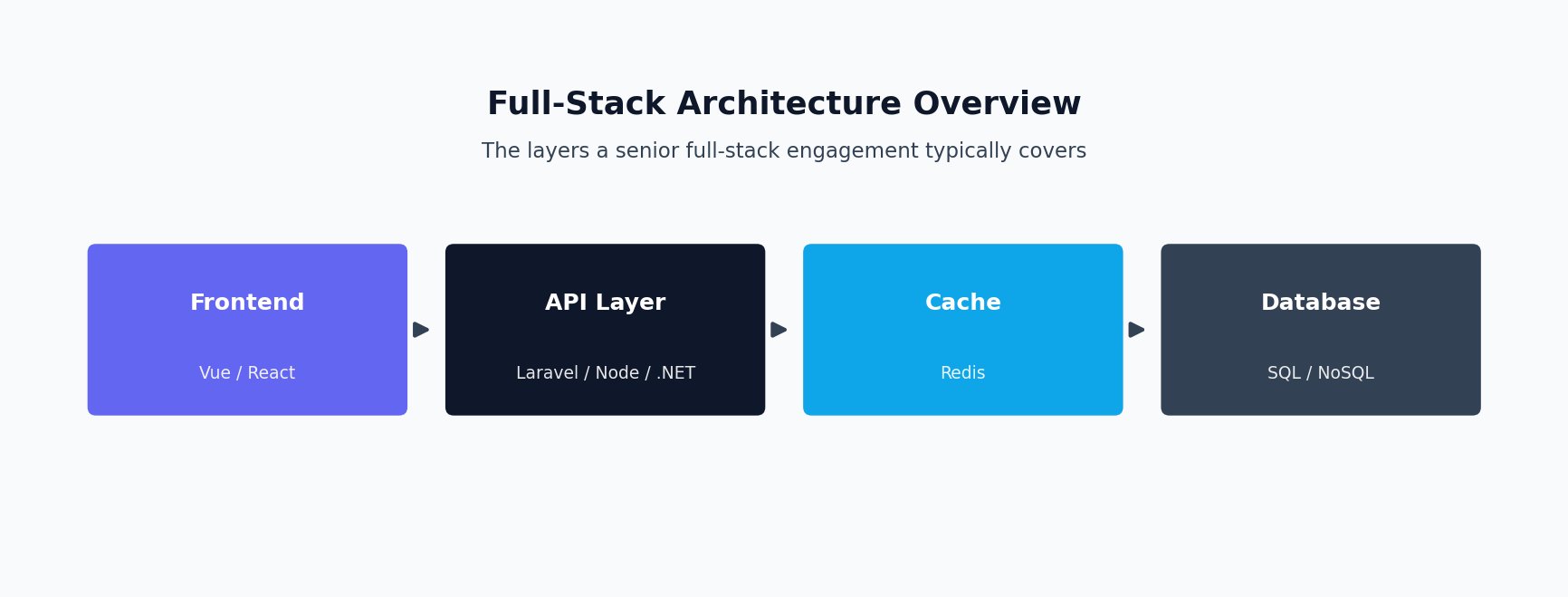
Table of Contents
Why Hire a Senior Developer Instead of a Team of Juniors
Before you hire a senior full stack developer or a team of juniors, know this: the pitch for a team of junior developers is usually cost. In practice, the cost shows up later, at the seams. Junior developers are often genuinely good within their own layer: a junior backend developer can build a clean API endpoint, and a junior frontend developer can consume it correctly. The problem is what happens at the boundary between those layers, where most real bugs actually live.
Here’s a concrete pattern I’ve seen play out on more than one SaaS product: a payment provider sends a webhook confirming a subscription was charged successfully, but the user’s browser is still sitting on the “processing” screen because the frontend is polling on its own timer, unaware the webhook already landed. If the backend and frontend were built by two different teams working from a shared spec but not a shared mental model, you get a race — the frontend’s local state says “pending,” the backend’s database says “paid.” Nobody wrote a bug here. Two correct pieces of code just disagreed about which one was the source of truth.
This is what a senior full-stack developer is actually for. Because I build both sides, I design the state ownership up front — the backend is the single source of truth, the frontend reconciles against it, and webhook handlers are idempotent by design so a retried event can’t double-charge anyone. That’s just what happens when one person is accountable for the whole flow instead of two teams each being correct about half of it.
The speed argument holds up too. A senior generalist skips the handoff meetings, skips the “who owns this bug” triage, and skips the API contract renegotiation that happens when the frontend team discovers the backend team modeled the data differently than expected. For launch-stage MVPs, scaling an app that’s starting to strain, or integrating a new payment or auth provider into an existing system, that compounding communication overhead is usually the real project cost.
What’s Included
| Area | What I deliver |
|---|---|
| Backend architecture | API design, database schema, business logic, service structure |
| Frontend | Component architecture, state management, responsive UI |
| Payments & integrations | Stripe, Reepay, and other third-party API integrations |
| Background processing | Queues, scheduled jobs, async workflows |
| Testing & CI/CD | Automated tests, deployment pipelines, monitoring |
Backend architecture. I design the database schema first — normalized where it needs to be, denormalized where read performance matters more — and build the API and service layer around it. In Laravel that means clean Eloquent models with business logic pulled into service classes; in ASP.NET Core, a proper layered architecture with dependency injection; in Node, a service structure that doesn’t turn into a folder of loosely related functions.
Frontend. I build component architecture that mirrors how your product actually behaves — shared state lives where it’s genuinely shared, local state stays local. Responsive layout is a baseline requirement, not a checkbox at the end.
Payments & integrations. Payment and subscription flows are where I’ve spent a disproportionate amount of my career. I’ve integrated Stripe and Reepay in production SaaS products: idempotent webhook handling, clear reconciliation between what your database believes and what the provider believes, and error states that are actually handled.
Background processing. Anything that shouldn’t block a user-facing request goes into a queue. On Laravel projects I use Horizon; on Node projects I use Bull.
Testing & CI/CD. I write automated tests as part of building the feature — PHPUnit on Laravel and .NET, Jest or Vitest on the frontend and Node. Combined with a CI/CD pipeline that runs tests on every push. Deployments run on Docker containers on AWS or Azure, with monitoring wired in from day one.
Tech Stack (Why Hire a Senior Full Stack Developer With This Range)
Backend: Laravel (PHP), Node.js, ASP.NET Core (C#), MySQL, PostgreSQL, Redis
Frontend: Vue.js, React
DevOps: Docker, AWS, Azure, CI/CD pipelines
Testing: PHPUnit, Jest, Vitest
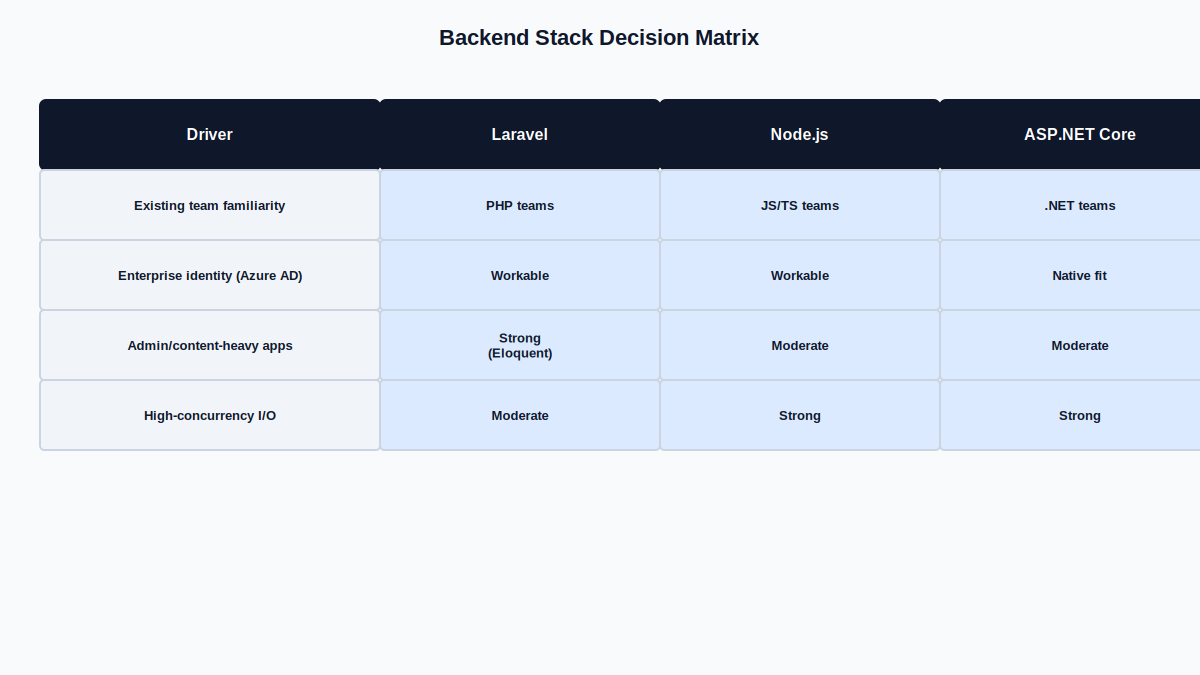
I maintain three backend stacks because clients rarely get to choose their stack in a vacuum — they inherit one from a previous developer, a technical co-founder’s preference, or an enterprise requirement (Azure AD, for instance, tends to pull a project toward .NET). Being fluent across Laravel, Node, and ASP.NET Core means I can step into whatever exists already. The same logic applies to Vue versus React — both are excellent tools, and the right choice depends more on your team’s existing familiarity than on any inherent superiority.
Case Studies
Specsavers — Lonely Planet App. Specsavers needed a booking and collection experience built on top of an internal identity system standardized on Azure Active Directory. I built the frontend in React and the backend in ASP.NET Core, with Azure AD handling authentication end to end. The core technical challenge was state consistency across the booking journey — a user starting a booking, getting authenticated, and reaching a collection confirmation needed to see one coherent flow even though several distinct systems were working together behind it. Choosing ASP.NET Core was a direct consequence of the Azure AD requirement — .NET’s first-party support for Azure identity made the integration far more reliable.
WingWarranty. A car-insurance SaaS platform built around recurring subscription billing, where a missed or mishandled payment isn’t a minor bug — it’s a lapse in someone’s actual coverage. I built the system on Laravel, Vue, and Node, with Reepay handling subscription billing. Getting the Reepay integration right meant treating billing state as the source of truth on the backend, with webhook handling built to be idempotent so a delayed or retried event could never result in a customer being double-billed or a lapsed policy showing as active.
Custimoo. A sports-apparel customization platform that put unusual pressure on the frontend: customers needed a fluid, real-time customization experience while the backend tracked exactly what was being ordered so payment and fulfillment stayed accurate. I used Laravel, Vue, and Node — Laravel and MySQL for the product/order/customer data model, Vue for a customization UI that needed to update instantly, and Node handling the more integration-heavy pieces of the payment flow. The hardest part was keeping customization state cleanly separated from order state, so a browser refresh or abandoned session couldn’t corrupt what reached fulfillment.
Minplan. A mental-health application where the backend architecture had to reflect data sensitivity from the first line of code. My work focused on the mobile backend — building APIs in ASP.NET Core with data-sensitivity requirements shaping how information was structured, how access was scoped, and how the API surface exposed only what a given client genuinely needed. This drew directly on instincts built at Seers, a GDPR-compliance SaaS platform.
Common Full-Stack Project Types
MVP builds. You have a validated idea and need a working product fast, without technical debt so severe it collapses the moment you get real traction. I keep the scope tight around the core value proposition and build the architecture to be extended later, not rewritten later.
Legacy system rescue and refactor. You’ve inherited a codebase that’s become risky to touch. This usually isn’t about a full rewrite — it’s about identifying which parts are load-bearing and stable, which parts are actively dangerous, and refactoring incrementally with tests around the danger zones.
Scaling an existing app. The product works but is starting to strain — slow queries under real load, a background job system that can’t keep up. This is diagnostic work first: profiling to find the actual bottleneck, then addressing it with the right tool.
Multi-system integration. You need your app talking to a payment provider, a CRM, an identity provider, and an internal API, and the risk is what happens when two of them disagree. Someone needs to own the whole seam, not just one side of it.
How I Work
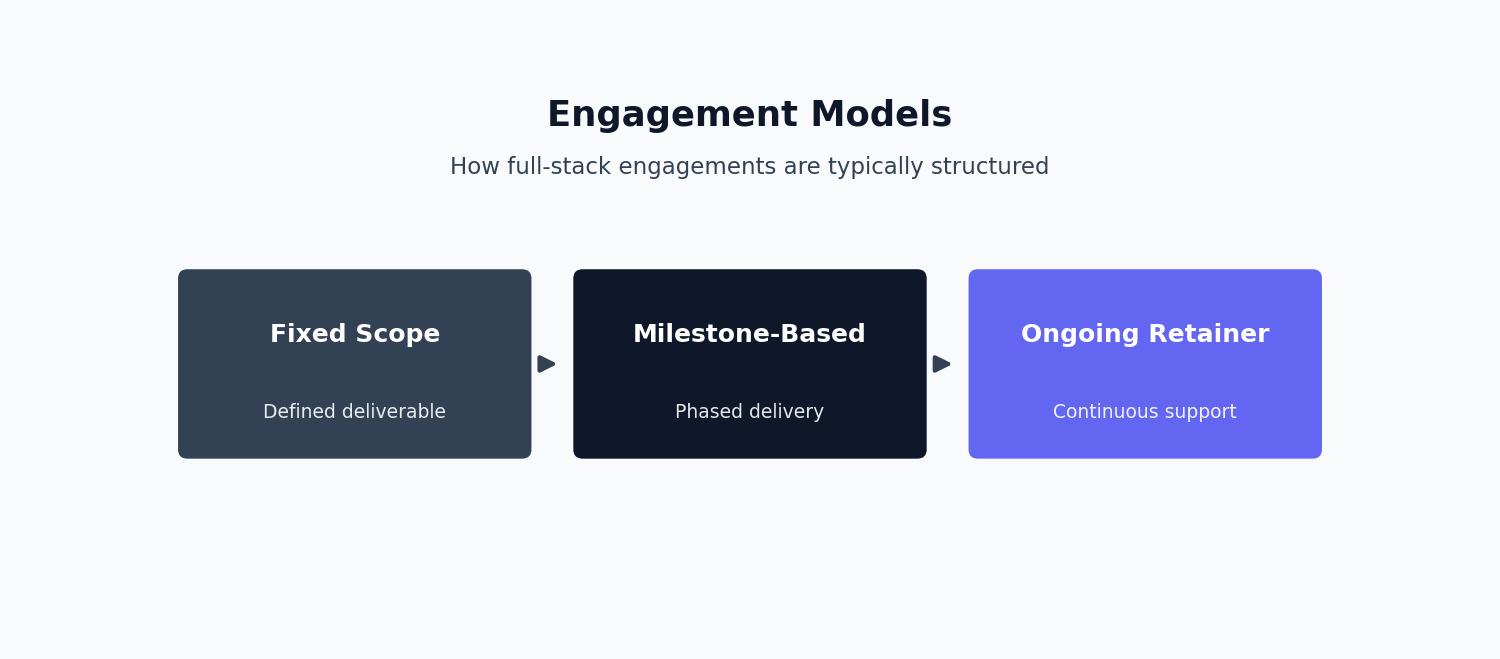
Discovery and planning. Understanding the actual business problem, not just the feature list — who the users are, what “done” looks like, and where the real constraints are.
Architecture and design. Before writing implementation code, I design the database schema, API contract, and overall system structure, and share that design with you before building on top of it.
Development in short cycles. Short, demoable increments rather than disappearing for weeks. You see working software regularly.
Deployment with monitoring. Docker on AWS or Azure with CI/CD pipelines, monitoring wired in from day one.
Post-launch plan. A plan for what happens after go-live — who’s watching for issues, how bug fixes get prioritized, and what ongoing support looks like.
Engagement Models
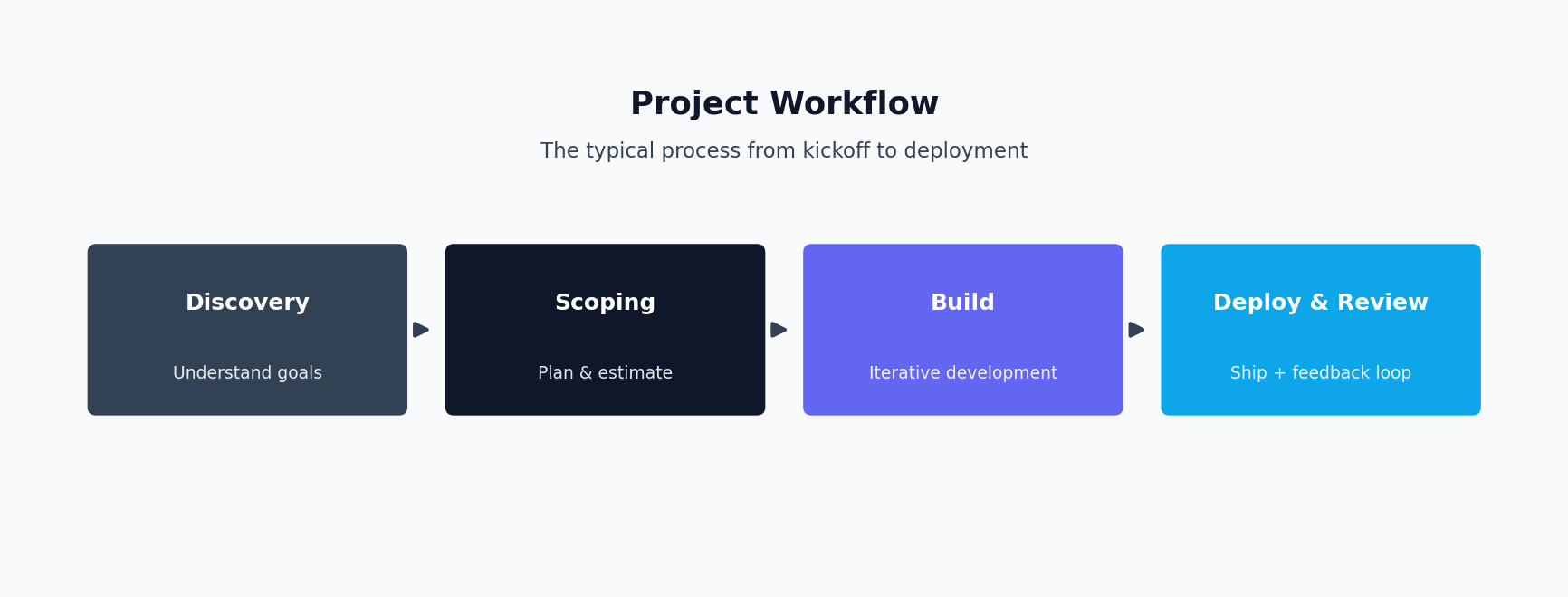
Hourly. Right for genuinely fluid scope — early-stage products, ongoing feature work, legacy rescue diagnostics.
Fixed-price project. Works well when scope is genuinely well-defined. I only quote fixed-price after a scoping conversation thorough enough that both of us are confident the scope won’t shift.
Dedicated/embedded. For companies wanting a senior full-stack resource integrated into their existing team on an ongoing basis, on a retainer basis.
How a scoping call works. I ask about your current stack, timeline, what’s already built, and what “success” looks like. You walk away with a recommended engagement model and a realistic scope and timeline.
For the containerization standard referenced above, see the official Docker documentation. If you need AI features or a Node.js/ASP.NET specialist alongside this work, see my AI integration services, Node.js development, and ASP.NET Core development pages.
FAQs
Do you actually have production experience in all these stacks, or is this a skills list to look good when someone wants to hire a senior full stack developer?
All of it is production experience. Specsavers’ Lonely Planet App runs on React and ASP.NET Core with Azure AD. WingWarranty and Custimoo run on Laravel, Vue, and Node. Minplan’s mobile backend runs on ASP.NET Core.
Can you handle both backend and frontend on the same project, or do I still need two developers?
Yes — that’s the core of what I offer. On WingWarranty and Custimoo I built the backend and the Vue frontend as one coherent system.
What’s a typical project timeline?
Depends heavily on scope. A focused MVP typically runs a small number of months from discovery to launch. I’ll give you a specific estimate after the scoping call.
Do you offer support after launch?
Yes. Every project ends with a post-launch plan agreed before go-live.
What industries have you worked in?
Retail and consumer services (Specsavers), insurance (WingWarranty), e-commerce and apparel customization (Custimoo), mental health (Minplan), and GDPR/data-compliance SaaS (Seers).
Can you work as part of an existing team, or only as a solo contractor?
Both. My work at Tech Scale since 2022 has been at a senior and lead level, including working alongside other engineers.
Can you rescue a legacy codebase, or do you only build new projects?
Legacy rescue is a regular part of my work. The first step is always an honest assessment before committing to an approach.
Do you build AI features into applications, or only traditional web apps?
Yes, when a project calls for it — AI-assisted workflows, content generation, or intelligent automation layered onto an existing product’s backend and frontend.
How does a technical scoping call actually work — what should I have ready?
Speak to what the product does, whether anything is already built, your rough timeline, and any hard constraints. You don’t need a full technical spec walking in.
What’s the real difference between fixed-price and hourly for the way you work?
Fixed-price means the scope is locked in before development starts. Hourly means the scope can flex as we learn more.
Do you work with startups, or mainly established companies?
Both. Specsavers is an established enterprise client; WingWarranty and Custimoo were built more from the ground up.
What if I only need frontend or only backend work, not the full stack?
That’s fine — I take on backend-only or frontend-only engagements regularly.
What exactly do I get when I hire a senior full stack developer like you?
When you hire a senior full stack developer with my background, you get someone who designs the API and the UI together — Laravel, Node.js, ASP.NET Core, Vue, and React — plus 6+ years of production experience across payments, auth, and queues.
Why hire a senior full stack developer instead of a junior or mid-level one?
Because the expensive mistakes in software — bad data modeling, missing auth boundaries, un-scalable queue design — happen early and are costly to unwind later. When you hire a senior full stack developer, you’re paying to avoid those mistakes, not just to write code faster.
How much does it cost to hire a senior full stack developer on a project basis?
It depends on scope — see the Engagement Models section above. Most clients who hire a senior full stack developer through me start with a free scoping call so the estimate is based on real requirements, not a generic rate card.
Can I hire a senior full stack developer for a short, focused engagement?
Yes — plenty of clients hire a senior full stack developer for a specific audit, a bug fix, or a scoped feature rather than a long-term build. Both hourly and fixed-price options are available depending on the shape of the work.
What’s the difference between hiring a senior full stack developer as a freelancer versus an agency?
When you hire a senior full stack developer directly, you work with the person actually writing the code, with no account-manager layer between you and the work. Agencies can be right for larger teams, but if you hire a senior full stack developer as an independent contractor, you typically get faster communication and more accountability for the outcome.
How do I know if I need to hire a senior full stack developer versus a specialist?
If your project spans both frontend and backend and you want one person who understands how the pieces fit together, that’s exactly when it makes sense to hire a senior full stack developer. If you only need deep expertise in one narrow area, a specialist may be a better fit — this gets discussed honestly on the scoping call.
What happens after I hire a senior full stack developer for my project?
The engagement starts with a discovery call, followed by a written scope and estimate. Most clients who hire a senior full stack developer through me see visible progress within the first week, not a six-week black box before anything is shown.
Do you offer a trial period before I fully commit to hiring you?
Yes — many clients hire a senior full stack developer for a small paid pilot task first (a scoped feature or audit) before committing to a larger engagement. It’s a low-risk way to evaluate fit before you hire a senior full stack developer for the full project.
Ready to talk through your project?
Frequently Asked Questions
Which stacks do you cover as a full stack developer?
I work across Laravel and Node.js on the backend, Vue.js and React on the frontend, and ASP.NET Core for .NET-based systems, so a single hire can cover most of a typical SaaS product’s stack.
Can one senior full stack hire really replace a small team?
For many early and mid-stage products, yes, one senior generalist who owns backend, frontend, and deployment can move faster than coordinating several specialists, especially before the codebase and team are large enough to need role specialization.
Do you work full-time, part-time, or project-based?
All three. Engagements can be structured as a dedicated full-time hire, a part-time ongoing arrangement, or a fixed-scope project, depending on what the work requires.
Can you add AI or LLM features to an existing product?
Yes, I build RAG pipelines, AI agents, and LLM integrations as part of full-stack work, so AI features can be added without bringing in a separate AI specialist.
How quickly can you get up to speed on an existing codebase?
With 6+ years of experience across 50+ projects in Laravel, Node, Vue, React, and .NET, I can generally review an existing codebase, identify its structure and pain points, and start contributing within the first one to two weeks.
How do we get started?
Book a free consultation to walk through your product, team, and goals, and I’ll follow up with a proposal covering scope, timeline, and cost.
Explore More Hiring Guides
Looking for a more specialized hire, or examples of engineering work in production? These pages cover specific stacks and case studies:
