If you want to hire a flutter developer who can debug a state-management race condition, wire up a background isolate that survives a locked screen, and then turn around and fix the API endpoint that’s actually causing the crash — here’s exactly what that looks like.
Most teams hiring for Flutter end up with two people instead of one. A Flutter specialist owns the widget tree, the animations, the platform channels. A separate backend engineer owns the Node.js or .NET API the app talks to. The moment a bug crosses that line — a token refresh race that only surfaces after the access token expires mid-session, an offline-sync conflict where two devices wrote to the same record, a background job on the server that quietly stopped firing push notifications — both people can plausibly say “not my code,” and the release slips while the ticket bounces between two Slack channels.
I’m Faisal Nadeem, a full-stack and AI integration engineer based in Lahore, Pakistan, working remotely with EU and US clients across 6+ years and 50+ projects. My Flutter work sits inside a broader full-stack practice: I build the mobile client, the API it calls, the database behind that API, and increasingly the AI features layered on top of both. When you hire a flutter developer through me, you’re hiring one person who can trace a bug from a broken button all the way down to a bad SQL query — instead of two specialists who each own half the stack and neither owns the seam between them.
I’ll also be upfront about where my strongest, most provable Flutter-adjacent evidence sits: backend and API integration for mobile apps. That includes Minplan, a mental-health safety-planning app where I built the ASP.NET Core APIs the mobile client runs on, plus several Node.js backends built specifically to serve mobile front ends. Flutter sits in my tech stack because full-stack range means I can take ownership of the UI layer too, with the same engineering discipline — not because I’m claiming a shelf of named Flutter apps I don’t have. Full detail is in the Relevant Experience section below.
Quick summary: whether you need to hire a flutter developer for state management fixes, hire a flutter developer to own native platform integration, or hire a flutter developer who also builds the backend, this page covers what that engagement actually looks like.
What a Flutter Developer Should Actually Build
“Flutter developer” gets used as shorthand for “person who can drag widgets onto a screen.” That’s not the job. A Flutter developer building something you’d actually ship needs to cover five layers, and most bugs that reach production live in the seams between them.
Cross-Platform UI That Doesn’t Look Cross-Platform
Flutter’s pitch is one codebase across iOS and Android. The catch: users notice when an app ignores platform conventions — back-gesture handling, scroll physics, safe-area insets, keyboard avoidance. Building the screens is the easy 80%; the per-platform polish is the other 20%, and it’s usually the part a template-driven build skips.
State Management (Provider, Riverpod, Bloc)
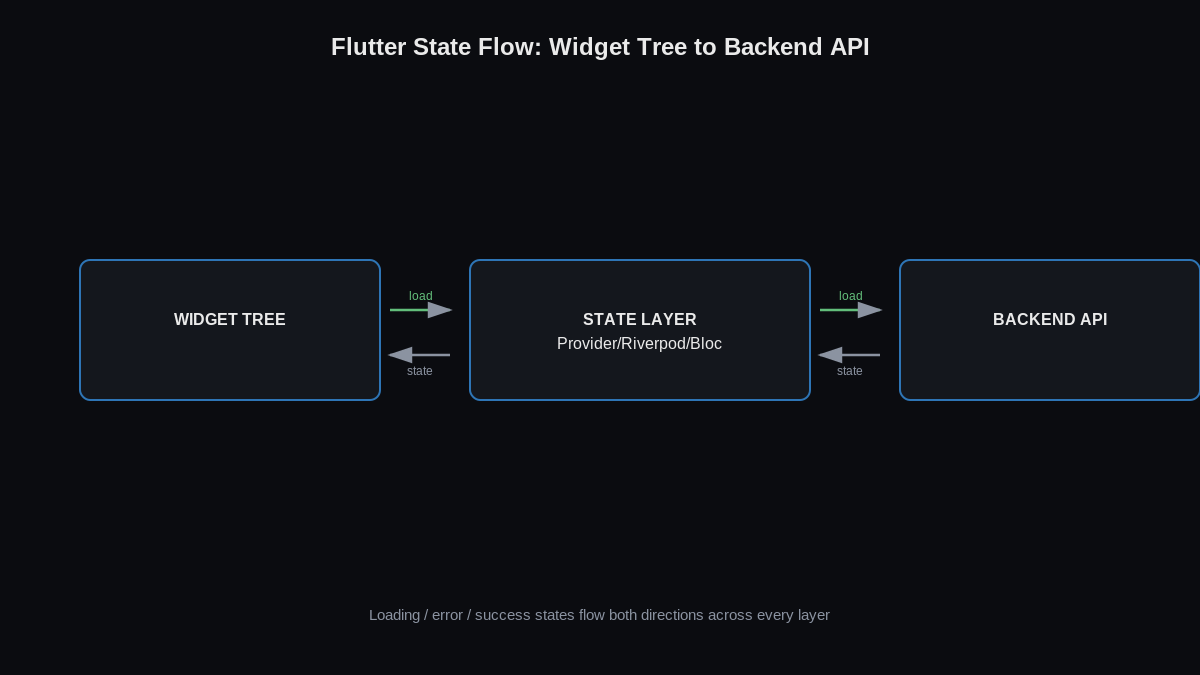
State management is where Flutter apps quietly rot. A screen that behaves perfectly in a demo starts returning stale data, firing duplicate network calls, or failing to update when a background stream emits — the moment real users start switching tabs mid-request. I’ve built with Provider, Riverpod, and Bloc. The library matters less than the discipline behind it: one source of truth per piece of state, explicit loading/error/success states, and no business logic hiding inside a widget’s build method.
Native Platform Integration
Push notifications, biometric auth, background location, deep links, camera and file-system access — these eventually require platform channels, native Android/Kotlin or iOS/Swift code, or a plugin that’s only half-maintained. Someone on the project needs to be comfortable reading a native crash log, not just a Dart stack trace.
Backend and API Integration
This is where most Flutter projects actually break: authentication and token refresh, pagination, offline caching and sync-conflict resolution, choosing between WebSockets and polling for real-time features, and error handling when the network drops mid-request on a commute. This is also the layer where my track record is deepest and best documented — covered in Relevant Experience below.
App Store Deployment and Release Engineering
Code signing, provisioning profiles, Play Store data-safety declarations, staged rollouts, and crash reporting wired up before launch rather than after the first 1-star review — release engineering is its own skill, and it’s where a lot of first-time Flutter builds stall for weeks. See the official Flutter documentation for the platform’s own deployment guidance.
Why Hire a Full-Stack Engineer for Flutter Instead of a Flutter-Only Specialist
A Flutter-only specialist is the right call when your backend already exists, is stable, and is owned by a team that knows it well. If that’s not your situation, splitting the work across two separate hires creates a specific, predictable failure mode: nobody owns the bug that lives at the boundary between app and API.
- One person, one root-cause chain. When the app shows a stale balance, is it a caching bug in Flutter or a missing cache-invalidation header on the API? A full-stack engineer traces it in one sitting instead of scheduling a call between two contractors.
- API design that fits the client, not the other way around. When the same person designs the endpoint and consumes it, pagination shapes, error codes, and payload sizes get built around the mobile use case from day one, not retrofitted after the Flutter developer complains.
- No handoff tax. Every specialist-to-specialist handoff costs a status meeting, a shared doc, and a day or two of “let me check with the backend guy.” On a lean project, that overhead often outweighs the actual work.
- Single point of accountability. Hire a flutter app developer separately from a backend engineer and a slipped deadline can always be attributed to “waiting on the other side.” With one engineer, that excuse doesn’t exist.
None of this makes a dedicated Flutter specialist the wrong choice for every project — a large team with a mature backend and a dedicated mobile lead is a legitimate setup. But for a startup, an MVP, or a small-to-mid product team without an existing backend, the case for a full-stack hire is usually stronger than a job spec that just says “Flutter developer” would suggest.
This is the stack you should expect when you hire a flutter developer for a production build, not a marketing keyword list.
Tech Stack
| Layer | Technologies |
|---|---|
| Mobile / cross-platform | Flutter, Dart, Provider, Riverpod, Bloc |
| Backend / API | ASP.NET Core, Node.js, Express, NestJS |
| Databases | PostgreSQL, SQL Server, MongoDB, Redis |
| AI integration | OpenAI API, LangChain, RAG pipelines, custom LLM tooling |
| Cloud / DevOps | Azure, AWS, Docker, CI/CD (GitHub Actions, Azure DevOps) |
| Auth / real-time | JWT, OAuth2, SignalR, WebSockets, Firebase Auth |
This is the same stack that shows up across my Node.js development and ASP.NET Core development pages, because it’s one practice, not three separate hats.
This is representative of what you get when you hire a flutter developer for backend-heavy mobile work.
Relevant Experience
I’m not going to invent a named Flutter app I shipped to the App Store, because I haven’t publicly documented one. What I do have is real, load-bearing experience one layer down: the backend and API work that every Flutter app depends on, plus full-stack projects where I owned both the client and the server end to end.
Minplan — Mobile APIs for a Mental-Health Safety-Planning App
Minplan is a digital safety-planning app for mental health use. I built the ASP.NET Core APIs the mobile app runs on — authentication, safety-plan data models, and the endpoints the mobile client calls — for a genuinely sensitive use case where a dropped request or a sync bug is not just an inconvenience. This is exactly the kind of backend a Flutter frontend needs sitting underneath it.
Node.js Mobile Backend Patterns
Across several engagements I’ve built Node.js backends specifically to serve mobile app clients — token refresh flows, push-notification triggers, pagination, and caching strategies designed around spotty mobile connections rather than a desktop browser’s assumptions.
Senior / Lead Full-Stack Delivery
Since 2022 I’ve worked as a senior/lead developer at Tech Scale, and earlier at Cityscape Technology Corporation and on Seers, a GDPR compliance SaaS platform. Across 50+ projects, the throughline is full-stack ownership: front end, backend, database, deployment, and increasingly AI features layered into existing products.
Where I’m strongest for a Flutter engagement: the backend, the API contract, authentication, and the data layer underneath the app. If you hire a flutter developer expecting a decade-long portfolio of ten shipped Flutter apps, I’m not that person. If you need someone who can own the whole stack a Flutter app depends on, and build the Flutter layer with the same engineering rigor, that’s the actual offer here.
Flutter vs React Native — Which Should You Choose
Both are legitimate choices, and any developer who tells you one is unconditionally better is selling something. Here’s the honest breakdown.
| Factor | Flutter | React Native |
|---|---|---|
| Language | Dart | JavaScript/TypeScript |
| UI rendering | Own rendering engine (Impeller/Skia) — pixel-identical across platforms | Renders through native components — closer to platform-native look by default |
| Performance ceiling | Very high; compiles to native ARM code | High; bridges to native modules, historically more bridging overhead |
| Hiring pool | Smaller, growing fast | Larger, especially if your team already knows React |
| Best for | Design-heavy apps needing pixel consistency, teams without existing React web code | Teams with an existing React/web codebase and shared component logic |
| Backend integration complexity | Same REST/GraphQL/WebSocket patterns as any mobile client | Same REST/GraphQL/WebSocket patterns as any mobile client |
If your team already ships React on the web and wants maximum code-sharing, React Native is worth serious consideration. If you want one visual result across iOS and Android without fighting platform-specific rendering quirks, or you’re starting fresh with no existing React codebase to leverage, Flutter is usually the stronger default. Either way, the backend decisions — auth, data modeling, offline sync — matter more to long-term maintainability than the frontend framework choice.
Here is what to expect once you hire a flutter developer through this process.
How Engagements Work
- Discovery call (30 minutes). We talk through what you’re building, what already exists (design files, an existing backend, a legacy app being replaced), and whether a full-stack Flutter engagement actually fits your situation.
- Scoping and estimate. I break the work into the layers above — UI, state management, native integration, backend/API, deployment — and give you a realistic estimate for each, not a single lump number.
- Architecture first. Before writing UI code, I define the API contract, data models, and state-management approach. This is the step that prevents the “rebuild half the app” problem three weeks in.
- Iterative delivery. Work ships in reviewable increments with working builds, not a single reveal at the end. You see progress weekly, not at a deadline.
- Testing and release. Device testing across the OS versions you actually care about, crash reporting wired in, then app store submission and staged rollout.
- Handover or ongoing support. Documented codebase and architecture notes at the end, with an option for ongoing maintenance if you don’t have an in-house team ready to take over.
Before the numbers: rates below assume you actually hire a flutter developer with production experience, not just someone with the job title on a resume.
What It Costs to Hire a Flutter Developer
Flutter developer rates vary enormously by region and seniority. Here’s a realistic 2026 market snapshot before you get a number attached to any specific engagement.
| Tier / region | Typical hourly rate (USD) |
|---|---|
| Offshore junior-to-mid (South/Southeast Asia) | $20 – $40 |
| Vetted marketplace mid-to-senior (Toptal, Lemon.io tier) | $40 – $75 |
| Eastern Europe (Poland, Ukraine, Romania) | $30 – $80 |
| US-based senior, native integration + release engineering | $65 – $100+ |
| Full project, 3-month MVP build (all-in) | $12,000 – $45,000 |
Where I fit: I’m a senior full-stack engineer based in Lahore serving EU/US clients, which puts my rates below Western agency pricing while reflecting genuine senior-level ownership — architecture, backend, and frontend together, not a junior rate for junior scope. Exact pricing depends on whether you need a fixed-scope build, a monthly retainer, or hourly consulting; that gets defined on the discovery call, not guessed at on a landing page.
Still deciding whether to hire a flutter developer directly or bring on a broader team? The FAQs below cover the practical questions people ask before they hire a flutter developer for state management, native integration, or full-stack work.
Frequently Asked Questions
Is it better to hire a flutter developer or a native iOS/Android team?
For most products, Flutter’s single-codebase model is faster to ship and cheaper to maintain than parallel native teams. Native makes sense when you need deep OS-specific capabilities (advanced camera pipelines, specialized AR, kernel-level features) that outweigh the maintenance cost of two codebases.
Do you have a portfolio of Flutter apps you’ve built?
Not a named, public one yet — and I’d rather tell you that directly than pad a page with vague claims. My deepest, most documented experience is the backend and API layer that Flutter apps run on, including mobile APIs for Minplan. Flutter is part of my full-stack practice, applied with the same rigor.
Why hire a flutter developer who’s really a full-stack engineer?
Because most Flutter bugs that actually cost time live at the boundary between the app and its API — token handling, sync conflicts, pagination mismatches. One engineer who owns both sides closes that gap instead of routing it through two people.
What state management approach do you recommend?
It depends on team size and app complexity. Provider is simplest for small-to-mid apps. Riverpod adds better testability and compile-time safety. Bloc suits larger teams that want a strict, predictable event-driven pattern. I’ll recommend one based on your actual codebase, not a personal favorite.
Can you build both the Flutter app and its backend?
Yes — that’s the core of the offer. I build the ASP.NET Core or Node.js API, the database schema, authentication, and the Flutter client that consumes it, so the whole system is designed as one coherent product rather than two integrated pieces.
How do you handle offline support and sync conflicts?
Local persistence (Hive, Drift, or SQLite depending on the app), a clear conflict-resolution strategy (last-write-wins, merge, or user-prompted resolution depending on the data), and background sync that retries without duplicating writes. This is one of the areas where a backend-aware Flutter developer earns their keep.
What does it cost to hire a flutter developer for a small MVP?
A lean MVP with a handful of screens, authentication, and a basic backend typically lands in the $12,000–$25,000 range depending on scope and integrations. A discovery call gets you a real number instead of a rough band.
Do you work with existing Flutter codebases, or only new builds?
Both. Taking over an existing codebase starts with an architecture and state-management audit — what’s causing the current pain (rebuild storms, memory leaks, flaky state) before touching a line of new feature code.
How involved are you in app store submission?
Fully. Code signing, provisioning, Play Store data-safety forms, App Store review guideline compliance, and staged rollouts are part of the engagement, not an afterthought handed back to the client.
Should I hire a flutter app developer or a React Native developer?
If your team already has a React web codebase you want to share logic with, React Native. If you want one consistent visual result across iOS and Android and you’re starting without existing React code, Flutter is usually the stronger default. See the Flutter vs React Native section above for the full comparison.
Do you integrate AI features into Flutter apps?
Yes. AI integration is a core part of my practice — OpenAI API integration, RAG pipelines, and custom LLM tooling wired into a backend that a Flutter (or web) client consumes, rather than a chatbot bolted onto the frontend with no real architecture behind it.
What’s the typical timeline to hire a flutter developer and start seeing progress?
A discovery call typically happens within a few days of first contact. Architecture and scoping take about a week. After that, working, reviewable builds ship on a weekly cadence rather than a single reveal at the end of the project.
Do you handle push notifications and deep linking?
Yes — Firebase Cloud Messaging or APNs/FCM setup, notification-triggered backend jobs, and deep link routing that correctly resumes app state rather than just opening the app to its home screen.
What if my project only needs backend work now, and Flutter later?
That’s a common and sensible sequence. I’ll build the backend with the mobile client in mind from day one — pagination, auth flows, and payload shapes designed for a future Flutter (or any) mobile client — so the Flutter phase doesn’t require reworking the API.
Do you offer ongoing maintenance after launch, or only new builds?
Both. Some clients need a one-time build with clean handover documentation; others prefer an ongoing retainer for bug fixes, OS-version compatibility updates, and new features. We agree on which model fits during the discovery call.
How do you price an engagement — hourly, fixed, or retainer?
All three are available depending on the project. Fixed-scope pricing works well for a defined MVP; hourly or retainer suits ongoing feature work or maintenance where scope evolves.
Why hire a flutter developer instead of using a no-code app builder?
No-code builders work for simple, template-shaped apps. The moment you need custom offline logic, non-trivial state management, real backend integration, or AI features, you hit the ceiling of what the builder supports and end up rebuilding in native code anyway.
Do you work across time zones with EU/US clients?
Yes. I’ve worked remotely with EU and US clients for six years and structure overlap hours and async updates (written progress notes, recorded demos, issue tracking) so time zone difference doesn’t slow decisions down.
What’s the single biggest mistake teams make when they hire a flutter developer?
Hiring for UI speed alone and treating the backend as an afterthought. The app that looks finished in a demo and then falls apart under real network conditions almost always traces back to a backend or state-management decision made too late.
If your Flutter app also needs native mobile screens built the same way, mobile app development covers the broader cross-platform picture. And if hiring across time zones is part of the decision, hiring remote developers covers how the engagement and overlap-hours model works.
Let’s Talk About Your Flutter Project
If you’re ready to hire a flutter developer who can own the UI, the state management, the native integration, and the backend API underneath all of it, the next step is a short call — not a sales pitch, a real conversation about your architecture and scope.
