If you want to hire a Node.js developer who ships production-grade backends, not just prototypes, start here. Some teams search more broadly to hire javascript developers rather than Node.js specifically — either framing works for scoping this kind of engagement. Node.js has a reputation problem it partly earned. It’s genuinely one of the fastest stacks to prototype in. That speed is exactly why so much Node.js code in production is quietly fragile. A queue job that throws an unhandled rejection and silently disappears. A long-running worker process that leaks memory over three days and gets killed by the host at 2am. A Stripe or Twilio webhook that arrives twice because the provider retried, and now a customer has been charged, or texted, twice.
None of these show up in a demo. They show up three weeks after launch, usually during a spike in real usage.
I’m Faisal Nadeem, a full-stack and AI integration engineer with 6+ years of experience shipping SaaS products end to end. Working remotely with teams across the EU and US from Lahore, Pakistan. Node.js is one of three backend stacks I work in daily, alongside Laravel and ASP.NET Core. Which matters more than it sounds like, because it means I’m not reaching for Node.js by default. When a client brings me a project, I’m evaluating whether Node is actually the right tool for that job.
Where I use Node.js in real projects. Building and hardening REST APIs, running background job and queue processing with Bull. Integrating third-party services like Twilio for messaging and Puppeteer for browser automation and document generation. Building backends for mobile apps that need to handle concurrent requests reliably. I’ve also used Node as the host language for AI and LLM integration work — RAG pipelines, agent orchestration, MCP servers.
This page covers what I actually build, how I think about the failure modes that catch teams off guard, and how engagements typically start.
What a Node.js Developer Should Actually Build
REST APIs & Backend Services
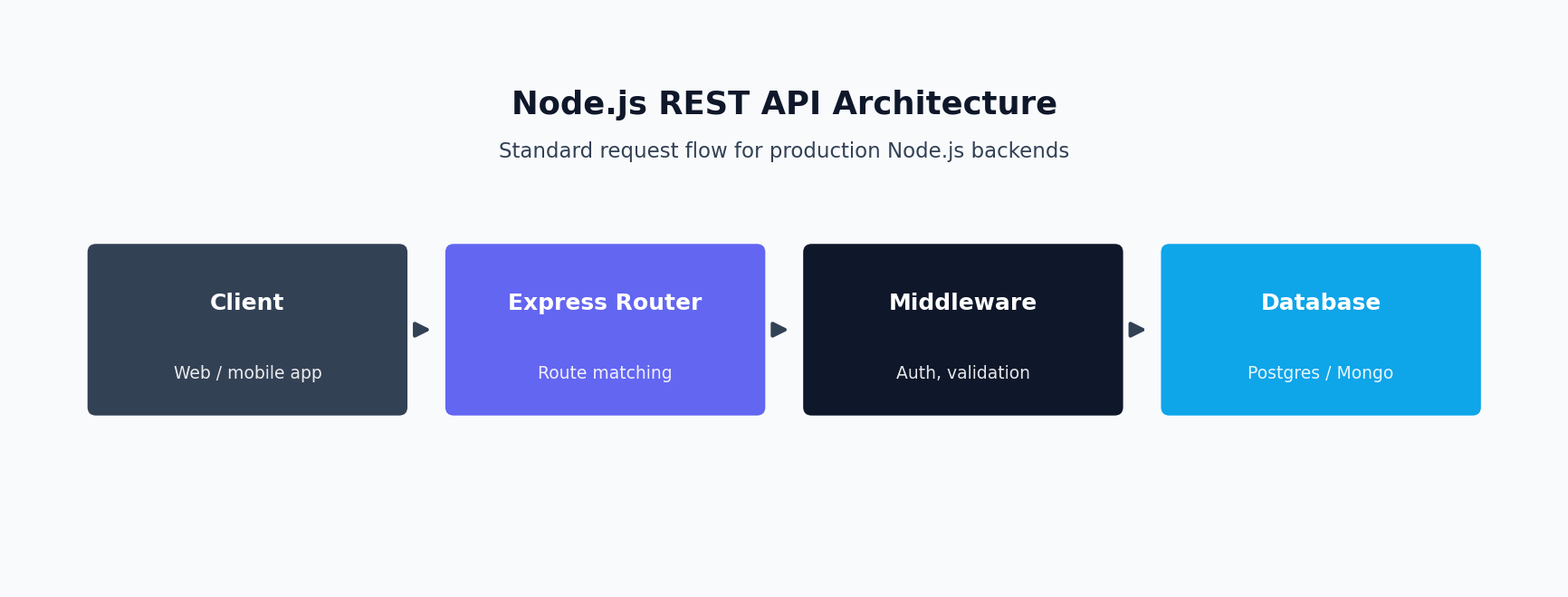
Most Node.js engagements start here. The difference between an API that works in a demo and one that holds up in production usually comes down to three things. Authentication, rate limiting, and versioning.
On authentication, I build token-based auth (JWT or session-based) with proper refresh token rotation. For multi-tenant SaaS products, I bake tenant isolation into the authorization layer itself rather than relying on every route handler to remember to filter by tenant ID.
Rate limiting is the thing nobody asks for until the API gets hit by abusive traffic or a client’s own retry logic gone wrong. I implement it at the middleware level — per-IP, per-API-key, or per-user — with sensible responses (proper 429 status codes, Retry-After headers).
Versioning matters the moment you have a mobile app or third-party integration consuming your API. I structure APIs so breaking changes go through explicit versioning rather than mutating an endpoint’s contract in place.
Beyond those three: consistent error response formats, input validation that fails loudly and specifically, structured logging, and API documentation that’s actually maintained.
Background Job & Queue Processing (Bull)
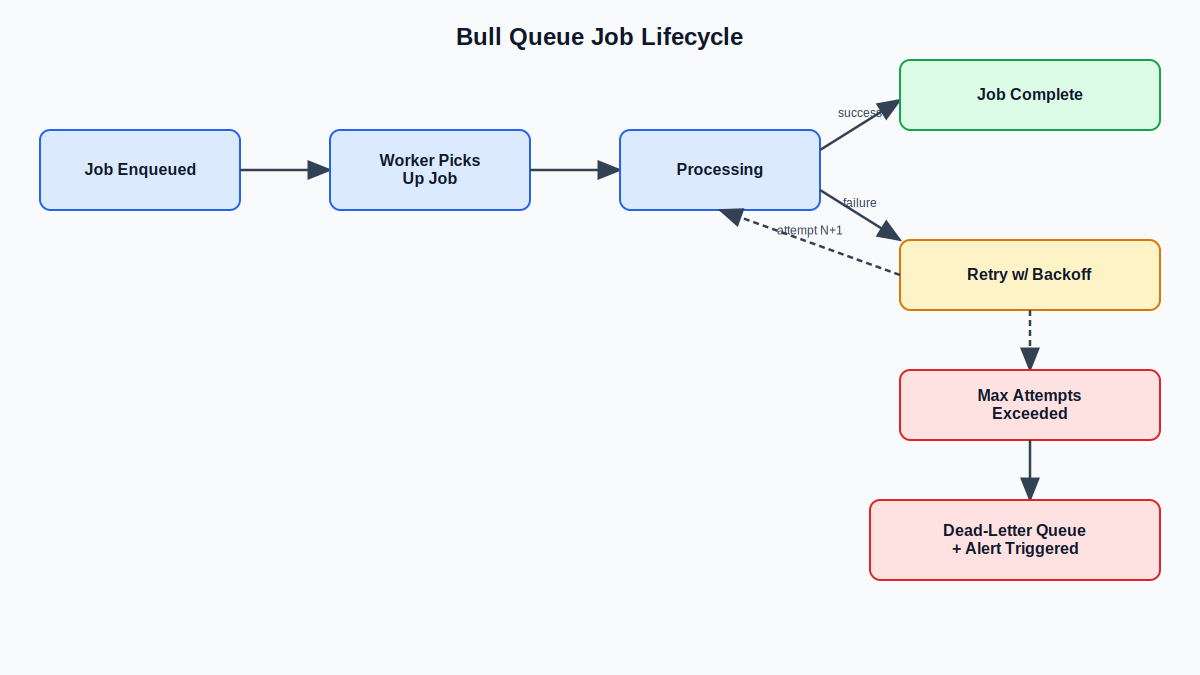
This is where I’ve spent a disproportionate amount of my Node.js time, because it’s where most production incidents actually live. I use Bull (Redis-backed) for background processing, and I’ve built and operated queue systems handling everything from transactional notifications to a full document-processing pipeline.
The part that separates a queue system that works from one that quietly loses jobs is retry and failure handling. I configure retry strategies with exponential backoff so transient failures resolve themselves, with sensible attempt limits. Jobs that fail permanently need to go somewhere visible — a dead-letter queue or a failed-jobs table — not just vanish. I set up monitoring around failed job counts and queue depth, and design jobs to be idempotent wherever possible.
For SaaS products specifically, queues are what let the rest of the system stay responsive under load. Move slow work into Bull queues with dedicated workers, and your API stays fast even when a background job is taking 30 seconds.
Third-Party Integrations (Twilio, Puppeteer)
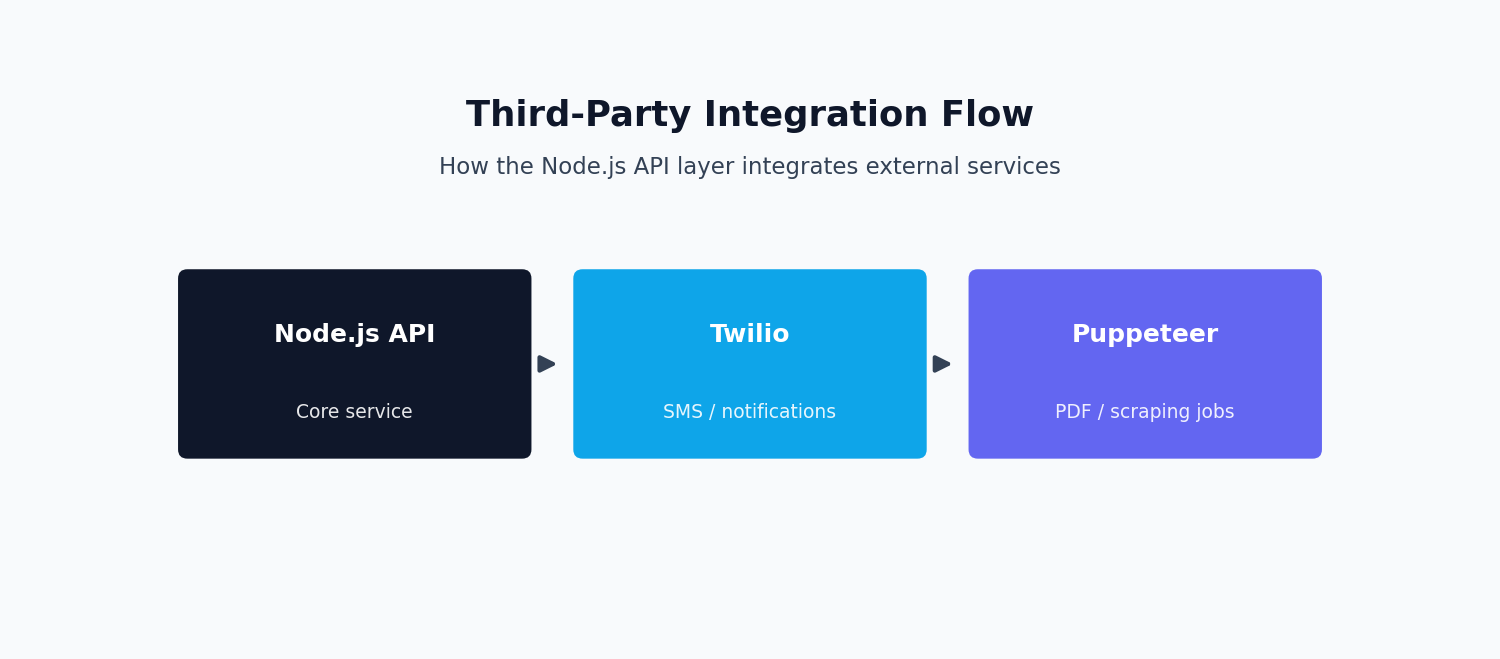
With Twilio, I’ve built SMS and messaging flows — transactional notifications, verification codes, alerts. The part that matters most is webhook handling: handling duplicate deliveries without double-processing, verifying request signatures, and responding quickly so Twilio doesn’t time out and retry unnecessarily.
Puppeteer serves two purposes in my work. The first is browser automation and scraping — driving a headless Chrome instance to interact with pages that don’t expose a clean API. The second is PDF and report generation. Both use cases share operational challenges. Headless browser instances are resource-heavy, so I run them inside queue workers rather than inline in API requests. Manage browser instance lifecycle carefully to avoid memory leaks.
Mobile App Backends
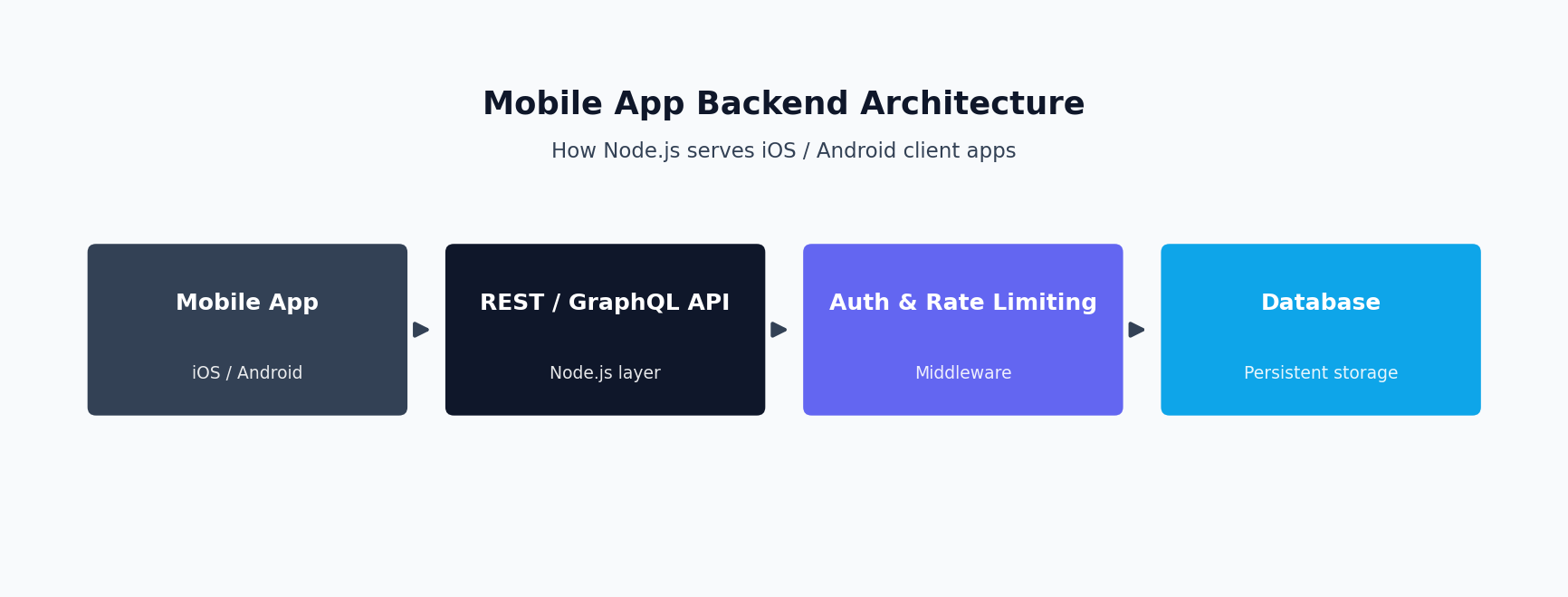
Node.js is a strong fit for mobile app backends because of how naturally it handles concurrent I/O. I design endpoints to return exactly what the screen needs, with pagination built in from the start. Push notifications need reliable delivery tracking, and real-time sync needs a clear strategy. Polling with proper caching, WebSocket-based push, or sync-on-resume, depending on how time-sensitive the data actually is.
Node.js for AI & LLM Backends
A newer but growing part of my work is using Node.js as the host language for AI integration. Building RAG pipelines, orchestrating multi-step LLM agent workflows, and standing up MCP servers. Node’s async-first design maps well onto AI workloads: chaining LLM calls, streaming responses, and coordinating calls to vector databases are all I/O-bound problems. This overlaps directly with the API and queue patterns described above, since LLM calls are slow and retryable.
Hiring a Node.js Developer for Your SaaS Product
A lot of the Node.js work that lands on my desk isn’t a standalone API. It’s one service inside a larger SaaS product, sitting next to a Laravel or ASP.NET Core application core, a billing system. A frontend that can’t afford backend hiccups. If you’re evaluating whether to hire a Node.js developer specifically for a SaaS backend. The questions that matter are different from a generic “can you write an API” evaluation.
For a SaaS product, I look at three things before writing any code. Where Node.js genuinely fits next to the rest of the stack (queues, webhooks, and real-time features — not necessarily the whole application). How the service handles the multi-tenant reality of a SaaS product (tenant isolation baked into the authorization layer, not bolted on later). And what happens to a background job or webhook delivery when a customer’s billing state or usage limits are on the line? That’s not a place for a job to silently disappear.
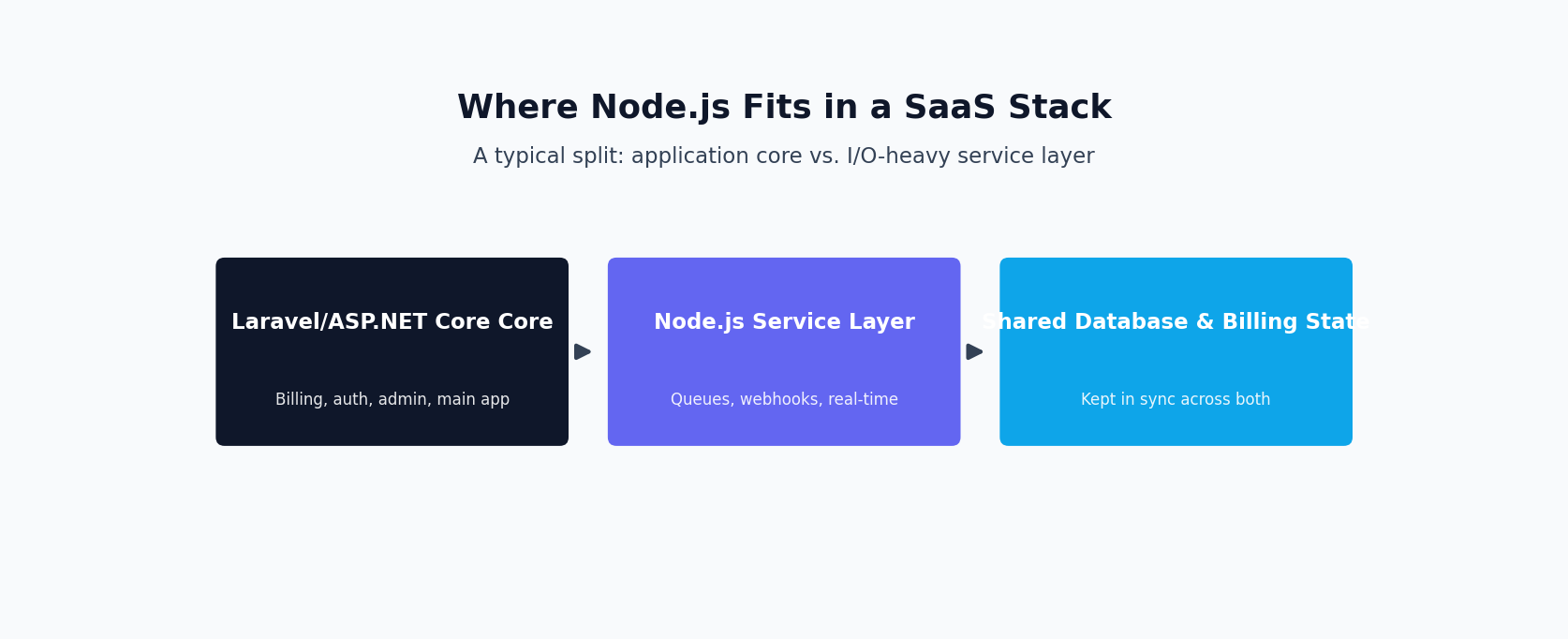
Custimoo, a sports-apparel SaaS platform, is a direct example. I worked across the product’s subscription lifecycle — signup, recurring billing, plan changes. Failed-payment handling — with Node.js handling specific backend workloads decoupled from the main Laravel application. That kept the billing-critical path simple while Node.js took on the I/O-heavy pieces it’s actually good at. WingWarranty follows a similar pattern. Your SaaS product may need a Node.js developer who understands where Node.js should own a piece of the system and where it shouldn’t. That’s the evaluation I bring.
Why a Full-Stack Engineer for Node.js Work
Working across Node.js, Laravel, and ASP.NET Core daily means I evaluate backend decisions on their merits rather than by habit. That shows up in practical ways. Knowing when a queue-based architecture is worth the operational complexity versus when a simpler synchronous approach is genuinely fine. Not reaching for a trendy pattern just because it’s the Node.js-community default.
It also matters because most of my work isn’t “build a standalone API”. It’s part of a larger SaaS product with a frontend, a database, billing, and often more than one backend service talking to each other. Custimoo and WingWarranty both combine Laravel and Vue with Node.js services for specific workloads. That full-picture view is hard to get from someone who has only ever seen the Node.js slice of a project.
Node.js vs Other Backends — When It’s the Right Choice
Node.js is my default recommendation when the workload is I/O-heavy and concurrency-sensitive. Think APIs with a lot of concurrent requests waiting on databases or third-party calls, real-time features, webhook-heavy integrations, or background processing pipelines built around queues.
Laravel is where I go for content-heavy or admin-heavy applications where convention-driven structure pays off — Eloquent’s ORM, built-in auth scaffolding, and a mature ecosystem of packages. Custimoo and WingWarranty both use Laravel as the application core, with Node.js layered in for specific workloads.
ASP.NET Core tends to win when a client already has a .NET environment or needs strong typing across a large codebase. It’s also a good fit for something with heavier CPU-bound processing.
Beyond the Resume: Skills, Job Description, and Team Fit
Most companies that hire a node js developer focus the job description entirely on technical skills. Years of experience, frameworks, maybe a take-home test — and skip the parts that actually predict whether the engagement goes well. When you hire node developers for a role that sits inside a larger team, soft skills like how someone communicates a blocked task. Pushes back on a requirement that doesn’t quite make sense, end up mattering as much as raw software development ability.
If you’re writing a job description to hire an node js programmer for the first time. It helps to separate what the role genuinely needs from what’s just a nice-to-have. A project with heavy webhook and queue work benefits from someone who treats asynchronous programming as a first-class skill, not something picked up incidentally. A project that’s mostly CRUD endpoints and admin screens doesn’t need that same depth, and hiring for it anyway just narrows your pool without improving outcomes.
Node developer, node js developer, or express.js developer — which title should the job description use?
The titles overlap more than job boards suggest. Someone who can hire node js developer for a REST API build can usually also cover the role of an express.js developer. Since Express is the framework most Node.js API work is actually built on. A business that wants to hire express.js developer specifically is often just describing a node js developer with an Express-heavy project. The distinction matters more for teams that hire node js developers doing something narrower. Like a Puppeteer-only browser-automation contract, where the framework name in the job description should match the actual day-to-day work.
Hire node developer, hire senior node.js developer, or hire dedicated node js developer — does the qualifier change anything?
It should. A team that wants to hire a node js developer for a two-week fix has different project requirements. Those requirements differ from a team that wants to hire a dedicated node js developer for a quarter of sustained feature work. “Senior” should signal ownership. Someone who can hire senior node.js developer expectations onto themselves and make architecture calls without escalating every decision — not just a higher day rate. When the qualifier in the title doesn’t match the actual project requirements, both sides end up disappointed. The client for paying a senior rate for junior-scoped work, or the engineer for being underused.
Remote development, and hire remote node.js developers
Nearly all of the node.js developer for hire work I take on is remote by default. Hire remote node.js developers searches usually come from teams that already know this. The real question underneath is whether remote development means asynchronous handoffs or real-time pairing. I structure communication around a defined overlap window with a client’s core hours rather than promising full-day availability. This tends to produce better outcomes for both web development and web applications work than an unstructured “always online” arrangement.
What “for hire” actually signals
Searches like node.js developer for hire, nodejs developer for hire. Node developers for hire generally mean a business wants a single named engineer, not a staffing agency relaying requests through an account manager. That distinction is worth confirming early. If a job description technically allows node.js developers for hire to mean “whoever’s free at the agency this week,” the results can vary. The actual application development experience on the project can shift wildly from one sprint to the next. This defeats the point of hiring specifically for continuity.
A note on spelling. Whether a job post says hire nodejs developer, hire nodejs developers, or the dotted hire node.js developer, recruiters and engineers mean the same role. Search behavior varies more than terminology does. The same goes for nodejs developer for hire versus node.js developer for hire, and node.js developers hire versus node.js developers for hire. If you’re trying to hire experienced node.js developer talent. Hire experienced node.js developers at scale for a bigger build. The signal that actually predicts a good hire is a portfolio of production incidents handled, not which exact phrase the job description uses. The same logic applies whether you’re trying to hire node js programmers for a scripting-heavy internal tool or a full production backend.
Whether the engagement is framed as web development, application development, or a narrower app development contract, the vetting question stays the same. Some clients bring me in through a broader development services relationship that starts with Node.js and expands into adjacent stack work as trust builds. Others hire specifically and only for the Node.js piece. Both are normal ways to start.
Proof
Custimoo — Sports-Apparel SaaS
I worked on this as a full-stack engineer across the product, including payment and subscription flows. I worked through the subscription lifecycle end to end. Signup and plan selection, recurring billing, plan changes and upgrades, handling failed payments and dunning. Keeping the application’s view of a customer’s access in sync with their actual billing state. Node.js handled specific backend service workloads decoupled from the main Laravel application.
Tech Scale — Node.js/Bull/Puppeteer Document Processing Pipeline
Proof this isn’t theoretical. At Tech Scale, where I’ve worked since 2022, one internal workflow involved generating and processing a high volume of documents and reports. Slow, resource-intensive, and a poor fit for synchronous handling. I designed and built a Node.js processing module to automate this pipeline. Using Bull queues to manage the job workload and Puppeteer for document generation and browser-automation steps. Puppeteer instances run inside queue workers with proper lifecycle management, and failed jobs retry with backoff.
The result was a significant speed-up in the internal document and report pipeline, with reliability characteristics that a synchronous or ad hoc process didn’t have.
How Engagements Work
1. Free scoping call. For an existing codebase, I’ll ask for read access or a call walking through the architecture before quoting anything.
2. Scope and approach. A written breakdown of what the work involves, how I’d approach it, and a realistic estimate.
3. Build, with visibility. Short, visible increments — regular updates, a staging environment, no multi-week silence.
4. Handoff or ongoing support. A clean handoff with documentation, or a retainer arrangement.
What It Costs to Hire a Node.js Developer
Rates for Node.js developers vary widely depending on where you’re hiring from and what vetting, if any, sits behind the number. Marketplace and vetted-network rates for mid-to-senior Node.js developers commonly land somewhere in the $30-$85/hour range. With vetted platforms toward the higher end and open marketplaces spanning wider depending on the freelancer’s location and track record.
I don’t publish a fixed rate card because the honest answer depends on scope. Not a flat number — a queue-system audit is a different shape of engagement than building a SaaS backend from zero. What I can tell you upfront. Every engagement starts with a free scoping call, so you get a real. Scoped estimate before committing to anything, rather than a rate card that doesn’t reflect your actual project.
Engagement & Pricing
- Fixed-scope projects — a well-defined deliverable with a clear start and end.
- Hourly — for genuinely fluid scope, or smaller tasks.
- Retainer — ongoing availability for feature work and maintenance.
I don’t publish flat rate cards here because Node.js engagements vary too much in shape. Every engagement starts with a free scoping call.
For the queue library referenced above, see the official Bull/BullMQ documentation. If your project also needs Laravel or ASP.NET Core work alongside Node.js, see my Laravel API development and ASP.NET Core development pages.
FAQ
Do you take over existing Node.js codebases, or only build from scratch?
Both, and taking over an existing codebase is a common starting point. I ask for access to review the code before quoting anything.
Do you handle deployment, Docker, and CI/CD, or just write the application code?
I handle deployment and containerization as part of the build, not a separate concern.
Do you write TypeScript, or plain JavaScript?
TypeScript by default for anything beyond a small script.
What’s your approach to testing?
Business logic, payment/billing flows, and queue job handlers get unit and integration tests as a matter of course, weighted toward the failure paths.
Can you build real-time features — WebSockets, live updates, that kind of thing?
Yes, and I evaluate whether a feature genuinely needs a persistent WebSocket connection or whether a simpler pattern meets the actual requirement.
How do you handle scaling — will this hold up if traffic grows?
I design for the traffic level a project actually needs, keeping API instances stateless so they scale horizontally. Queue workers that scale independently of the API layer.
Do you only do backend work, or can you cover the frontend too?
Both, depending on what the engagement needs.
Can you integrate AI or LLM features into an existing Node.js backend?
Yes — a growing part of my work.
How quickly can you start?
Depends on current workload, which I’ll tell you honestly on the scoping call.
How much does it cost to hire a Node.js developer for a SaaS backend?
It depends on scope, but as a reference point, mid-to-senior Node.js developers across marketplaces and vetted networks typically run $30-$85/hour. I quote from a scoped estimate after a free call rather than a flat rate. Since a queue audit and a full SaaS backend build are very different engagements.
Can you fix a Node.js queue system that’s silently losing jobs?
Yes — this is one of the most common reasons clients bring me into an existing codebase. Silently disappearing jobs are almost always a missing retry/backoff strategy or an unhandled rejection in a job handler, and both are fixable without a rebuild.
Do you build a new SaaS product’s Node.js backend from scratch, or only join existing ones?
Both. Greenfield SaaS backends and taking over an existing one are equally common starting points. The difference is just how much of the first engagement goes into understanding what’s already there before changing anything.
Is Node.js the right choice for our SaaS product, or should we use Laravel or ASP.NET Core instead?
Depends on the workload, and I’ll tell you honestly if Node.js isn’t the best fit. It’s usually the right call for the I/O-heavy pieces of a SaaS product — queues, webhooks. Real-time features — while Laravel or ASP.NET Core often makes more sense as the application core. That’s exactly the split I built for Custimoo and WingWarranty.
Let’s Talk About Your Node.js Project
If you need a REST API built or hardened, a queue system that won’t lose jobs under load, a Twilio or Puppeteer integration done properly. A backend for a mobile app that needs to hold up under real concurrent traffic. Book a free scoping call.
What exactly do I get when I hire a Node.js developer like you?
When you hire a Node.js developer with my background, you get REST APIs, Bull queue infrastructure, Twilio and Puppeteer integrations. Backend systems built for real concurrent traffic. Not just prototype code.
Why hire a Node.js developer instead of using a generic backend template?
Because the failure modes that matter — unhandled promise rejections, memory leaks in long-running workers, duplicate webhook processing — don’t show up until production. When you hire a Node.js developer with production experience, those get handled before they become 2am incidents.
How much does it cost to hire a Node.js developer for a project?
It depends on scope — hourly for exploratory work, fixed-price once scope is defined, or a retainer for ongoing work. Most clients who hire a Node.js developer through me start with a free scoping call.
Can I hire a Node.js developer for a short, focused engagement?
Yes — a queue system audit, a webhook reliability fix. A scoped feature are all common reasons clients hire a Node.js developer without committing to a long build.
Do you hire a Node.js developer role out to a team, or do you do the work yourself?
I do the work myself. When you hire a Node.js developer through me, you’re working directly with the engineer writing the code, not an account manager relaying updates from someone else.
What if I already have a Node.js codebase and just need help fixing it?
That’s common. You don’t need to hire a Node.js developer for a full rebuild. An audit of the existing queue setup, webhook handling, and error patterns often finds the specific issues causing production incidents, and fixes can be scoped from there.
Do you offer ongoing support after I hire a Node.js developer for the initial build?
Yes, structured as a retainer. Node.js dependencies and the surrounding ecosystem move quickly. So ongoing support after you hire a Node.js developer for launch is often worth planning for rather than treating launch as the finish line.
Is it better to hire a Node.js developer as a contractor or bring one on full-time?
For most projects with defined scope, it’s more cost-effective to hire a Node.js developer as a contractor for the build, then decide on ongoing needs afterward. Full-time hiring makes more sense once there’s sustained, ongoing Node.js work to justify it.
What industries do you typically hire a Node.js developer for?
SaaS platforms, mobile app backends, and internal automation tooling are the most common. When teams hire a Node.js developer for these use cases, queue reliability and integration correctness usually matter more than raw framework choice.
Frequently Asked Questions
What kind of Node.js projects do you typically work on?
I build production-grade Node.js backends, REST and GraphQL APIs, background job and queue systems, and services that integrate with AI and LLM providers. This is backend development for SaaS products and growing engineering teams, drawing on 6+ years of full-stack experience across 50+ projects.
Do you work on a contract, hourly, or full-time basis?
I take on remote engagements in whichever format fits the project: fixed-scope contracts, hourly consulting, or dedicated full-time hire. I can scope the right arrangement during an initial consultation.
Can you integrate AI or LLM features into an existing Node.js backend?
Yes. Alongside core Node.js backend work, I build RAG pipelines, AI agents, and LLM integrations. AI-powered features can be added to an existing Node.js codebase this way, without bringing in a separate specialist.
Do you handle deployment and infrastructure as well as application code?
I work across the stack from API design through deployment. This means I can take ownership of a Node.js service end-to-end, rather than only delivering code that needs additional DevOps support.
Do you work with distributed or international teams?
Yes, I work remotely with clients and teams worldwide and structure communication, async updates, overlapping working hours, and regular check-ins, to fit each team’s time zone.
How do we get started?
Book a free consultation to walk through your project’s scope and requirements, and I’ll follow up with a proposal covering timeline, approach, and cost.
