Looking for Laravel API development that survives real production traffic, not just a demo? Most “Laravel APIs” work fine in a demo. They fall apart three weeks after launch. When Stripe fires a webhook twice in the same second, when a mobile client retries a timed-out request and creates a duplicate order. When a third-party vendor changes their payload shape without a changelog. When 200 concurrent users hit an endpoint that was only ever tested with one.
That gap between “it works on my machine” and “it survives production” is where most freelance Laravel API development work quietly fails clients. Not because the code is wrong, but because it was never built to handle the messy, asynchronous, occasionally hostile conditions real integrations run in.
I’m Faisal Nadeem, a full-stack and AI integration engineer with 6+ years building Laravel backends for SaaS platforms. Subscription billing systems, mobile-app backends, and enterprise-facing APIs — for EU and US clients while based in Lahore, Pakistan. I’ve built payment flows on Stripe and Reepay, integrated Twilio messaging, and wired up Azure AD authentication for enterprise apps. I’ve also used Bull queues to make webhook processing actually reliable, instead of a best-effort script that silently drops events.
If you need a Laravel API developer who thinks about idempotency, retry logic, and versioning as first-class requirements. Not afterthoughts — this page explains exactly how I build and what to expect from working with me.
Development Services
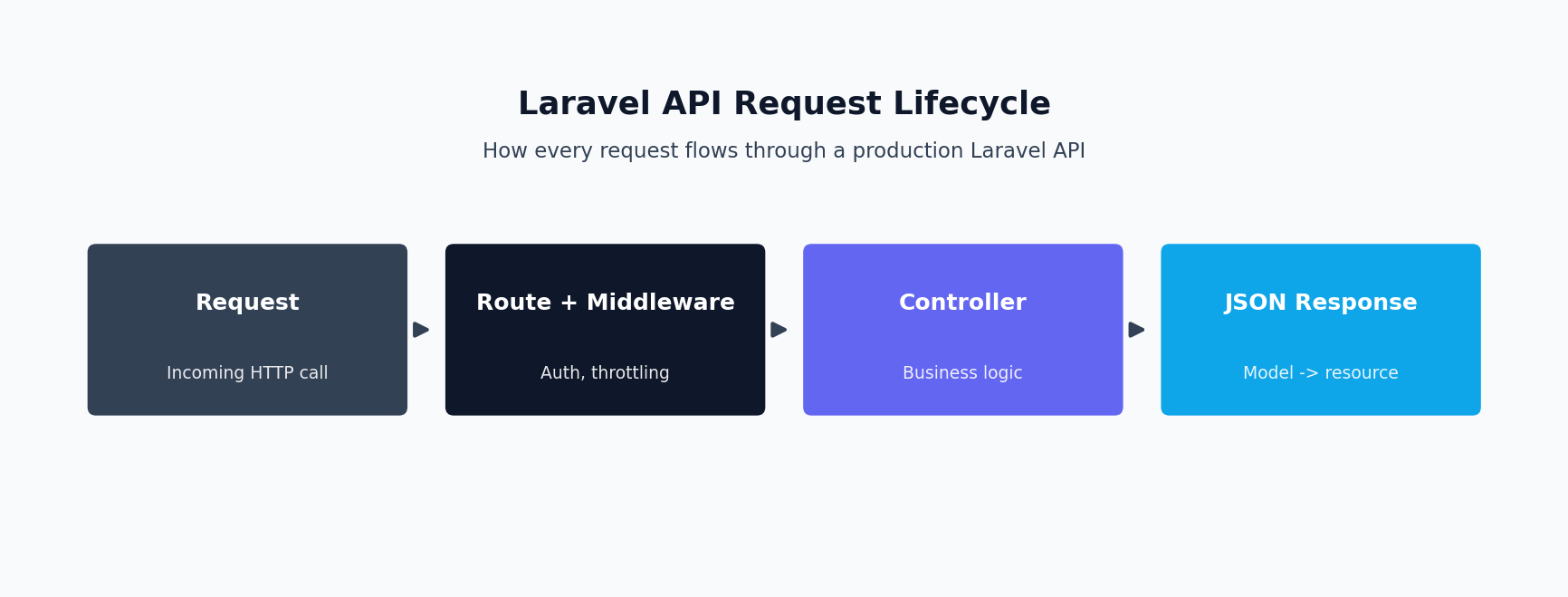
I work across the full lifecycle of API development. Designing the resource model, building the endpoints, integrating the third-party services your product depends on. Documenting it well enough that your team (or your next contractor) doesn’t have to reverse-engineer it.
REST API Design & Build
A REST API’s long-term maintainability — the core of good API design — is decided before the first route is written. I design resource structures around how the data is actually consumed. Not a 1:1 mirror of database tables — so that endpoints stay stable as the underlying schema evolves. That means proper use of API resources and transformers in Laravel to decouple your response shape from your Eloquent models. Consistent naming and nesting conventions generated with a php artisan make:resource artisan command so the transformation layer stays consistent across the project. Request validation that rejects bad input before it touches business logic.
Versioning is non-negotiable for anything with external consumers — mobile apps, partner integrations, or a frontend team on a different release cycle than the backend. I default to URI or header-based versioning (/v1/, /v2/) with a clear deprecation path, so a breaking change doesn’t mean breaking every client at once. Pagination is built for scale from day one. Cursor-based pagination for high-volume or frequently-changing collections, offset-based where the dataset is small and stable. With consistent metadata (total counts, next/prev links) so frontend and mobile teams aren’t guessing at contract behavior.
I also build in consistent, structured error responses. Proper HTTP status codes, machine-readable error codes, and human-readable messages. Rather than the generic 500s and inconsistent JSON shapes that make client-side error handling a guessing game. On platforms like Custimoo, a sports-apparel customization SaaS built on Laravel and Vue.js. This kind of disciplined resource design is what let the frontend team build against a stable contract while the backend kept evolving underneath it.
Payment Gateway Integration (Stripe, Reepay, Fenerum)
Subscription billing is where sloppy Laravel API development becomes expensive. I’ve built payment and subscription flows using Stripe, Reepay, and Fenerum, and the pattern that actually holds up in production is the same across all three. Treat every payment operation as something that can be retried, delayed, or received twice.
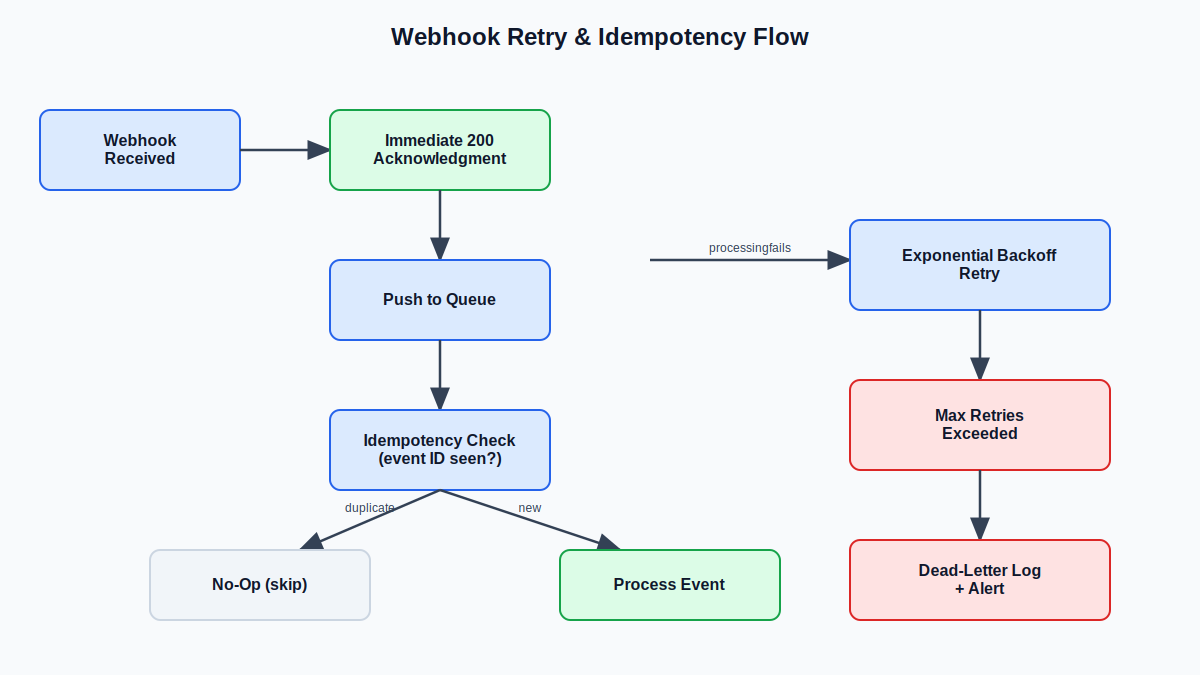
That means idempotency keys on every payment-creation and charge request, so a network timeout that causes a client to retry doesn’t result in a double charge. It means designing subscription state machines that account for trials, upgrades, downgrades, and cancellations as distinct, auditable transitions — not just a status column that gets overwritten. And it means building explicit failed-payment handling. Dunning logic for retrying failed charges, grace periods before access is revoked. Clear webhook-driven state syncing so your application’s view of a subscription never drifts from what the payment provider actually thinks is true.
On WingWarranty, a car-insurance SaaS platform built on Laravel, Vue.js, and Node.js, I integrated Reepay for subscription billing. Building out the payment flow APIs that handle recurring charges, plan changes, and payment failures without leaving customers in a broken subscription state. That work is the template I bring to any Stripe, Reepay, or Fenerum integration. The payment provider’s webhook is the source of truth. The application state has to be built to catch up to it reliably, not assume it will always arrive once, in order, and on time.
Webhook Architecture (Retries, Idempotency, Failure Handling)
Webhooks are the part of this work most freelance builds get wrong, because they look simple. Receive a POST, do something. Right up until a provider retries a failed delivery, sends events out of order. Delivers the same event twice because your endpoint took too long to respond.
My webhook architecture starts with responding fast. Acknowledge receipt immediately, then push the actual processing onto a queue (I use Bull for this in Node-adjacent parts of a stack. Laravel’s native queue system for PHP-side processing) so a slow downstream operation never causes the provider to time out and retry unnecessarily. Every webhook handler is idempotent by design. I store the provider’s event ID and check it before processing, so a duplicate delivery is a no-op instead of a duplicate order, duplicate email. Double-decremented inventory count.
Failure handling matters just as much as the happy path. If processing a webhook fails midway. A downstream API is down, a database constraint fails — the job goes back on the queue with exponential backoff, not a silent drop. I log every webhook event with enough context to replay it manually if needed. This matters enormously when a payment provider’s dashboard shows an event as “delivered” but your system never acted on it. This is the layer where most of the “why did this order never get fulfilled” support tickets originate. It’s the layer I spend the most deliberate design time on.
API Authentication (Sanctum, Passport, Azure AD / Enterprise SSO)
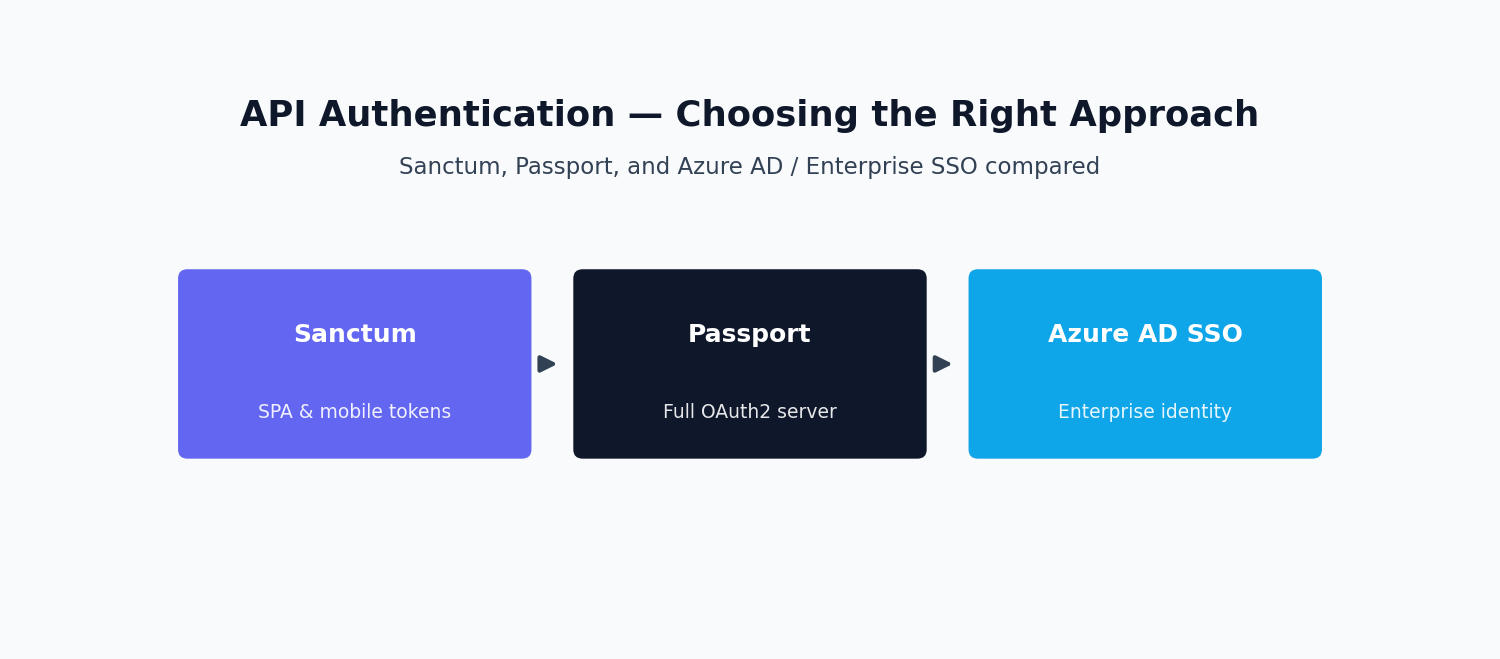
Authentication strategy here depends entirely on who’s consuming the API. For a first-party SPA or mobile app talking to your own Laravel backend, I use Sanctum. Lightweight, cookie or token-based, without the OAuth2 overhead you don’t need. For scenarios with third-party clients, multiple scopes, or token-based access that needs fine-grained permissions, I use Passport’s full OAuth2 implementation.
For enterprise clients, authentication often isn’t a Laravel-native decision at all — it’s whatever identity provider the organization already standardizes on. I’ve implemented Azure Active Directory authentication for secure user-management APIs on the Specsavers–Lonely Planet booking and collection app (a React + ASP.NET Core build). Handling the token validation, claims mapping. Session logic that enterprise SSO requires. That same discipline — validating tokens against the right issuer, respecting token expiry and refresh flows. Mapping identity claims to internal permission models — applies directly to Laravel apps that need to sit behind Azure AD, Okta. Another enterprise identity provider rather than rolling custom auth.
Whichever strategy fits, I build role and permission checks as middleware and policies, not scattered if statements in controllers, so access control stays auditable as the API grows.
Mobile-App Backend APIs (Concurrency, Rate Limiting)
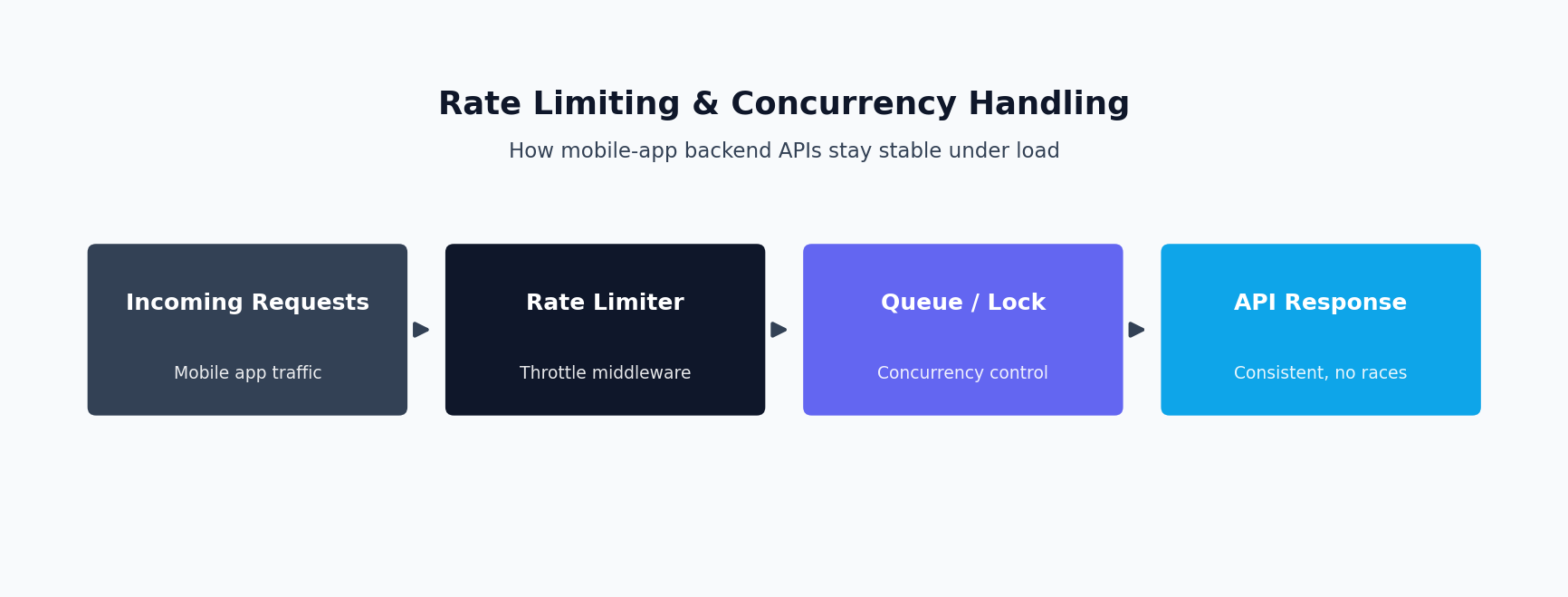
Mobile backends are a distinct part of this work, with different failure modes than web-facing APIs. Connections drop mid-request, clients retry aggressively on flaky networks. Multiple app instances can hit the same endpoint simultaneously from the same user switching between wifi and cellular. I build for that reality. Rate limiting tuned per-endpoint (not a single blanket throttle) so abusive or buggy retry loops don’t take down the API for everyone else. Database-level locking or optimistic concurrency checks on anything that mutates shared state, so two near-simultaneous requests from the same user don’t corrupt a record.
I built the backend APIs for Minplan, a mental-health mobile application, on ASP.NET Core — and the concurrency and rate-limiting patterns are stack-agnostic. In Laravel, that means using database transactions with appropriate isolation levels for anything financial or state-changing. Redis-backed rate limiters that scale across multiple app servers instead of in-memory counters that reset on deploy. Queue-based processing for anything that doesn’t need to block the mobile client’s UI thread waiting on a response. Mobile users notice slow APIs immediately. They generate support tickets and app-store reviews — so this is an area where I test explicitly for concurrent load, not just correctness.
API Documentation (OpenAPI / Postman)
API development without documentation isn’t finished — it’s a liability for whoever has to consume it next, including future-you. I document endpoints using OpenAPI/Swagger specs where the project calls for machine-readable, generateable documentation. Well-organized Postman collections with example requests, responses, and environment variables when a lighter-weight reference is more appropriate for the team.
Good API documentation covers more than endpoint lists: authentication flow with real examples, error code reference, rate-limit behavior, webhook payload schemas and retry behavior, and versioning/deprecation notes. I write documentation as part of the build, not as a rushed afterthought at handover. Which is also why my APIs tend to be easier for a client’s in-house team to pick up and extend after I’ve moved on.
What “Production-Grade” Actually Means
A lot of this work gets delivered as “done” once the happy path returns a 200. That’s the gap between a working API and a production-grade one, and it’s where most thin agency deliverables — and most competing freelance pages — stop short.
Testing. I write feature tests around API endpoints that cover not just successful requests but validation failures, auth rejections. Edge cases like duplicate webhook delivery or concurrent writes. Tests aren’t there to hit a coverage number — they’re there so a future change doesn’t silently break a payment flow six months from now.
Monitoring and logging. Every non-trivial API I build logs structured, searchable events for payment operations, webhook processing, and auth failures — not generic Laravel logs nobody reads until something breaks. When something does go wrong, I want the answer to “what happened” to be a log query, not a guess.
Versioning discipline. APIs that serve external consumers get a real versioning strategy from the start, with deprecation windows communicated rather than breaking changes shipped silently into a shared endpoint.
Backward compatibility. New fields get added additively. Response shapes don’t change under existing clients without a version bump. This sounds obvious in the abstract and is the single most common thing that gets skipped under deadline pressure.
Proof: This Works in Production
Specsavers – Lonely Planet App. A React + ASP.NET Core booking and collection platform where I built secure user-management APIs authenticated via Azure Active Directory. Enterprise SSO integration means getting token validation, claims handling, and session security right. The same discipline I apply to Sanctum/Passport-based Laravel APIs that need to sit behind an organization’s existing identity provider.
Minplan. Backend APIs for a mental-health mobile application, built on ASP.NET Core, designed around the concurrency and rate-limiting demands of a live mobile user base. Patterns I carry directly into Laravel mobile backends.
WingWarranty. A car-insurance SaaS platform on Laravel, Vue.js. Node.js, where I integrated the Reepay payment gateway for subscription billing and built the payment flow APIs handling recurring charges and plan changes.
Alongside these, I built full-stack features and payment/subscription flows for Custimoo, a Laravel/Vue.js/Node.js sports-apparel customization SaaS. I’ve also worked across employers including Tech Scale (2022–present), Cityscape Technology Corporation, and Seers.
How Laravel API Development Engagements Work
1. Audit or scoping call. We start with a free call to understand what you’re building. If there’s an existing Laravel project, I review the codebase before quoting anything.
2. API contract design. Before writing implementation code, I define the resource structure, authentication approach, versioning strategy, and — for integrations — the webhook and error-handling behavior.
3. Build with tests. I implement against that contract, with feature tests covering both expected and edge-case behavior as I go.
4. Documentation and handover. Every engagement ends with documentation your team can actually use.
Engagement & Pricing
- Hourly — for smaller, well-defined tasks: a single integration, a bug fix in an existing API, an audit of current implementation.
- Fixed-price — for scoped builds with a clear deliverable, agreed after the scoping call.
- Retainer — for ongoing API maintenance, new endpoint development, or acting as the backend engineer for a product that’s past initial launch.
I don’t quote speculative numbers on a page like this. Every project’s scope, integration complexity, and existing-codebase condition affects the estimate too much for a generic figure to mean anything. The scoping call is free, and you’ll leave it with a real estimate.
For the underlying REST standards this follows, see the HTTP semantics specification (RFC 9110). If you also need frontend or full-stack work around this API, see my Vue.js development and full-stack developer pages.
FAQ
Can you fix or refactor an existing Laravel API instead of building from scratch?
Yes — this is a large share of the work I do. I start with an audit of the current implementation and give you a clear picture of what’s solid, what’s risky. What needs to change before we touch anything.
Do you take integration-only projects, like just adding Stripe or Reepay to an existing app?
Yes. Payment gateway and third-party integrations are a core part of my work.
Do you offer an SLA for ongoing work?
For retainer engagements, yes — we agree on response times and priority handling as part of the retainer setup.
What’s your typical response time during an active engagement?
I respond to project communication within one business day, and for retainer clients we set faster agreed response windows for production issues.
Do you write automated tests, or just ship working code?
I write feature tests as part of the build, not as an optional extra.
Can you work inside an existing team’s Laravel codebase, or do you only build greenfield?
Both. A good share of my work is joining an existing codebase.
Do you handle API documentation as part of the project, or is that a separate ask?
It’s included. Every build ends with documentation appropriate to the project.
What if my API needs to integrate with a vendor you haven’t listed here?
Stripe, Reepay, Fenerum, Twilio, and Azure AD are the integrations I have direct project experience with, but the underlying skill transfers to any well-documented third-party API.
What exactly does your work include?
It covers REST API design, Stripe/Reepay/Fenerum payment integrations, webhook retry logic, idempotency handling, and authentication — the full production-grade stack, not just CRUD endpoints.
Who is this a good fit for?
SaaS teams and founders who need an API that survives real traffic: duplicate webhook events, timed-out retries, and concurrent load. Not just a demo that works once.
How is it priced?
Hourly for exploratory or audit work, fixed-price once a specific scope is defined, or a retainer for ongoing work after launch.
Does this replace my existing team?
No — the work is designed to plug into your existing engineering team, joining an existing codebase as often as starting a greenfield build from scratch.
Ready to Talk?
If your Laravel API needs to hold up under real payment volume, real webhook traffic, and real third-party quirks — not just a demo — let’s talk. Book a free scoping call and I’ll tell you honestly what it’ll take to get it production-ready.
Frequently Asked Questions
What kind of API projects do you typically build?
I design and build secure, well-documented REST and GraphQL APIs in Laravel for SaaS products, mobile app backends, and third-party integrations. This draws on 6+ years of full-stack experience across 50+ projects.
Do you handle authentication and authorization for the API?
Yes. I implement token-based auth (Sanctum or Passport depending on the use case), role and permission systems, and rate limiting. These are part of the API build, not a separate add-on.
Can the API support mobile apps and third-party integrations at the same time?
Yes. I design Laravel APIs to serve multiple consumers, web front-ends, mobile apps, and external integrations, from a single, versioned API surface.
Do you write API documentation?
Yes, I document endpoints (typically with OpenAPI/Swagger or Postman collections) so your team or third parties can integrate against the API without back-and-forth.
Can you add AI or LLM-powered endpoints to the API?
Yes. Alongside core Laravel API work I build RAG pipelines and LLM integrations. AI-powered endpoints can be added to the same API this way, rather than maintaining a separate service.
How do we get started?
Book a free consultation to walk through your API requirements, existing systems, and timeline, and I’ll follow up with a scoped proposal.
