Frontend & Full Stack
What This Category Covers
Modern frontend and full-stack engineering insights covering Vue.js, React, Angular, TypeScript, and the architectural patterns that connect a frontend to a reliable backend. Topics include component design and state management, strict typing strategies for large codebases, performance optimization (code splitting, lazy loading, rendering performance), accessibility, and patterns for structuring full-stack applications so the frontend and backend evolve cleanly together.
Guides focus on real decisions frontend and full-stack engineers face when building production interfaces: choosing between client-side and server-side rendering, managing complex form state, integrating with REST and GraphQL APIs, and keeping a growing codebase maintainable as a team scales. Whether you’re migrating a legacy Options API codebase to the Composition API and TypeScript, or architecting a new full-stack application from the ground up, these articles focus on practical, production-tested approaches rather than framework hype.
A recurring focus in this category is TypeScript adoption in Vue 3 projects: how to set up strict typing for components without fighting the compiler, how to model props, emits, and composables in a way that catches real bugs at build time instead of runtime, and how teams that were burned by loosely-typed Options API codebases can migrate incrementally rather than in one risky rewrite.
Beyond Vue, articles in this category cover React and Angular component architecture, state management trade-offs between context, stores, and signals-based reactivity, and the full-stack glue code, API contracts, shared validation logic, and authentication flows, that determines whether a frontend feels fast and reliable or brittle under real user load.
This category is written for engineers who own the user-facing layer of a product end to end and need concrete guidance on architecture decisions that are easy to get wrong early and expensive to unwind later.
State Management
State management gets deep coverage in this category because it’s where most frontend codebases accumulate the most long-term complexity. Posts here compare Vuex versus Pinia for Vue applications, Redux Toolkit versus Context plus hooks for React, and NgRx for Angular, with concrete guidance on when a full state management library is overkill for a feature and when skipping one leads to prop-drilling and duplicated fetch logic across components. The focus stays on maintainability years into a project’s life, not which library is trendiest.
Migrating from Vue 2 to Vue 3
The Vue 2 to Vue 3 migration content in particular walks through moving away from the Options API to the Composition API incrementally rather than as a single risky rewrite: how to keep both patterns working side by side during a transition period, how TypeScript typing improves once components move to script setup, and how to handle third-party libraries that haven’t fully caught up to Vue 3 yet, including workarounds that don’t compromise the rest of the migration.
Component Architecture and Design Systems
Component architecture and design system consistency show up across the React, Vue, and Angular content: building a shared component library that multiple teams can consume without every team forking and modifying it locally, establishing prop and event contracts that don’t silently break consuming components, and structuring component tests so refactors can be done with confidence instead of manual QA passes before every release.
Full-Stack Glue Code
Full-stack glue code, meaning everything that sits between a frontend and its backend API, gets specific attention: typed API clients generated from OpenAPI specs so frontend and backend can’t silently drift out of sync, handling optimistic UI updates correctly when a mutation might fail after the UI has already updated, and structuring authentication token refresh so users don’t get logged out mid-session due to a race condition between an expiring token and an in-flight request.
Performance as a Frontend Discipline
Performance is treated as a frontend engineering discipline, not just a Lighthouse score to chase: code-splitting strategies that actually reduce time-to-interactive for real users on real network conditions, avoiding unnecessary re-renders in component trees that have grown organically over time, and diagnosing memory leaks in long-lived single-page applications that only show up after hours of use, not in a quick manual test.
The Throughline: Systems That Scale With the Team
The throughline across this entire category is building frontend and full-stack systems that stay easy to extend as a product grows, where new engineers can onboard quickly, and where a UI bug can actually be traced back to its root cause instead of being patched over with another special case.
Cross-Framework Consistency
Cross-framework consistency shows up as a recurring practical concern for teams that maintain more than one frontend stack at once, whether from an acquisition, a partial migration, or different teams choosing different tools independently: how to keep design tokens, spacing, and accessibility standards consistent across a Vue app and a React app that live under the same product, and how to avoid duplicating business logic in two different state management implementations when the underlying rules should be identical.
Accessibility and Semantic Markup
Accessibility and semantic markup get concrete treatment rather than a checklist mention: structuring forms so screen readers announce validation errors correctly, keyboard navigation that actually works through complex components like modals and multi-step wizards, and color contrast and focus states that hold up under an actual audit rather than just looking fine visually to a sighted developer during manual testing.
Build Tooling, Testing, and Rendering Strategy
Build tooling and developer experience round out this category as well, since frontend teams spend a meaningful fraction of their time fighting the build rather than shipping features: configuring Vite or webpack so cold starts and hot module replacement stay fast as a codebase grows, structuring monorepos so shared component libraries and utilities can be consumed by multiple applications without duplicated code or version drift, and setting up linting and formatting rules that catch real issues without becoming noisy enough that engineers start ignoring warnings altogether.
Testing strategy gets specific treatment too: component testing with Testing Library patterns that test behavior rather than implementation details, visual regression testing to catch unintended UI changes before they reach production, and end-to-end test suites scoped narrowly enough to run in a reasonable time in CI while still covering the critical user flows that would be expensive to break.
Server-side rendering and hydration are covered as a category of their own real-world complexity: avoiding hydration mismatches between server-rendered and client-rendered markup, deciding which parts of a page genuinely need to be interactive versus static, and structuring data fetching so a page doesn’t waterfall through multiple sequential round trips before it becomes usable.
Internationalization is another practical concern for full-stack teams shipping to more than one market: structuring translation keys so they don’t become unmaintainable as a product grows, handling pluralization and right-to-left layouts correctly, and keeping translated strings in sync with source content as features change.
Latest Posts in This Category
The articles below cover these frontend and full-stack patterns in Vue, React, and Angular codebases running in production.
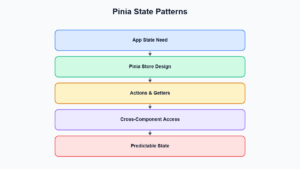
Pinia State Management Patterns for Large Vue 3 Apps
Every Vue 3 app that grows past a handful of components runs into the same problem: state that used to live comfortably in one component now needs to be shared,...
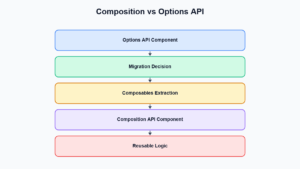
Vue 3 Composition API vs Options API: A Migration Guide
\n\nIf you maintain a Vue 2 codebase, or a Vue 3 app that was written before <script setup> became the default recommendation, you’ve probably had the “should we migrate to...
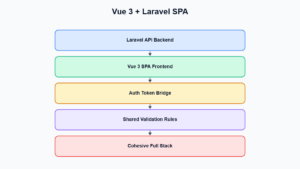
Vue 3 and Laravel: Structuring a Full-Stack SPA Correctly
Vue 3 and Laravel is one of the most common full-stack pairings we see teams reach for, and it’s also one of the pairings where the very first architectural decision...
TypeScript With Vue 3: Setting Up Strict Types for Components
If you tried TypeScript with Vue 2 and walked away unimpressed, you are not alone. The Options API forced you to type a sprawling this-bound object, and even with the...