If you want to hire remote developers who ship working software on schedule, tell you when something is going to slip before it slips, and don’t vanish the moment a sprint gets hard, here’s exactly what that looks like — and what it takes to find it.
I’ve worked as a remote developer for 6+ years, entirely with EU and US companies, from Lahore, Pakistan. I’ve been the person on the other end of the hiring decision you’re about to make — the remote hire who either becomes the most reliable person on the team or the cautionary story someone tells in a post-mortem. I’ve seen both outcomes up close, on other people’s teams and my own contracts. This page is what I’d tell a founder or engineering lead before they hire remote developers for the first time, or the fifth time.
What Actually Goes Wrong When Companies Hire Remote Developers
Most advice about how to hire remote developers focuses on where to find them. That’s the easy part. The failure modes show up after the contract is signed, and they follow a pattern I’ve watched repeat across clients, agencies, and marketplaces.
The two-week silence. A remote developer takes on a feature, confirms the scope, and then goes quiet. No blockers reported, no partial progress shared. Two weeks later something arrives — and it doesn’t match the spec, doesn’t run against the current codebase, or solves a version of the problem that no longer exists. The client didn’t do anything wrong. They just had no visibility into a process that was happening entirely inside one person’s head.
The 24-hour bug-fix loop. A client in New York reports a bug at 10am their time. Their remote developer is asleep — it’s 8pm in Lahore, or later. The developer sees it in the morning, replies at what is now evening for the client. A single fix that should take 20 minutes of back-and-forth stretches into three or four calendar days because every message crosses a full sleep cycle before it gets a reply. Nobody is doing anything wrong; the schedules just don’t touch.
Unreachable when production breaks. Something goes down at 2am the client’s time. The contractor who owns that system is unreachable — wrong number, no on-call agreement, no monitoring alert routed anywhere a human will see it quickly. The client ends up fixing their own production incident, or waiting, while paying someone specifically to prevent that scenario.
The handoff nobody can use. The engagement ends, and what’s left behind is undocumented, inconsistently structured, or dependent entirely on the departing developer’s memory. The next person — in-house or another remote hire — spends weeks reverse-engineering decisions that should have been written down as they were made.
None of this is inherent to remote work. It’s inherent to hiring remote developers without a plan for overlap, visibility, and documentation. Companies that get burned by one of these usually conclude “remote doesn’t work for us,” when the actual lesson is narrower: that specific hiring and management process didn’t work.
How to Hire Remote Developers Who Actually Deliver
If you’re working out how to hire remote developers for a real production codebase — not a one-off script — the process needs to answer four questions before anyone touches a repository: when do we talk in real time, how does work move forward when we’re not both online, what do we check for before signing, and what happens in the first 30 days.
Timezone Overlap Strategy
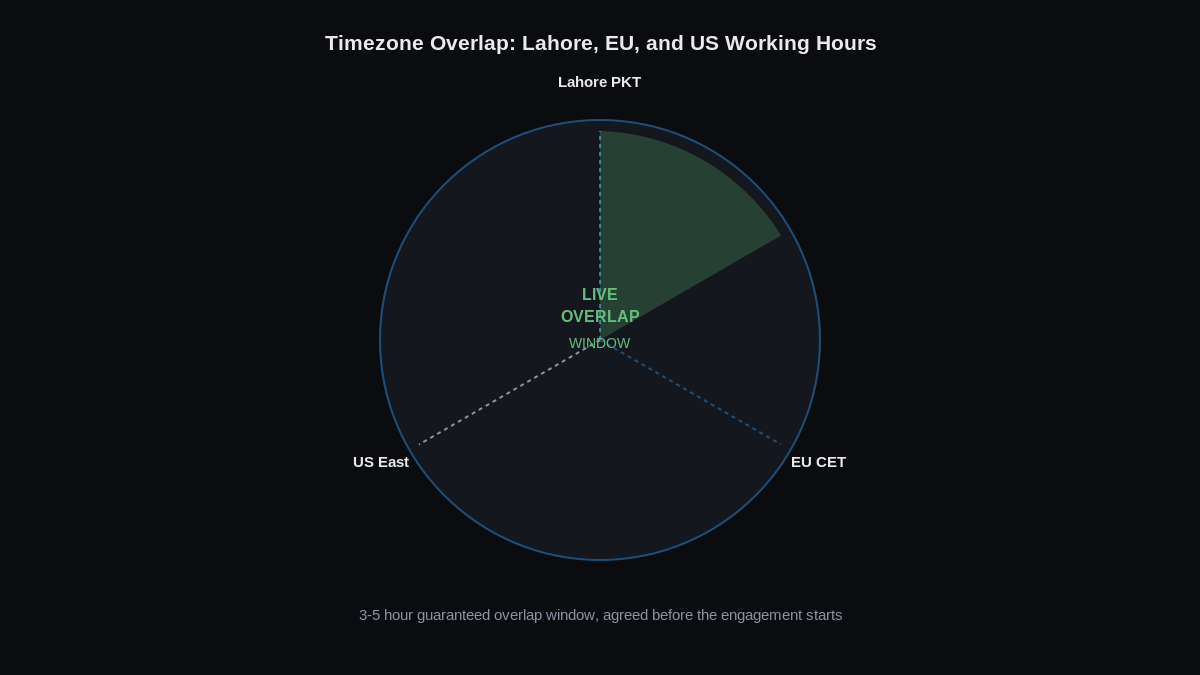
You don’t need a remote developer in your timezone. You need a guaranteed overlap window and a default assumption about who adjusts to bridge the rest. Lahore (PKT, UTC+5) overlaps naturally with European working hours in the local morning and with US East Coast hours in the Lahore evening. A deliberate 3-5 hour overlap window, fixed on both sides, is enough for daily syncs, pairing sessions, and same-day answers on anything urgent — and it means production incidents have an actual human awake and reachable, not a gap.
The mistake companies make is treating overlap as a nice-to-have instead of a contract term. Before you hire remote developers, get the overlap hours written down: which hours are guaranteed live, what the response-time expectation is outside those hours, and who’s on point if something breaks off-hours.
Async Communication Practices
Overlap hours handle urgency. Everything else should move without requiring both people online at once. That means:
- Written specs before work starts, not verbal agreements that live in someone’s memory.
- Daily async updates — what shipped, what’s blocked, what’s next — posted whether or not anyone asks.
- Short screen recordings for anything visual, instead of a paragraph trying to describe a UI change.
- A staging environment every change lands on before it reaches production, so “done” is something you can click through, not something you take on faith.
- Decisions written down where the whole team can find them later, not buried in a DM thread.
Red Flags in a Remote Hiring Process
A few signals during the hiring conversation tell you more than any portfolio:
- Vague answers about working hours — “flexible” with no actual overlap commitment usually means no overlap.
- No mention of how they’ll communicate progress before you ask about it.
- Reluctance to do a small paid trial task before a longer commitment.
- No staging or demo environment in their normal workflow — everything gets “sent over” instead of shown running.
- Can’t describe how a past remote engagement actually ended — what was handed off, and to whom.
Structuring the First 30 Days
The first month decides whether the engagement works. A structure that holds up in practice:
- Week 1 — access provisioned, environment running locally, a full walkthrough of the codebase and its known rough edges, not just a README.
- Week 2 — one small, real ticket shipped end-to-end, through the same review and deploy process everything else will use, so both sides see the actual working rhythm early.
- Week 3 — first substantial feature, first live demo to stakeholders, not just the internal team.
- Week 4 — independent ownership of a defined workstream, plus a short retro on what’s working and what needs to change before it becomes a habit.
If you’re building a longer-term team rather than a single hire, this same structure applies to a senior addition just as much as a first contractor — see hire a senior full-stack developer for how it looks when the role is a lead or architecture-level position rather than a single feature owner.
Why Hire a Remote Developer From Pakistan Specifically
This isn’t a race-to-the-bottom pitch, and I’d rather lose the client than pretend it is. The honest argument for choosing to hire a remote developer from Pakistan is a combination of two things that don’t usually come packaged together: genuine seniority and a cost structure shaped by a different economy, not a discount on quality.
Lahore has a real, mature software industry — universities producing computer science graduates every year, companies delivering production systems for clients across the EU, UK, and US for over a decade, and engineers who’ve spent years working inside international teams rather than adapting to one for the first time. I have an MCS from the University of Management and Technology (UMT) Lahore and a BSc from the University of the Punjab, and I’ve spent 6+ years since then working exclusively with remote EU and US clients and teams — not as a side gig, as the entire practice.
The rate difference is real and it’s structural: cost of living and local market rates in Pakistan are a fraction of US or EU equivalents, so the same seniority costs meaningfully less without either side pretending it’s charity or a shortcut. What doesn’t change is the bar — production systems, real deadlines, and the same accountability you’d expect from someone sitting in your own office. Companies that hire remote developers from Pakistan on that basis — seniority first, cost efficiency as a genuine byproduct — tend to keep the relationship for years rather than one project.
How I Work as a Remote Engineer
I’ve been a senior/lead developer at Tech Scale since 2022, fully remote, working with international clients and teams on Custimoo, WingWarranty, Specsavers, and Minplan. Before that, Cityscape Technology Corporation (2021-2022) and Seers, a GDPR compliance SaaS platform (2020-2021). Every one of those engagements was delivered remotely, across timezones, without the client and me ever sharing an office.
The practices in the sections above aren’t theoretical — they’re how those projects actually ran:
- Daily async updates posted regardless of whether a client asks, covering what shipped, what’s blocked, and what’s next.
- Staging environments on every project, so a client can click through a feature rather than take a status report on faith.
- Regular demos on a fixed cadence, not only when something is “finished,” so direction gets corrected early rather than after weeks of silent divergence.
- Documented handoffs — architecture decisions, environment setup, and known issues written down as they happen, not reconstructed at the end of a contract.
- Fixed overlap hours agreed at the start of every engagement, covering EU mornings and US East Coast evenings from Lahore.
Across 50+ projects delivered this way, the pattern holds regardless of stack — Laravel APIs, Vue.js and React front ends, Node.js services, ASP.NET Core systems, and more recently AI/RAG integration work for teams that need retrieval-augmented pipelines built on top of their existing product. If AI integration is the piece you’re evaluating specifically, AI integration services covers that work in more depth.
Tech Stack
| Area | Technologies | Typical Use |
|---|---|---|
| Backend | Laravel, Node.js, ASP.NET Core | APIs, business logic, integrations, background processing |
| Frontend | Vue.js, React | Dashboards, customer-facing apps, admin panels |
| AI / RAG | LLM integration, vector search, retrieval pipelines | Internal knowledge assistants, support automation, document Q&A |
| Data | MySQL, PostgreSQL, Redis | Application data, caching, queues |
| Infrastructure | CI/CD pipelines, staging environments, cloud hosting | Reliable deploys, visible work-in-progress |
Because the stack spans full-stack web development and AI integration, hiring remote developers through this route means one senior engineer who can own a feature end to end — API, frontend, and any AI component — instead of coordinating three separate specialists across three separate handoffs.
How Engagements Work
- 1. Intro call. We talk through the problem, the current stack, and what “done” looks like for the first phase. No pitch deck, just a working conversation.
- 2. Scoped proposal. A written scope, timeline, and rate structure — fixed-price for well-defined work, or a monthly retainer for ongoing product work.
- 3. Overlap hours agreed. We fix the daily window where we’re both online, in writing, before anything starts.
- 4. First small task. A short, real, paid piece of work — not a free trial — so both sides see the actual working rhythm before committing further.
- 5. Ongoing delivery. Daily async updates, a staging environment, and a regular demo cadence for the length of the engagement.
- 6. Documented handoff. Whether the engagement runs three months or three years, decisions and setup stay written down as they happen — not reconstructed at the end.
What It Costs to Hire Remote Developers
| Option | Typical Rate (2026) | What You’re Actually Paying For |
|---|---|---|
| US/EU in-house senior developer | $90,000-$150,000+/year (plus benefits, office, taxes) | Local presence, full-time availability, highest base cost |
| Agency-staffed remote developer | $60-$120+/hour | Vetting and account management layered on top of the engineer’s actual rate |
| Independent remote hire from Pakistan/South Asia (senior) | $25-$45/hour or comparable monthly retainer | Direct access to the engineer, no agency markup, senior-level experience |
| Offshore junior/unvetted freelance | Under $15/hour | Lower cost, but usually the source of the failure modes described above |
The honest way to read this table: the gap between “US/EU in-house” and “senior remote hire from Pakistan” is a real cost saving without a quality trade-off, when the person is genuinely senior. The gap between “senior remote hire” and “unvetted offshore freelance” is where most of the horror stories about hiring remote developers actually come from — and it’s a quality gap, not a geography gap.
Frequently Asked Questions
What’s the biggest mistake companies make when they hire remote developers?
Treating timezone overlap and communication cadence as details to figure out later instead of terms to agree on before the contract starts. Almost every failure mode above traces back to that.
How do I hire remote developers without losing visibility into the work?
Require a staging environment from day one, daily async updates regardless of whether you ask, and a fixed demo cadence. Visibility is a process choice, not a personality trait you have to hope for.
What’s a reasonable timezone overlap when I hire remote developers from Pakistan?
Three to five hours of guaranteed live overlap is enough for daily syncs and same-day answers on anything urgent, using either EU morning hours or US East Coast evening hours from Lahore.
How to hire remote developers for an ongoing product, not just a one-off project?
Start with a short, paid trial task before a longer commitment, agree on overlap hours and communication cadence in writing, and structure the first 30 days deliberately rather than assuming it will sort itself out.
Is it cheaper to hire remote developers from Pakistan than to hire locally?
Yes, meaningfully — often 50-70% less than a comparable US or EU in-house senior hire — but the saving comes from cost-of-living and market-rate differences, not from lower seniority or a race-to-the-bottom approach.
How do I vet seniority when I hire remote developers I can’t interview in person?
Ask for specific past project names and what was actually delivered, not just a stack list. Run a small paid trial task through your real review process. Ask how a previous remote engagement ended and what was handed off.
What happens if something breaks in production outside agreed working hours?
That should be defined before the engagement starts — who’s on point, what the response-time expectation is, and how they’re reached. If a contractor can’t answer that question clearly, that’s the red flag, not the timezone itself.
Do I need daily standups to hire remote developers successfully?
Not necessarily live ones. A written daily async update — what shipped, what’s blocked, what’s next — accomplishes the same goal without requiring both people online simultaneously.
What stack do you cover if I hire a remote developer for a full-stack role?
Laravel, Node.js, and ASP.NET Core on the backend; Vue.js and React on the frontend; plus AI/RAG integration for teams adding retrieval-augmented features on top of an existing product.
How long does it take to onboard after I hire remote developers?
With a structured first 30 days — access and environment in week one, a small real task in week two, a full feature and first demo by week three — a remote hire should be independently productive within a month.
Should I hire remote developers through an agency or directly?
An agency adds a markup layer for vetting and account management. Hiring directly costs less for the same seniority, provided you do your own vetting — a paid trial task and a real conversation about past engagements substitute for what an agency would otherwise check.
What red flags should I watch for before I hire remote developers?
Vague answers about working hours, no communication plan volunteered upfront, reluctance to do a small paid trial, no staging/demo habit, and no clear answer about how a past remote engagement actually ended.
Can a remote developer really own a production system end to end?
Yes, with the right practices in place — staging environments, documented decisions, fixed overlap hours, and a clear on-call agreement for anything outside those hours. That’s the actual difference between “remote” working and not.
How is hiring remote developers different from hiring an in-house senior engineer?
The engineering standard doesn’t change. What changes is that communication and visibility become deliberate processes instead of things that happen automatically because everyone’s in the same room.
What’s the typical engagement length when I hire remote developers this way?
It ranges from a single scoped project to multi-year ongoing work — Tech Scale’s engagement has run since 2022. Structure supports both; the first 30 days and the overlap/communication agreement look the same either way.
Do you work with teams that already have an in-house engineering team?
Yes — a large share of this work is joining an existing team as a senior or lead contributor, not replacing one, which is where documented handoffs and demo cadence matter most.
What industries have you delivered remote work for?
Warranty and product support platforms, optical retail, GDPR compliance SaaS, and general SaaS/product companies across the EU, UK, and US, spanning Custimoo, WingWarranty, Specsavers, Minplan, and Seers.
Distributed teams aren’t a workaround for hiring locally — done properly, they’re a legitimate way to build an engineering team, and the practices that make it work are well documented. GitLab’s public all-remote guide is a good reference for the broader practices behind async-first, documentation-driven teams, independent of who you eventually hire.
Ready to Hire a Remote Developer Who Actually Delivers?
Depending on the stack, that remote hire might specifically be a React developer, a Flutter developer, a mobile app developer, a WordPress developer, a Python developer, or a SaaS developer — the overlap-hours and engagement model below applies the same way regardless of which one fits your project.
If you’re ready to hire remote developers for a real production codebase — not a one-off script — the fastest way to find out if this is a fit is a direct conversation about your stack, your timeline, and your current team’s overlap hours.
Book a 30-minute call: Book a Free 30-Minute Call
