If you want to hire a python developer who can build a production backend, wire up a real data pipeline, and integrate an LLM feature that doesn’t fall over the first week it sees real traffic, here’s exactly what that looks like: someone who treats Python as a systems language, not a scripting shortcut, and who has actually shipped the AI half of the stack, not just read about it.
Most “Python developer” listings split into two camps. One camp is Django/Flask generalists who can build you a CRUD API and call it done. The other is data-science profiles who are comfortable in a notebook but have never deployed anything behind a load balancer. Neither camp, on its own, is what most companies actually need in 2026, because the projects coming in now increasingly need both: a backend that holds up in production and an AI layer — RAG, embeddings, an agent calling OpenAI or Anthropic — bolted onto it correctly.
I’ve watched both failure modes up close. A data pipeline that silently drops records because nobody wrote a dead-letter queue or logged the exception, so the business is making decisions off numbers that are quietly wrong. An LLM integration with no retry logic and no rate-limit handling, burning through the monthly API budget in eleven days because every transient 429 gets treated as a hard failure and retried in a tight loop.
A Flask app with no proper background task handling, where a report-generation endpoint blocks the request thread for ninety seconds and the whole API falls over under five concurrent users. These aren’t edge cases — they’re the default outcome when you hire a python developer who’s strong in one half of the stack and guessing at the other.
I’m Faisal Nadeem, a full-stack and AI integration engineer with 6+ years of experience and 50+ delivered projects, working remotely from Lahore for EU and US clients. Python is one of my two primary languages — I use it for production backend and data-platform work (Flask, analytics pipelines) and as my primary language for AI/LLM integration (RAG pipelines, vector search, agent orchestration). That combination — not “Python for web” or “Python for data science” in isolation — is the actual differentiator when you hire a python developer for anything shipping in 2026.
Quick summary: whether you need to hire a python developer for production backend work, hire a python developer for AI and RAG integration, or hire a python developer who can do both end to end, this page covers what that engagement actually looks like.
What a Python Developer Should Actually Build
Before you hire a python developer, it’s worth being specific about what “Python developer” should mean on your project. In practice it breaks down into five overlapping capabilities, and a developer worth hiring should be credible in most of them, not just one.
Flask/backend API development
A Flask backend that’s actually production-ready has structured error handling, request validation, proper auth (JWT/OAuth, not a hand-rolled token check), and a clear separation between the API layer and the business logic. It has logging that tells you what happened when something breaks at 2am, not a stack trace with no context. Blueprints are organized by domain, not by whatever file got created first.
Data analytics & business intelligence pipelines
This is Python doing what it’s genuinely best at: pulling data from multiple sources, cleaning and transforming it reliably, and turning it into something a business can act on. The bar here isn’t “the script ran once on my machine” — it’s idempotent jobs, schema validation on ingestion, and pipelines that fail loudly instead of silently dropping rows.
RAG pipelines & vector search (Qdrant, Neo4j)
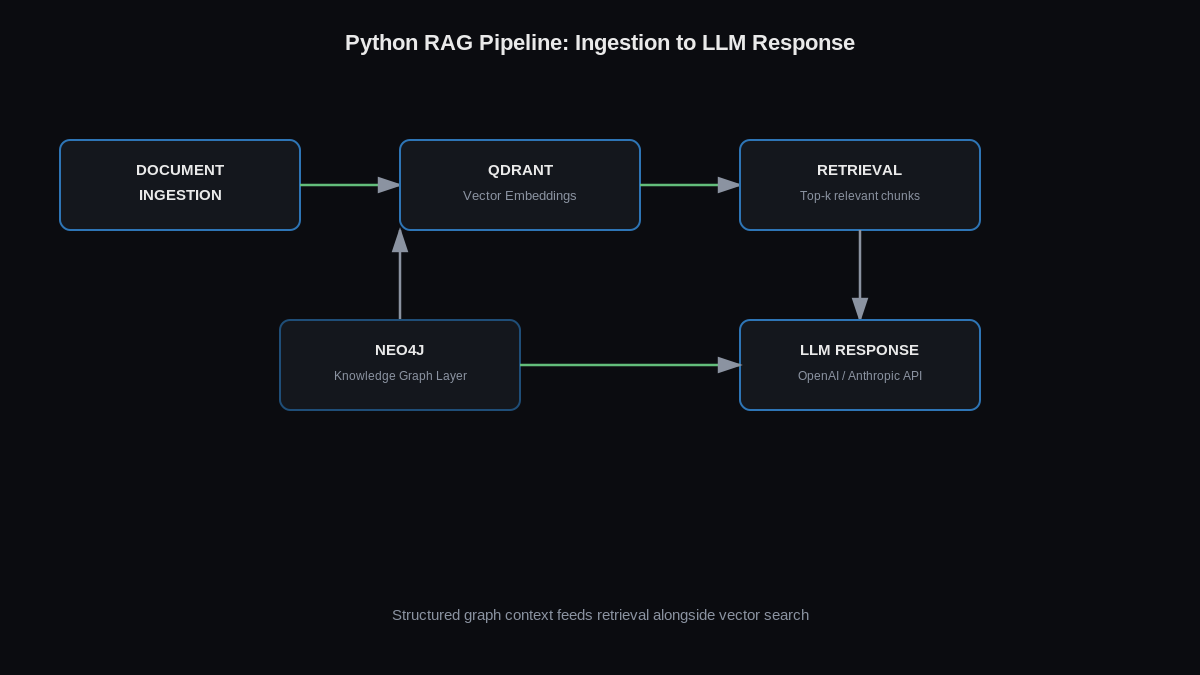
Retrieval-augmented generation is where most of the current AI integration work actually lives. That means chunking documents sensibly, generating and storing embeddings in a vector database like Qdrant, and — when the data has real relationships worth modeling — layering in a knowledge graph with Neo4j so retrieval isn’t just “nearest neighbor on a paragraph” but grounded in how the entities actually connect.
LLM/AI agent integration (OpenAI, Anthropic APIs)
Calling an LLM API is the easy 20% of this work. The other 80% is retry logic with exponential backoff, rate-limit handling that doesn’t quietly stall your app, token-usage tracking so you’re not surprised by the bill, prompt versioning, and streaming responses without breaking your request lifecycle. This is orchestration work as much as it is AI work.
Background job & data processing
Anything that takes more than a second or two — report generation, embedding a document batch, calling a third-party API — belongs in a background worker (Celery, RQ, or an async task queue), not in the request/response cycle. A Flask app with no background task handling is a Flask app that will eventually block every request behind one slow one.
Why Hire a Full-Stack + AI Engineer for Python Instead of a Narrow Specialist
Here’s the practical case for why you should hire a python developer who spans full-stack and AI, rather than stitching together a backend contractor and a separate “AI person.”
- Fewer handoffs, fewer integration bugs. When the same engineer owns the Flask API and the RAG pipeline feeding it, the interface between them is designed once, correctly — not reverse-engineered by two people who never talked.
- Realistic AI scoping. A backend engineer who’s also done the AI integration work knows what a vector search feature actually costs in latency, infra, and API spend — so you get an honest estimate up front instead of a surprise three weeks in.
- Production discipline applied to AI features. Retry logic, rate limiting, logging, and monitoring aren’t AI-specific skills — they’re backend engineering skills applied to a new kind of external dependency. A developer who’s only done notebooks skips them.
- One point of accountability. If the RAG results are bad, is it the retrieval, the embedding model, or the API layer serving it? One engineer who owns the whole path can actually answer that instead of two teams pointing at each other.
This is why, increasingly, companies choose to hire a python developer with a dual background rather than defaulting to whichever specialist is easiest to find on a marketplace.
Tech Stack
| Layer | Tools |
|---|---|
| Backend / API | Python, Flask, FastAPI, REST/GraphQL APIs |
| Frontend (paired with Python APIs) | Nuxt.js, Vue.js, React |
| Data & analytics | Pandas, NumPy, SQL, ETL pipelines, BI dashboards |
| AI / RAG / vector search | Qdrant, Neo4j, embedding models, LangChain-style orchestration |
| LLM providers | OpenAI API, Anthropic API |
| Background processing | Celery, RQ, async task queues |
| Databases | PostgreSQL, MySQL, MongoDB, Redis |
| Infra & delivery | Docker, CI/CD, cloud deployment (AWS/GCP/Azure) |
Proof
The clearest example of what “hire a python developer” should actually get you is StormIQ, an automated technical analysis platform I built as a full-stack Python engagement.
StormIQ is an analytics platform providing advanced AI-driven analytics and business intelligence solutions, built to help organizations transform complex data into actionable insights rather than raw numbers they have to interpret themselves. The backend runs on Python and Flask — handling data ingestion, processing, and the analytical logic that turns disparate inputs into structured, decision-ready output. The frontend is built in Nuxt.js, giving the platform a fast, interactive interface for the dashboards and reports the analytics layer generates.
The engineering challenge wasn’t “call an API and render a chart.” It was designing a data pipeline that could reliably process complex, varied inputs and apply AI-driven analytical logic consistently, so the business intelligence layer on top could be trusted. That’s the same discipline — reliable ingestion, validated transformation, no silent data loss — that separates a real analytics platform from a script that happens to work in a demo.
Alongside platform work like StormIQ, Python is also the primary language behind my AI Integration Services work: RAG pipelines using Qdrant for vector search and Neo4j for knowledge graphs, orchestrated in Python or Node.js/Laravel depending on the client’s stack. That’s a direct description of how the AI integration side of my practice runs day to day — document ingestion, embedding, retrieval, and LLM response generation, built and maintained in Python for clients who need the AI layer to actually hold up in production, not just in a proof-of-concept. AI integration services
If your project is Node-based rather than Python-based but needs the same combination of backend discipline and AI integration, the same approach applies there too. Node.js development
How Engagements Work
- Discovery call. We talk through what you’re building, what “done” looks like, and whether this is backend work, AI integration, or both. No sales script — if it’s not a fit, I’ll say so.
- Scoping and estimate. You get a written breakdown of the work, a realistic timeline, and — for AI/RAG features specifically — an honest estimate of ongoing API and infra costs, not just build cost.
- Architecture sign-off. Before code gets written, we agree on the shape of the system: API structure, data flow, where the vector store and knowledge graph fit, how background jobs are handled.
- Build in milestones. Work ships in reviewable chunks, not one black-box delivery at the end. You see progress and can redirect early if priorities shift.
- Handover or ongoing support. Documented code, a clear README, and either a clean handover to your team or continued engagement for iteration and maintenance.
Before the numbers: rates below assume you actually hire a python developer with production experience, not just someone with the job title on a resume.
What It Costs to Hire a Python Developer
Rates for Python work vary more than most people expect, largely because “Python developer” covers everyone from junior scripting help to specialists who can only be found in a thin, expensive slice of the market.
| Profile | Typical Rate (2026) | What you actually get |
|---|---|---|
| Junior / entry-level | $25–$40/hr | Simple scripts, basic CRUD endpoints, supervision required |
| Mid-level generalist | $50–$80/hr | Solid Flask/Django APIs, standard data tasks, limited AI exposure |
| Senior full-stack Python | $95–$160/hr | Production backends, data pipelines, architecture decisions |
| AI/LLM integration specialist | $145–$300/hr | RAG pipelines, vector search, agent orchestration, production LLM ops |
The reason to note that last row: AI/LLM-specialized Python work commands a real premium over generic scripting or CRUD work, because engineers who’ve actually shipped a RAG pipeline to production — not just prototyped one — are still in short supply. When you hire a python developer for a project that combines backend and AI, you’re often paying one rate for two specializations that would otherwise cost you two separate hires at two separate premiums.
Engagements are typically structured as milestone-based fixed-fee for well-scoped builds, or hourly/retainer for ongoing work and iteration — whichever fits how defined your requirements are today.
Still deciding whether to hire a python developer directly or bring on a broader team? The FAQs below cover the practical questions people ask before they hire a python developer for backend, data, or AI integration work.
Frequently Asked Questions
Why should I hire a python developer instead of using a marketplace like Upwork or Toptal?
Marketplaces optimize for fast matching against a large pool, which is useful when you need volume. If you need one engineer who understands both the backend and the AI integration deeply enough to make architecture calls, working directly with someone who can show you a real, named project — like StormIQ — gives you more certainty than a profile page and star rating.
What’s the difference between a Flask developer and a python developer who does AI integration?
A Flask developer builds and maintains web APIs. AI integration work — RAG pipelines, vector search, LLM orchestration — is a distinct skill set involving embeddings, retrieval logic, and handling a third-party model API reliably. Some developers do both; most specialize in one, which is exactly why it matters who you hire a python developer from.
Can one python developer really handle both backend and AI work?
Yes, if the backend and AI work share the same language and runtime, which they do in Python. The skills overlap more than people assume: API design, background job handling, and reliability practices apply directly to serving a RAG pipeline or an LLM-backed feature.
How much does it cost to hire a python developer in 2026?
Generalist rates run $50–$160/hr depending on seniority. AI/LLM integration specialists run $145–$300/hr because of the current supply shortage for engineers with real production RAG experience. Fixed-fee milestone pricing is common for well-scoped builds.
What is RAG and why does my python developer need to know it?
Retrieval-augmented generation retrieves relevant context — from a vector database or knowledge graph — before passing it to an LLM, so responses are grounded in your actual data instead of the model’s general training. If your project involves “chat with your data” or an internal knowledge assistant, this is the core architecture, and it needs to be built by someone who’s done it before.
What’s the difference between Qdrant and Neo4j in a RAG pipeline?
Qdrant is a vector database used for similarity search over embeddings — finding the chunks of text most relevant to a query. Neo4j is a graph database used when the relationships between entities matter as much as the text itself. Many production RAG systems use both: vector search for recall, graph traversal for grounded, relationship-aware context.
Do I need a data engineer, or should I just hire a python developer, for a BI pipeline?
For most mid-sized BI projects, you can just hire a python developer with data pipeline experience and cover it end to end — ingestion, transformation, and delivering the processed data to a dashboard or reporting layer. Dedicated data engineering teams become worth it at a scale most companies aren’t at yet.
How do I hire a python developer for an existing Flask codebase?
Share the repo (or a redacted version) ahead of the discovery call. A capable engineer should be able to point to specific structural issues — missing background task handling, weak error boundaries, tightly coupled business logic — within the first review, before any contract is signed.
What happens if my LLM integration is already burning through API budget?
This is one of the most common fixes I get brought in for. Usually it’s missing retry/backoff logic treating every rate-limit response as a failure and re-firing immediately, no caching of repeated queries, or no token-usage tracking at all. It’s a diagnosable, fixable problem, not a reason to rebuild from scratch.
Should I hire a python developer or a Node.js developer for an AI integration project?
Both are viable — the RAG and LLM orchestration patterns are nearly identical across the two. Python tends to have the edge for heavier data processing and ML-adjacent tooling; Node.js/Laravel fits well when the rest of your stack is already JavaScript or PHP. Node.js development
Can a python developer work with my existing Anthropic or OpenAI account and prompts?
Yes — integrating against an existing API account, model choice, and prompt library is standard. The engineering work is in the orchestration layer around the calls: retries, streaming, rate limits, and how retrieved context gets assembled into the prompt.
How long does it take to hire a python developer for a project vs. building an in-house team?
Engaging a freelance specialist typically starts within days of a scoping call. Hiring in-house for the same combination of backend and AI/LLM skills often takes months, given how thin the market is for engineers with genuine production RAG experience.
What does a typical Flask API project include?
Route and blueprint structure by domain, request validation, authentication, structured logging, background job handling for anything slow, and a clear deployment path — Docker plus CI/CD at minimum. See the official Flask documentation for the framework fundamentals underneath this.
Is Python still a good choice for backend development in 2026, or should I use Node.js?
Both remain solid choices; the decision usually comes down to team familiarity, the surrounding ecosystem, and whether the project leans data/AI-heavy (where Python’s tooling has an edge) or needs to share code with a JavaScript frontend team.
What background does a python developer need for data analytics work?
Comfort with Pandas/NumPy for transformation, SQL for querying, and — critically — the engineering discipline to make pipelines idempotent and failure-visible, not just “worked once.” StormIQ is a direct example of this applied to a real analytics platform.
Do you work with companies outside the US/EU?
Yes. Most of my clients are in the EU and US, working remotely from Lahore, Pakistan, but the engagement model — discovery call, scoping, milestone delivery — works the same regardless of where the client is based.
What’s your background and why should I trust you with this?
I’m Faisal Nadeem, a full-stack and AI integration engineer with an MCS from the University of Management and Technology (UMT) Lahore and a BSc from the University of the Punjab. 6+ years of experience, 50+ delivered projects, currently senior/lead developer at Tech Scale (since 2022), with earlier roles at Cityscape Technology Corporation and Seers, a GDPR SaaS company.
Can I start with a small paid trial project before committing to a larger engagement?
Yes. A scoped, well-defined smaller piece of work — a single API endpoint, a focused RAG prototype — is a reasonable way to evaluate fit before committing to the full build.
What if I only need help with the AI/RAG portion, not the whole backend?
That’s a common and entirely reasonable scope. The discovery call establishes exactly where the boundary sits, so you’re not paying for backend work you don’t need.
If the project also needs a SaaS-style multi-tenant architecture around this backend, hiring a SaaS developer covers that side. And if hiring across time zones is part of the decision, hiring remote developers covers how the engagement and overlap-hours model works.
If any of this matches what you’re trying to build — a backend that won’t fall over, a data pipeline you can trust, or an AI feature that actually survives production traffic — the next step is a conversation, not a proposal. Book a Free 30-Minute Call and we’ll figure out in thirty minutes whether this is a fit.
