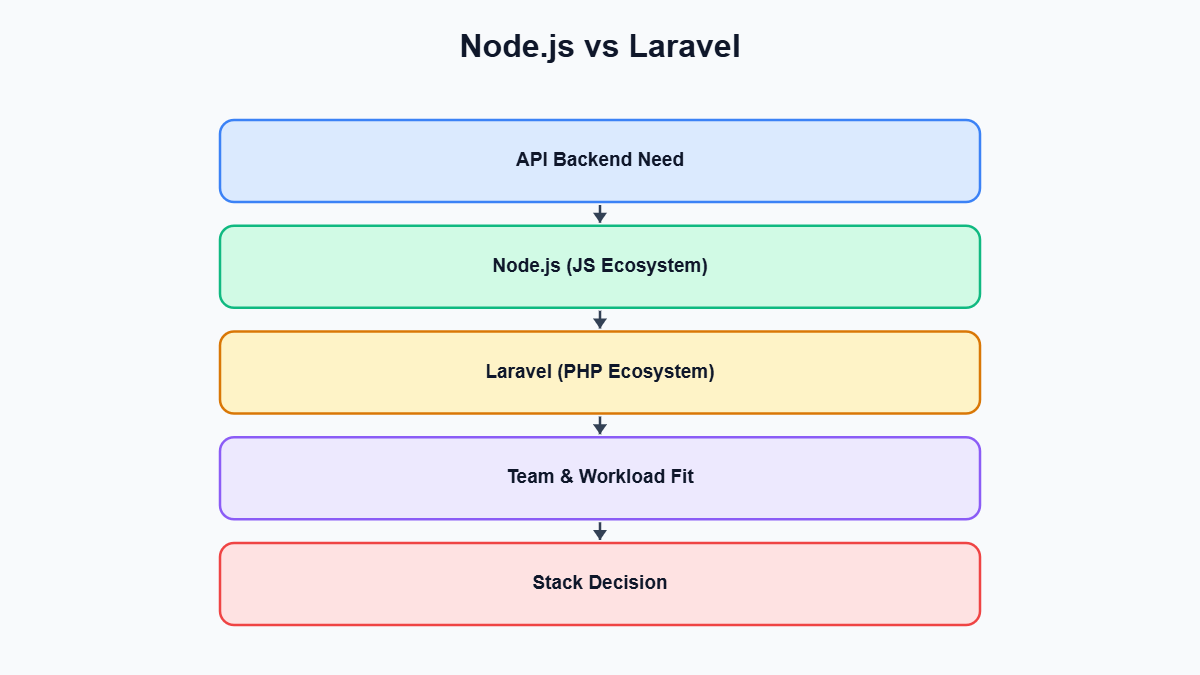
Every few months, a technical lead on a new product opens a ticket titled something like “backend framework decision” and closes it three weeks later having learned more about their own team than about either technology. The Node.js vs Laravel debate gets framed online as a holy war, but in practice it’s rarely a blowout. Both are mature, production-proven choices for building backend APIs, both power real companies at real scale, and both will happily fall over if the team using them doesn’t understand the tradeoffs they’re signing up for. This post is an attempt to lay out those tradeoffs honestly, without pretending the answer is the same for every team or manufacturing a “winner” where the real answer is “it depends on what you’re optimizing for.”
Why This Comparison Keeps Coming Up
Node.js and Laravel solve overlapping problems from very different starting points. Node.js is a JavaScript runtime built on Chrome’s V8 engine, and by itself it’s not a framework at all — you build APIs on top of it using something like Express, Fastify, NestJS, or Koa. Laravel, by contrast, is a full-featured PHP framework with strong opinions about routing, database access, authentication, queueing, and testing baked in from day one. Comparing “Node.js vs Laravel” is a little like comparing a language-plus-ecosystem to a single opinionated framework, and that asymmetry matters more than most comparison articles admit — you’re not just picking a runtime, you’re picking how much structure you want handed to you versus how much you want to assemble yourself.
Both ecosystems have converged on similar target markets — SaaS products, internal tooling, e-commerce backends, content platforms, and API-first services that need to talk to a web frontend, a mobile app, or both. If you’re evaluating Node.js vs Laravel for a new backend, either stack can get you there. The differences show up in velocity, maintenance cost, hiring, and how the system behaves under specific kinds of load — not in whether the thing can be built at all.
Language and Ecosystem: JavaScript Everywhere vs PHP With Guardrails
The most visible difference is the language itself, and it has real consequences beyond syntax preference.
Node.js means JavaScript (or, in almost every serious production codebase today, TypeScript) on the server. If your frontend is already React, Vue, or Angular, this gives you a genuinely useful property: the same language, sometimes shared type definitions, and often the same engineers moving between frontend and backend work without a context switch. Shared validation logic, shared types for API payloads, and a single hiring pipeline for “JavaScript engineers” are real, tangible benefits — not marketing fluff. Teams that are frontend-heavy or want engineers who can work full-stack tend to gravitate here for exactly this reason.
Laravel means PHP, and modern PHP (8.x) is a considerably more capable language than its reputation from a decade ago suggests — it has a real type system, enums, attributes, and a fast engine underneath via OPcache and, increasingly, tools like Laravel Octane for keeping the framework warm between requests. What Laravel brings that Node’s ecosystem generally doesn’t is cohesion. The Laravel documentation covers routing, Eloquent ORM, migrations, queues, caching, mail, authentication, authorization policies, and testing as one coherent system, versioned and upgraded together. You’re not choosing an ORM, a validation library, and a queue system from five different maintainers and hoping they play nicely.
Node’s ecosystem, via the official Node.js documentation and the surrounding npm registry, is enormous and fast-moving, which is both its strength and its tax. You get more packages and faster adoption of new patterns — but you also inherit the responsibility of choosing and maintaining that assembly yourself. A Laravel developer joining a new Laravel project has a very good idea of what they’ll find. A Node developer joining a new Node project might find Express with Sequelize, or Fastify with Prisma, or NestJS with TypeORM, or something entirely bespoke — and each combination behaves differently enough that “I know Node” doesn’t fully transfer. Neither approach is inherently better; it’s a genuine tradeoff between flexibility and consistency, and which one you want depends on how much you trust your team’s architectural judgment versus how much you want a framework enforcing it for you.
Performance Characteristics for Typical API Workloads
This is where a lot of comparison content gets dishonest, usually by citing a synthetic benchmark that ran a single endpoint under artificial load and drew sweeping conclusions from it. We’re not going to do that here, because those numbers rarely predict what happens in your actual production system, with your actual database, network topology, and traffic patterns. What’s worth understanding instead is the architectural difference underneath, because that has real, predictable consequences.
Node’s Event Loop
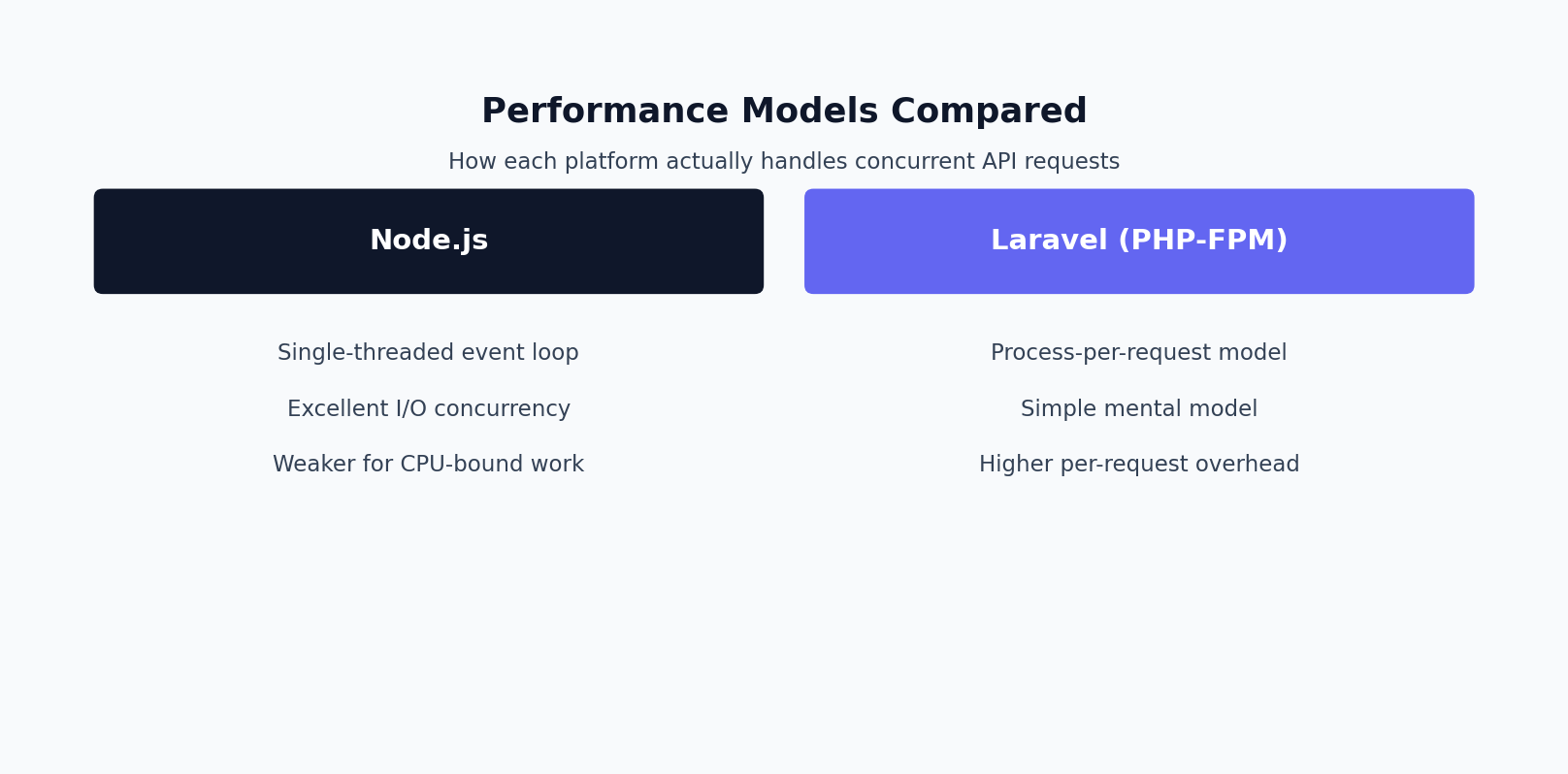
Node runs on a single-threaded event loop with non-blocking I/O. When a request needs to hit a database, call an external API, or read a file, Node doesn’t block that thread waiting for the response — it registers a callback and moves on to handle other requests, then comes back when the I/O operation completes. For workloads dominated by waiting — calling third-party APIs, querying databases, proxying requests, streaming data — this model is genuinely well-suited. You can handle a large number of concurrent connections without spinning up a new OS-level thread or process per request, keeping memory overhead relatively low for I/O-heavy workloads.
The tradeoff is CPU-bound work. If a request requires heavy synchronous computation — image processing, complex data transformation, cryptographic operations — that work blocks the single event loop thread and everything waiting behind it stalls. Node has answers to this (worker threads, offloading to separate services, native addons), but they’re workarounds you have to reach for deliberately, not something the runtime handles for you by default.
PHP-FPM’s Process Model
Laravel, running under PHP-FPM (or Octane, which changes this picture somewhat), typically handles each request in its own process or worker, with a shared-nothing model between requests by default. Because each request gets a clean slate, you don’t get the class of bugs where state accidentally leaks between requests due to a shared in-memory object — a category of bug Node developers do have to actively guard against, since long-lived processes mean long-lived state if you’re not careful. The cost is that traditional PHP-FPM scales concurrency by adding worker processes, which carries more memory overhead per concurrent request than Node’s event-loop model, particularly for I/O-heavy workloads.
Laravel Octane closes some of this gap by keeping the application booted in memory and using event-driven servers like Swoole or RoadRunner underneath, getting closer to Node-style performance for I/O-bound work — but it’s an opt-in addition, not the default deployment model most Laravel teams run, and it reintroduces some shared-state concerns that plain PHP-FPM sidesteps.
What This Actually Means for You
For a typical CRUD API — reading and writing to a relational database, calling a handful of external services, serving JSON to a frontend — both stacks perform adequately well when built competently. For most products, database query patterns, N+1 issues, missing indexes, and poor caching decisions dominate the performance profile far more than the runtime’s request-handling model does. Node’s event loop gives you a genuine edge in workloads with high I/O concurrency and light per-request computation — proxying and aggregating calls to multiple downstream services, handling large numbers of long-lived connections, or streaming data. Laravel is a wash or even preferable where raw throughput per request matters less than protecting against subtle shared-state bugs. If your product’s actual bottleneck is your database or third-party API latency — which it usually is — framework choice will matter far less than you think at the start of the project.
Developer Productivity and Built-In Tooling
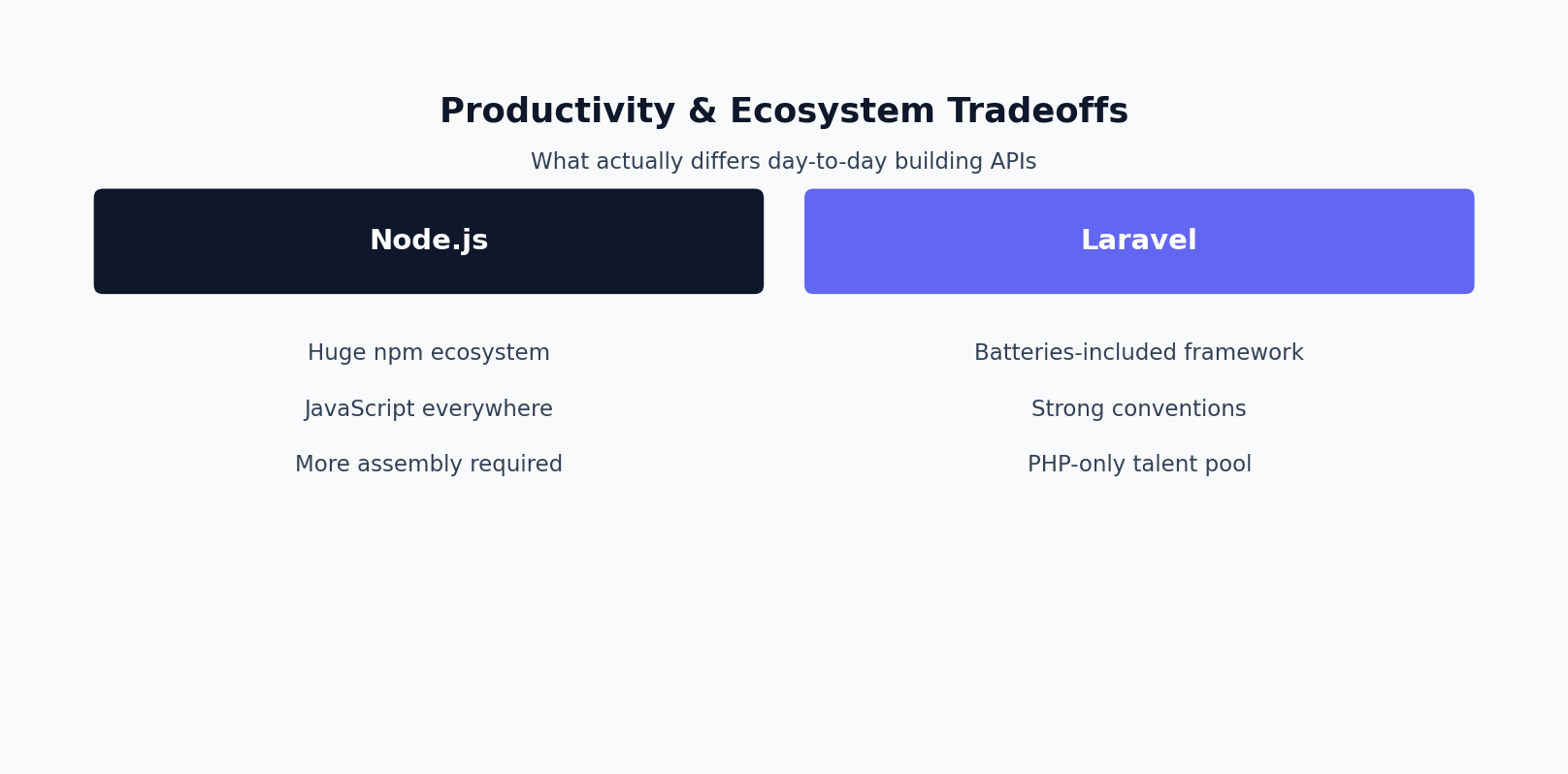
This is where the two ecosystems diverge most sharply in philosophy, and it’s often the more decisive factor in practice than performance.
Laravel is batteries-included in a way that’s hard to overstate if you haven’t worked in it. Authentication scaffolding, form request validation, an ORM (Eloquent) with a mature migration system, a queue abstraction that works the same way across Redis, SQS, or a database driver, a built-in job scheduler, a templating engine, a mail system with swappable transports, and a testing framework are all there on day one, documented in one place, and designed to work together. A competent developer can have authentication, migrations, and a first working endpoint running within a day, largely because they’re not making a dozen small library-selection decisions before writing business logic.
Node’s ecosystem trades that immediacy for choice. You’ll decide between Express (minimal, extremely mature, huge community), Fastify (faster, more structured, growing fast), NestJS (opinionated, Angular-inspired, closest thing to Laravel’s structure in the Node world), or something else entirely. Then you’ll pick an ORM or query builder — Prisma, TypeORM, Drizzle, Knex — a validation library, an auth strategy, and a queue solution (BullMQ being the common modern choice on top of Redis). None of these decisions are hard individually, but they add up to setup time and, more importantly, real risk of inconsistency across a growing team if there isn’t a strong architectural voice keeping choices coherent. NestJS narrows this gap considerably by imposing Angular-style structure on top of Node, and teams that want Laravel-like cohesion in the Node world often land there rather than on bare Express.
The honest takeaway: if your priority is shipping a standard CRUD-heavy API fast, with fewer early architectural decisions and conventions a new hire can learn quickly, Laravel’s built-in tooling is a genuine productivity advantage, not just a preference. If your priority is maximum flexibility or tight integration with a JavaScript-heavy frontend and tooling chain, Node’s assemble-it-yourself model is worth the setup cost.
Hiring Pool and Team Considerations
Framework decisions outlive the person who made them, and hiring reality should weigh more heavily here than most teams give it credit for.
JavaScript and TypeScript are, by nearly every developer survey and job board measure, among the most widely known languages in the industry, partly because frontend work forces broad exposure to JavaScript regardless of backend preference. That means a large, if uneven, hiring pool for Node.js roles — uneven because “knows JavaScript” and “can build a well-architected Node.js API” are not the same skill, and the gap between them is wider than in more opinionated ecosystems. Vetting matters more here: you’re evaluating not just language familiarity but architectural judgment, since the framework won’t impose much of that for you.
PHP has a smaller but still substantial hiring pool, and Laravel specifically has become the dominant PHP framework, meaning most PHP developers hired in recent years have Laravel experience or can onboard to it quickly given how standardized its conventions are. The tradeoff shows up on the senior end: there are fewer PHP specialists in absolute numbers in most Western tech hubs than JavaScript specialists, though this varies by region — Laravel has particularly strong developer communities in parts of Europe, Latin America, and South and Southeast Asia.
For teams building or scaling a full-stack engineering org, there’s also a practical org-design question: do you want backend and frontend engineers to move fluidly between codebases, or a clean separation of concerns with specialists on each side? Node.js supports the former much more naturally. Laravel, paired with a separate JavaScript frontend, pushes you toward the latter, which some teams actually prefer because it keeps backend and frontend concerns decoupled and lets each side optimize independently. If you’re planning to bring in outside help rather than hire in-house, this is also where scoping matters — when a team is evaluating options for hiring a Node.js developer versus a Laravel specialist, the calculus should include not just current team skills but how the codebase needs to evolve over the next few years.
Real-Time and WebSocket Use Cases
This is one section where the honest answer isn’t “it depends.” If your product involves live chat, collaborative editing, live dashboards, multiplayer features, or any use case built around persistent bidirectional connections, Node.js is generally the better default choice, and it’s not close.
The reason traces back to the same event loop model discussed earlier. Node handles large numbers of concurrent long-lived connections efficiently, because those connections spend almost all their time idle from the CPU’s perspective, waiting for the next message. Libraries like Socket.IO and the ws package are mature, widely used, and well-documented, and the broader Node ecosystem has a decade-plus of production experience building exactly this kind of system.
PHP’s traditional request-response model, built around PHP-FPM spinning up a process to handle a request and tear it down afterward, is fundamentally mismatched to long-lived persistent connections. Laravel does have an answer — Laravel Echo paired with a broadcasting driver (Pusher, Ably, or a self-hosted solution using Soketi or Laravel Reverb, built specifically to bring first-party WebSocket support into the framework). These are legitimate, production-capable solutions, and plenty of Laravel apps ship real-time features this way. But architecturally, you’re bolting a real-time layer onto a framework designed around a different request model, versus Node where handling persistent connections is close to the runtime’s native strength. If real-time functionality is a core part of your product rather than a minor feature, this is a scenario where the Node.js vs Laravel decision should lean heavily toward Node, and pretending otherwise for the sake of “balance” would be dishonest.
Long-Term Maintainability and Codebase Health at Scale
Initial productivity is one thing; what a codebase looks like after three years and a dozen contributors is another, and it’s arguably the more important question for a business making this decision.
Laravel’s opinionated structure tends to age well specifically because it constrains drift. A Laravel codebase built several years ago and one built today will look recognizably similar — controllers, models, migrations, service providers, form requests — because there’s really one dominant “correct” way to structure most things. This isn’t just aesthetic; it materially reduces onboarding time and the odds of accumulating competing patterns for the same problem across a growing codebase. The framework’s own upgrade path is also unusually well maintained, with clear guides between major versions.
Node.js codebases have a wider variance in long-term health, and this correlates strongly with decisions made in the first few months rather than anything inherent to the runtime. A Node/TypeScript codebase built on NestJS with strict linting and disciplined dependency management can be just as maintainable as a Laravel app years later — TypeScript’s type system, used well, catches entire categories of bugs before production. But a Node codebase assembled ad hoc on bare Express, without conventions enforced early, tends to accumulate inconsistency faster — different modules handling errors and validation differently, dependencies added by different engineers with nobody owning the system’s overall shape. The ecosystem’s flexibility, a strength early on, becomes a liability if nobody is actively curating it.
There’s also dependency management. The npm ecosystem’s sheer size means more supply-chain surface area — more transitive dependencies, more packages of varying maintenance quality, and periodic incidents involving compromised or abandoned packages. Composer, PHP’s package manager, has a materially smaller ecosystem, and Laravel’s first-party packages cover more ground natively, reducing (though not eliminating) this exposure. Neither ecosystem is unsafe when managed with normal diligence — auditing, lockfiles, regular updates — but it’s a real difference in baseline surface area worth factoring in.
A Practical Decision Framework
Here’s how we’d actually advise a team working through this decision, rather than handing down a blanket verdict.
- Lean Node.js if: your frontend is already React, Vue, or Angular and you want engineers moving fluidly across the stack; your product has meaningful real-time or WebSocket requirements; your workload is I/O-heavy with lots of calls to external APIs or microservices; or your team has strong JavaScript/TypeScript expertise and the discipline to keep an assembled stack consistent.
- Lean Laravel if: you’re building a standard data-driven API and want to move fast without making a dozen early tooling decisions; your team is PHP-experienced or you want a framework that enforces consistent conventions as it grows; you value a cohesive, well-documented ecosystem over maximum flexibility; or you lack a strong in-house architect who’d otherwise need to impose that structure on a Node project.
- It’s genuinely close if: you’re building a conventional CRUD API with a moderate feature set, no unusual performance requirements, and a team that could ramp up on either. Here, the deciding factor should be your team’s skills and hiring strategy, not a theoretical edge that won’t materialize in practice.
One more point worth making plainly: this decision is reversible less often than teams assume, but it’s not irreversible either. Plenty of products have migrated backend services from one stack to the other, usually incrementally, service by service, once real usage patterns revealed a genuine mismatch. That’s a reasonable fallback plan, but it’s expensive enough that it shouldn’t be your primary plan. Spend the time upfront getting an honest read on your team’s actual strengths, your product’s workload shape, and your hiring reality, and the Node.js vs Laravel choice tends to resolve itself with far less anxiety than the framing of “which is better” usually implies.
If the workload and team profile point toward Node, the next practical step is usually less about the runtime itself and more about finding engineers who’ve actually built production systems on it — people who understand where the event loop helps and where it doesn’t, and won’t rediscover the same architectural lessons at your expense. That’s the gap that comes up when teams look into hiring a Node.js developer rather than staffing and architecting the decision entirely in-house.
Frequently Asked Questions
Is Node.js or Laravel faster for backend APIs?
It depends on the workload, not on which is “faster” in the abstract. Node’s event loop has a genuine edge for I/O-heavy work with high concurrency, proxying calls, streaming data, or handling many long-lived connections. Laravel under PHP-FPM is a wash, or even preferable, where protecting against shared-state bugs matters more than raw request-handling concurrency. For most typical CRUD APIs, database query patterns and caching decisions dominate performance far more than the framework choice does.
Which is better for real-time features like chat or live dashboards?
Node.js, and it isn’t close. Its event loop handles large numbers of concurrent long-lived connections natively, and libraries like Socket.IO have a decade-plus of production use for exactly this. Laravel’s request-response model can add real-time support via Reverb, Soketi, or Pusher, but it’s bolting a real-time layer onto a framework built around a different model.
Is Laravel faster to build a CRUD API with than Node.js?
Usually, yes, for standard data-driven APIs. Laravel is batteries-included: authentication, Eloquent ORM, queues, and testing all ship together and are designed to work as one system. Node’s ecosystem trades that immediacy for choice, you assemble a framework, ORM, validator, and queue library yourself, which costs setup time and creates more room for inconsistency across a growing team.
Should I choose Node.js or Laravel based on my frontend stack?
It’s a reasonable factor. If your frontend is already React, Vue, or Angular and you want engineers moving fluidly between frontend and backend work, Node.js gives you a shared language and sometimes shared types. If you’d rather keep backend and frontend cleanly separated with specialists on each side, Laravel paired with a separate JS frontend supports that naturally.
Is it expensive to switch from Node.js to Laravel, or vice versa, later?
It’s reversible but not cheap. Plenty of products have migrated backend services from one stack to the other, usually incrementally and service by service, once real usage patterns revealed a genuine mismatch. That should be a fallback plan, not the primary plan, since it’s expensive enough to justify getting the initial decision right.
Which framework has a bigger hiring pool, Node.js or Laravel?
JavaScript and TypeScript have the larger overall hiring pool, partly because frontend work forces broad exposure to JS regardless of backend preference, but “knows JavaScript” and “can architect a solid Node.js API” are not the same skill, so vetting matters more. Laravel has a smaller pool, but most PHP developers hired recently already have Laravel experience, since it’s the dominant PHP framework and its conventions are standardized.
