Every founder hits the same fork in the road eventually. The product needs more engineering hands, and the budget spreadsheet shows two very different numbers. A junior full stack developer might cost half of what a senior one does. On paper, the job description looks identical: “build features, fix bugs, ship code.” So why do so many teams that hire junior end up re-hiring senior six months later to clean up the result? The gap isn’t talent or effort. Junior developers usually work hard and want to do good work. The real gap is judgment. A senior developer makes hundreds of small decisions automatically, often before a problem even becomes visible. A junior developer doesn’t yet know those decisions exist. This post walks through what that gap looks like in practice: in code, in architecture, in review quality, and in project economics. The goal is to help you make an informed call on junior vs senior full stack developer hiring, instead of guessing.
What “Senior” Actually Means Beyond Years of Experience
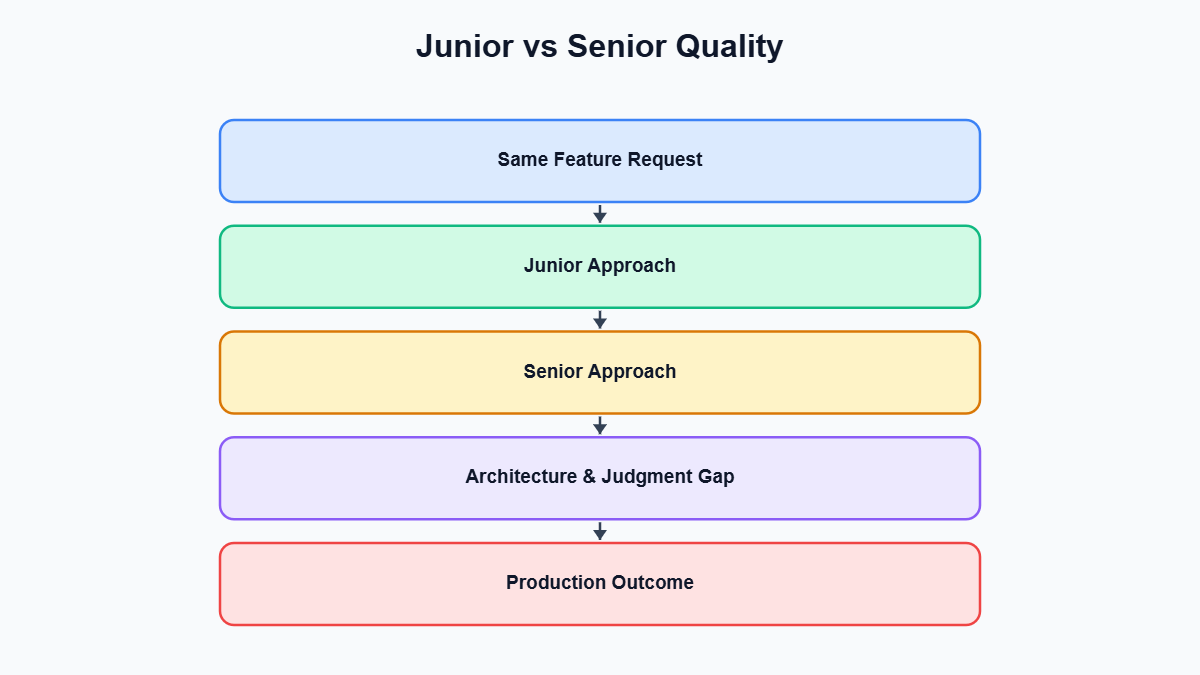 Years of experience is a weak proxy for seniority. Plenty of people write five years of the same first year, repeated five times, because they never worked somewhere that forced them to confront the consequences of their own decisions. Real seniority comes from exposure to consequences — shipping something, watching it break in production, getting paged because of it, and fixing it under pressure while real users are affected. Repeated across enough failure modes, that loop builds instinct.
Concretely, a senior full stack developer has usually internalized, often without being able to fully explain why:
- What happens to a system under concurrent access, not just single-user testing — race conditions, double-submits, stale reads.
- Which failures are silent (data quietly wrong) versus loud (a visible exception), and why silent failures are more dangerous.
- How a schema decision made in week one constrains what’s possible in month eight.
- Where the real cost of a feature lives — usually in the edge cases and operational tooling, not the happy path.
- When to say “this will take longer than you want, and here’s why” instead of quietly cutting corners.
None of this shows up on a resume that says “5 years experience.” It shows up in code, in the questions someone asks before writing it, and in what they choose not to build. That’s the real substance behind the junior vs senior full stack developer distinction — a difference in what each person has already seen go wrong.
The Code Quality Gap: A Real Before/After Example
For a deeper look at what strong review culture actually catches, see Google’s own engineering code review guidelines and Martin Fowler’s writing on technical debt — both explain why senior judgment compounds over a codebase’s lifetime.
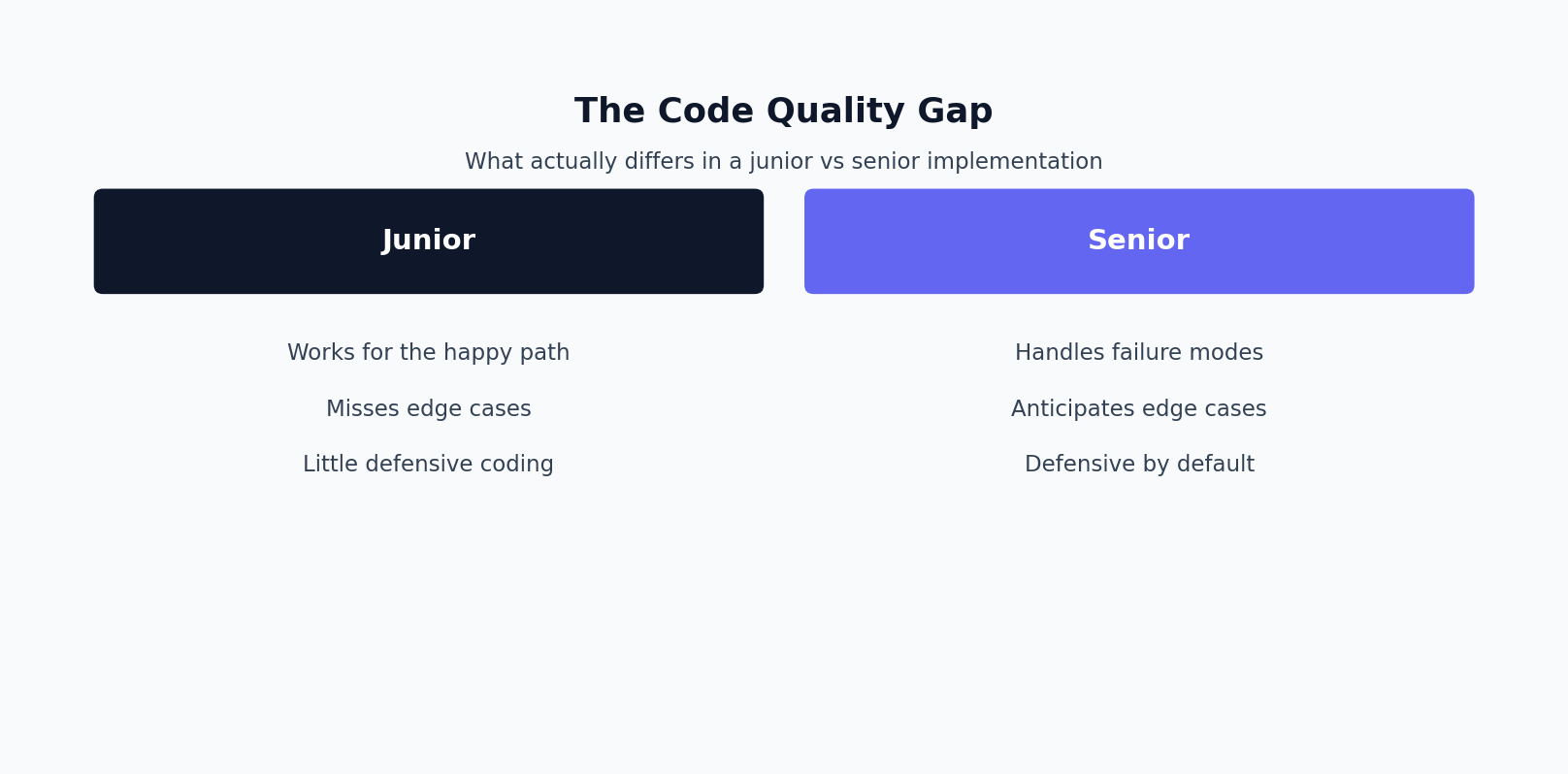
Abstract claims about “code quality” are hard to verify, so consider an endpoint that exists in almost every SaaS product: creating an order tied to a user account. It touches validation, database writes, error handling, and side effects all at once, which makes it a good test case. Here’s a version a competent junior developer might genuinely write — it passes the happy path and works fine in the demo.
// POST /orders
app.post('/orders', async (req, res) => {
  const { userId, items, couponCode } = req.body;

  const user = await db.query('SELECT * FROM users WHERE id = ' + userId);
  const total = items.reduce((sum, item) => sum + item.price * item.qty, 0);

  let discount = 0;
  if (couponCode) {
    const coupon = await db.query(
      \`SELECT * FROM coupons WHERE code = '\${couponCode}'\`
    );
    discount = coupon[0].amount;
  }

  const order = await db.query(
    \`INSERT INTO orders (user_id, total, discount) VALUES (\${userId}, \${total}, \${discount})\`
  );

  await sendConfirmationEmail(user[0].email, order);

  res.json({ success: true, orderId: order.insertId });
});
To someone who hasn’t been burned yet, this looks reasonable. To a senior developer, it’s a list of production incidents waiting for a trigger:
- SQL injection. String-concatenated queries with
userIdandcouponCodeare a direct injection vector. - No input validation. Nothing checks that
itemsis a non-empty array, that quantities and prices are positive, or thatuserIdrefers to a real user. - Unhandled null case. If the coupon doesn’t exist,
coupon[0]isundefined, and.amountthrows or silently producesNaN. - Trusting client-supplied prices. Prices come straight from
req.body— nothing recalculates them from the product catalog. - No transaction. The order and related rows aren’t atomic, so a crash mid-request leaves inconsistent data.
- Side effect coupled to the request cycle. A slow email provider hangs or fails the whole request even though the order already exists.
- No logging or error context. When this breaks at 3 a.m., there’s no request ID, no structured log, no way to reproduce it.
- Not testable in isolation. Database calls, email, and business logic are tangled together, so nothing can be unit tested without a real database.
Here’s closer to what a senior developer ships for the same feature. It’s longer, and that length is the point — the extra lines are the actual engineering, not decoration.
// orderService.js — pure, testable business logic
function calculateOrderTotal(items, coupon) {
  if (!Array.isArray(items) || items.length === 0) {
    throw new ValidationError('Order must contain at least one item');
  }

  const subtotal = items.reduce((sum, item) => {
    if (item.qty <= 0 || item.unitPrice < 0) {
      throw new ValidationError(\`Invalid item: \${item.sku}\`);
    }
    return sum + item.unitPrice * item.qty;
  }, 0);

  const discount = coupon ? Math.min(coupon.amount, subtotal) : 0;
  return { subtotal, discount, total: subtotal - discount };
}

module.exports = { calculateOrderTotal };

// routes/orders.js — HTTP layer, thin and defensive
app.post('/orders', authenticate, async (req, res, next) => {
  const requestId = req.id;
  try {
    const { items, couponCode } = validateOrderPayload(req.body);
    const userId = req.user.id; // from auth middleware, never from body

    const catalogItems = await productCatalog.priceItems(items);
    const coupon = couponCode
      ? await couponRepository.findActiveByCode(couponCode)
      : null;

    if (couponCode && !coupon) {
      throw new ValidationError('Coupon code is invalid or expired');
    }

    const { subtotal, discount, total } = calculateOrderTotal(catalogItems, coupon);

    const order = await db.transaction(async (trx) => {
      const created = await orderRepository.create(
        { userId, subtotal, discount, total, items: catalogItems }, trx
      );
      await inventoryRepository.decrementStock(catalogItems, trx);
      return created;
    });

    await emailQueue.enqueue('order-confirmation', { orderId: order.id });
    logger.info('order.created', { requestId, orderId: order.id, userId });
    res.status(201).json({ orderId: order.id, total });
  } catch (err) {
    if (err instanceof ValidationError) {
      logger.warn('order.validation_failed', { requestId, message: err.message });
      return res.status(422).json({ error: err.message });
    }
    logger.error('order.create_failed', { requestId, error: err.message });
    return next(err);
  }
});
Notice what actually changed — nothing cosmetic, no renaming for its own sake. Every addition closes a specific hole: parameterized queries instead of concatenation, server-side price recalculation instead of trusting the client, a transaction so partial failures can’t corrupt data, a queue instead of a blocking call for email, structured logs with a request ID, and a pure function for the total calculation that can be unit tested with a dozen edge cases in milliseconds — no database required. The original tangled version can only be tested by mocking half the application.
If you’re staffing a real project and weighing Junior vs Senior Full Stack Developer tradeoffs, our senior full stack developer service page covers exactly how we scope that decision.
Architecture Decisions Juniors Don’t Know to Make
Code-level quality is the visible layer, but the more expensive gap sits upstream, before implementation starts. A junior developer usually optimizes for “does this satisfy the ticket.” A senior developer is simultaneously asking questions the ticket never mentioned:
- What’s the actual access pattern? Does this need to support fifty records or five million? That answer determines whether a simple query is fine or an index and pagination are required from day one.
- What changes later, and what should be decoupled now? Payments, email, and file generation are natural boundaries because they’re slow or unreliable — seniors default to a queue or service boundary around them; juniors call them inline because it’s simpler in the moment, and unwinding that later is expensive.
- Where does state live, and who owns it? Duplicating state across client and server is the fastest way to ship one feature and the root cause of most “works on my screen, not theirs” bugs.
- What’s reversible and what isn’t? A migration that drops a column or a chosen primary key strategy is expensive to undo. Seniors spend disproportionate care there and move fast everywhere else; juniors often apply the same care everywhere, or move fastest exactly where they shouldn’t.
- How does this fail, not just how does it succeed? Every third-party integration has outages and rate limits. Seniors design for that up front — retries, idempotency keys, dead-letter queues — while a first junior pass usually assumes the external service always responds correctly.
None of this is about raw intelligence. It’s pattern recognition built from watching a poorly chosen schema turn a two-day feature into a two-week migration, or being on call when an un-queued third-party call took down checkout. A junior developer hasn’t accumulated that scar tissue yet, and reading about it doesn’t substitute for living through it once.
Code Review Quality: What Gets Caught, What Doesn’t
Before going further, it helps to restate the core Junior vs Senior Full Stack Developer principle discussed above — the right Junior vs Senior Full Stack Developer approach depends on the specifics of your team and codebase, not a one-size-fits-all rule.
Code review quality differs enormously by seniority, and it compounds over a project’s life. A junior reviewer tends to focus on what’s easy to see — naming, formatting, whether tests pass, whether the diff matches the ticket. Those things matter, but a linter or an AI review tool now catches most of them automatically.
A senior reviewer is looking at a different layer:
- Does this introduce a race condition under concurrent requests?
- Does the transaction boundary actually cover everything that needs to be atomic?
- Will this migration lock a large production table, or break backward compatibility mid-deploy?
- Could a subtly wrong authorization check leak data across tenants?
- Is an error being swallowed somewhere, hiding a real failure behind a fake success response?
- Does this quietly add database round-trips per request in a way that won’t show up until real load?
These bugs don’t show up in a demo or a coverage percentage — they show up under real concurrent traffic, often after launch. A team of only junior developers reviewing each other’s code will catch the surface issues and miss most of this list, not from carelessness but because you can’t catch a category of bug you don’t yet know to look for. This is why one senior developer embedded in a team, even part-time, has an outsized effect on overall quality: they catch the expensive bugs before they ship, not after.
Cost is where the Junior vs Senior Full Stack Developer debate gets concrete fastest — a lower Junior vs Senior Full Stack Developer rate today can mean a much higher bill once rework is counted.
How This Affects Cost, Timeline, and Risk
The financial case isn’t as simple as comparing hourly rates. It’s worth being honest about both directions of the trade-off. A junior developer’s lower rate is real, and it’s the correct choice in plenty of situations covered below. But total cost isn’t just the hours spent writing a feature. It’s those hours, plus the hours spent later finding and fixing what was missed. It’s also the cost of the gap between “looks done” and “actually production-ready.” Code shipped without adequate error handling tends to surface its problems at the worst possible time: after launch, under real traffic. Fixing it retroactively is nearly always more expensive than building it right the first time. By then, there’s live data to migrate and a production system you can’t afford to break.
Timeline risk follows the same pattern. Senior estimates tend to be more reliable. They already account for the parts a junior developer doesn’t yet know to plan for: edge cases, migrations, rollback plans. A junior estimate is often, in effect, an estimate of the happy path only. The unplanned work then shows up mid-sprint as “unexpected” delay. That kind of surprise disrupts a schedule far more than the same work would if it had been planned for up front.
Risk concentration is the factor founders underweight most. A junior developer working unsupervised on a core data model or auth flow is making irreversible decisions without the experience to recognize them as irreversible. The fix isn’t necessarily “always hire senior” — it’s matching autonomy to experience, and making sure the highest-risk parts of a system get senior eyes even when day-to-day feature work doesn’t.
When a Junior Developer Is Actually the Right Choice
This is another place where Junior vs Senior Full Stack Developer decisions compound — getting Junior vs Senior Full Stack Developer right here saves rework later.
It would be dishonest to frame this as “always hire senior” — that wastes money in situations where it doesn’t apply. Junior developers are the better choice in several common scenarios:
- Well-scoped work under senior supervision. If a senior has already made the architectural decisions and reviews pull requests, a junior implementing clear tickets is efficient and a great way for them to grow.
- Low-risk, easily reversible work. Internal tooling, admin dashboards, and throwaway prototypes don’t need the rigor of a production payment flow.
- High volume of routine tasks. Bug fixes in well-understood code, small UI changes, writing tests for existing code — a junior’s time is well spent here and a senior’s is wasted.
- Tight budget and tolerable risk. Early-stage idea validation, where the code will likely be rewritten once product-market fit is found, doesn’t need production-grade rigor yet.
- Team growth is a stated goal. Hiring juniors and investing in mentorship is a legitimate long-term strategy — just not a shortcut for immediate execution speed on a tight deadline.
The mistake isn’t hiring junior. It’s putting a junior unsupervised on the parts of the system where a subtle mistake is expensive and hard to reverse.
Junior vs Senior Full Stack Developer: A Side-by-Side Comparison
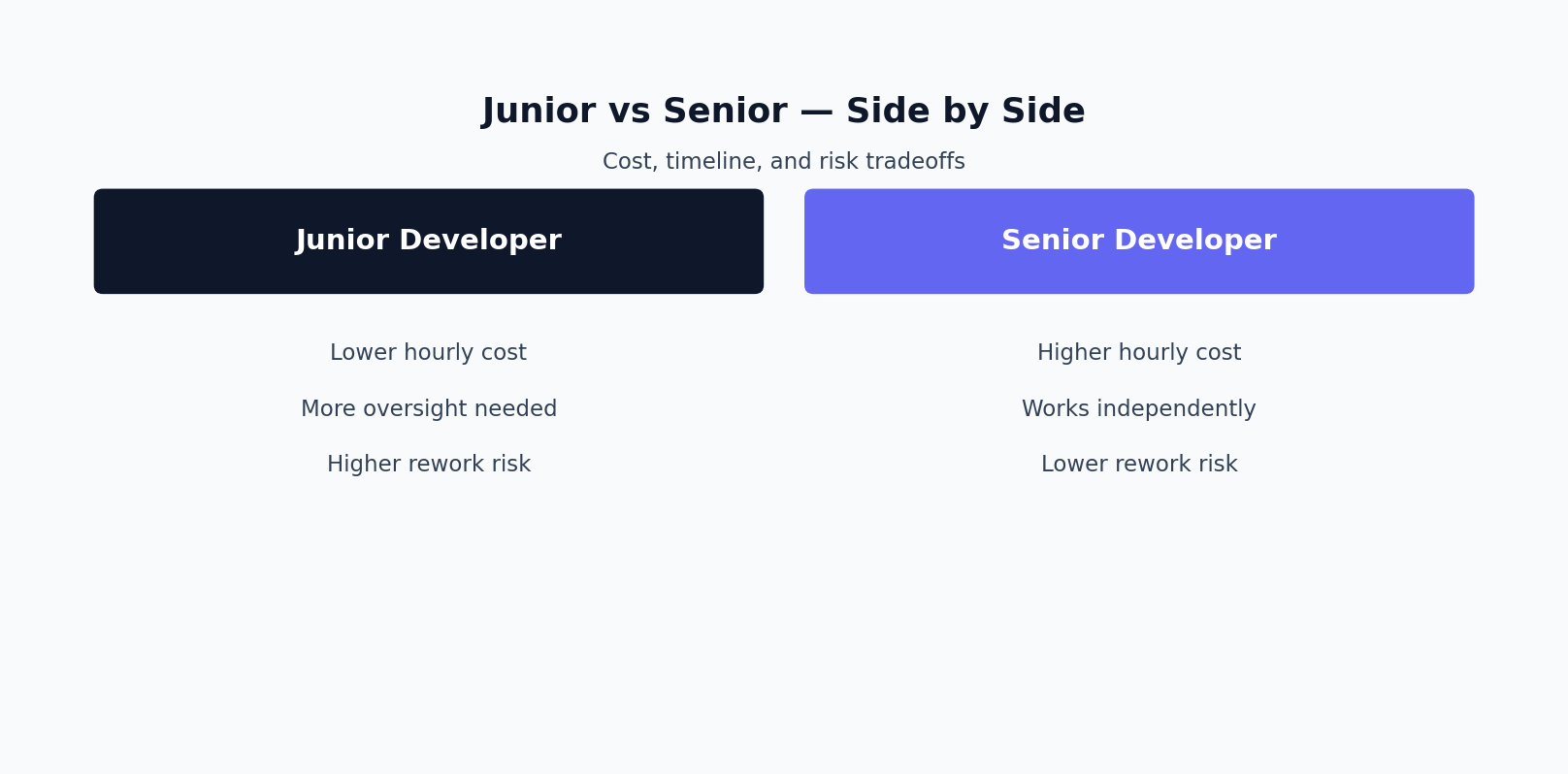
The table below summarizes the practical differences across the dimensions that matter most when staffing a real project.
| Dimension | Junior Full Stack Developer | Senior Full Stack Developer |
|---|---|---|
| Code review need | Every pull request needs review, ideally line by line | Can review their own and others’ work; benefits from peer review but doesn’t require it to ship safely |
| Estimation accuracy | Often underestimates by omitting edge cases and error handling | Estimates already include the “invisible” work, so they’re closer to actual delivery time |
| Unsupervised scope | Best limited to well-defined tickets in low-risk areas | Can own ambiguous requirements and core system design without direct oversight |
| Error handling instinct | Handles the happy path; errors added after a bug report | Designs for failure modes up front — outages, race conditions, malformed input |
| Architecture involvement | Implements within a structure someone else defined | Defines the structure — data model, service boundaries, scaling strategy |
| Security awareness | Learns vulnerabilities case by case, often after review catches one | Defaults to secure patterns without being told |
| Debugging production issues | Needs logs and reproduction steps to make progress | Navigates unfamiliar code under pressure and isolates root cause efficiently |
| Stakeholder communication | Reports status on assigned tasks | Surfaces risk and trade-offs proactively, including pushing back on unrealistic scope |
| Cost per hour | Lower | Higher |
| Total cost on complex work | Often higher once rework and incidents are counted | Often lower despite the higher rate, because less gets rebuilt later |
A Practical Decision Framework for Hiring
To recap the Junior vs Senior Full Stack Developer guidance so far: consistency matters as much as any single technical choice when it comes to Junior vs Senior Full Stack Developer.
Rather than treating this as a binary brand choice, break it into a few concrete questions before posting a job or picking a freelancer:
- What’s the blast radius if this code has a bug? A wrong color on an internal dashboard tolerates risk. A double-charged payment or a data leak across accounts doesn’t — and low tolerance should pull in senior involvement, even just for that piece.
- Is there anyone available to review the work? A junior without senior oversight is effectively unsupervised in production. If no one on the team can review at the depth described above, fill that gap — hire senior directly, or bring one in part-time for architecture and review.
- How reversible are the early decisions? Schema design, auth architecture, and the core data model are expensive to redo. These pieces benefit disproportionately from senior involvement even on an otherwise junior-staffed project.
- What’s the real timeline pressure? If the deadline is firm and slipping it is costly, a senior’s more accurate estimates and fewer surprise delays are often worth the rate difference on their own.
- Is this a growth investment or a delivery requirement? Junior hires with mentorship make sense as a strategic investment. If the goal is simply “ship this correctly, on time,” that calculation usually favors senior talent for the core of the work.
In practice, the most cost-effective structure for many small and mid-sized projects isn’t “all junior” or “all senior” — it’s a senior developer owning architecture, the highest-risk components, and code review, with junior or mid-level developers implementing well-scoped pieces underneath. That combination gets close to senior-level quality across the whole codebase while keeping the blended cost lower than an all-senior team.
Making the Call for Your Project
In short, Junior vs Senior Full Stack Developer is not a checkbox you tick once — revisit this Junior vs Senior Full Stack Developer guidance whenever your team or scope changes materially.
The junior vs senior full stack developer question isn’t really about credentials or years on a resume — it’s about which parts of your project can tolerate a mistake and which can’t, and who’s available to catch problems before they reach production. Junior developers can absolutely produce good work, and they’re often the right economic choice for well-scoped, well-supervised, low-risk tasks. But once a project involves real user data, payment flows, authentication, or architecture decisions that are expensive to reverse, the judgment a senior developer brings — the instinct for what fails, what needs a transaction, what needs a queue, what needs a second look before it ships — tends to pay for itself many times over in avoided rework and avoided incidents.
If you’re weighing this decision for a real project and want a second opinion on scope, architecture, or where the risk actually sits, that’s worth discussing before any code gets written. Faisal Nadeem works with founders and teams on full stack projects where getting the foundation right matters — reach out through the “Hire a Senior Full Stack Developer” service page to talk through what your project actually needs before committing to a staffing decision.
Frequently Asked Questions
Why do teams that hire a junior developer often end up re-hiring a senior one later?
Not because of talent or effort, but because of judgment. A senior developer makes hundreds of small decisions automatically, often before a problem becomes visible, while a junior developer doesn’t yet know those decisions exist to make. The code both produce might look similar at first glance, but the gap shows up once the product needs to scale or survive contact with real users.
What does “senior” actually mean if it’s not just years of experience?
Real seniority comes from exposure to consequences: shipping something, watching it break in production, getting paged because of it, and fixing it under pressure while real users are affected. Someone can have five years of experience that’s really one year repeated five times if they never worked somewhere that forced them to confront the results of their own decisions.
What architecture decisions do juniors typically not know to make?
Things like anticipating how a data model will need to evolve, choosing boundaries between services or modules that won’t require a rewrite later, and recognizing when a “simple” feature request has a hidden scaling or security implication. These are decisions senior developers make by pattern-matching against past failures, which juniors haven’t accumulated yet.
Is a junior full stack developer ever the right choice?
Yes, for well-scoped, low-risk work with senior oversight available, such as building out features against an already-established architecture, or for teams that have the bandwidth to mentor and review closely. The risk goes up sharply when a junior is making unsupervised architecture decisions on a project with real production stakes.
How does the junior vs senior gap affect project cost and timeline?
A junior developer’s lower hourly rate can be offset, or exceeded, by rework costs when architecture mistakes surface later, plus the time a senior developer spends reviewing and fixing that work. The real cost comparison isn’t hourly rate versus hourly rate, it’s total cost including the cleanup that under-scoped junior work often requires.
What gets caught in code review with a senior developer that gets missed with a junior one?
Senior reviewers catch issues like race conditions, missing edge cases, and architectural decisions that will cause pain later, because they’ve seen those failure modes before. Junior-to-junior review tends to focus on style and obvious bugs, missing the subtler problems that only show up under production load or edge-case input.
