Every growing product eventually runs into the same staffing question. Do you hire one person who can carry a feature from database schema to pixel-perfect UI? Or do you split the work between a frontend specialist and a backend specialist who each go deeper into their half of the stack? The Full Stack Developer vs Specialist decision sounds like a hiring detail. In practice, it’s a decision about how your product gets built, how fast it moves, and how much friction your team absorbs along the way. Founders and CTOs tend to treat it as a budget line item. But it actually shapes communication patterns, code ownership, and even how bugs get triaged six months from now. There is no universally correct answer. The right model depends on where your product sits in its lifecycle, how complex your frontend and backend problems actually are, and how much coordination overhead your organization can tolerate. This post walks through what changes structurally when you choose one model over the other. It covers why the right answer shifts as a product matures, what the cost and hiring tradeoffs really look like, which hybrid arrangements tend to work in the real world, and how to diagnose which path fits your situation before you commit budget and months of runway to it.
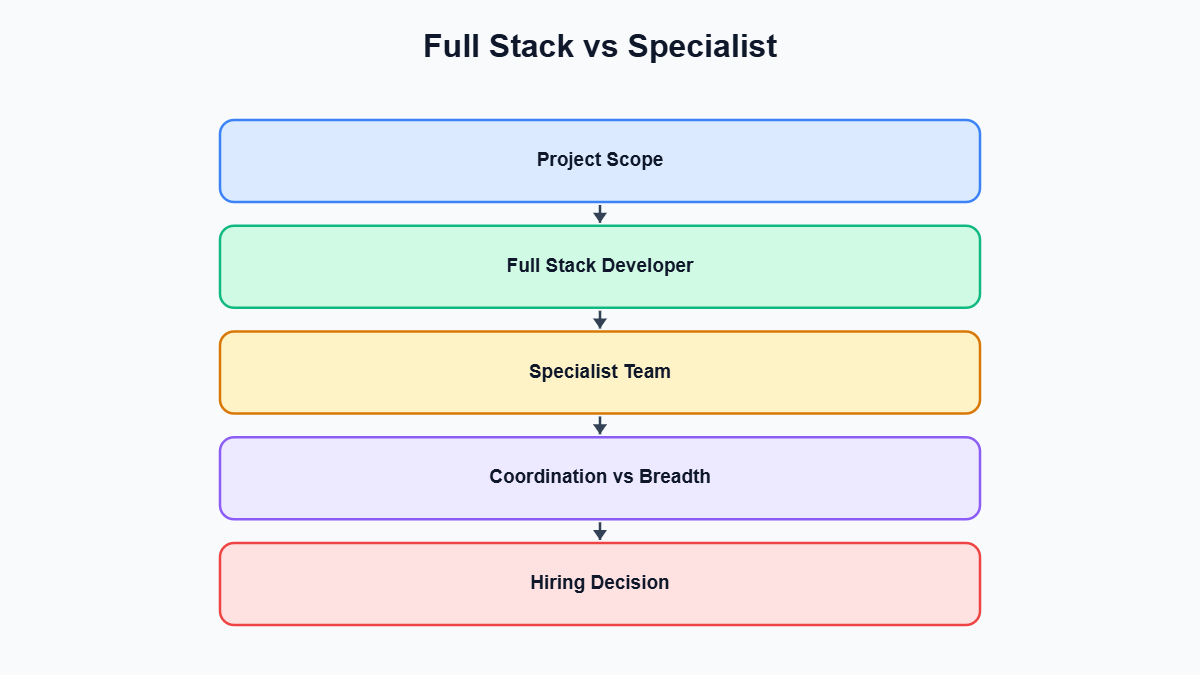
What Actually Changes in Team Structure and Communication Overhead
The most immediate difference between a single full stack developer and a split frontend/backend team is not skill depth, it is the number of communication paths a feature has to travel through before it ships. When one developer owns a vertical slice of a feature, end to end, there is no handoff. They design the API, write the endpoint, wire up the UI, and test the whole path themselves. Decisions that would otherwise require a meeting, a shared document, or a Slack thread simply happen inside one person’s head. That collapses a huge amount of latency out of the development cycle, especially for small, fast-moving teams where every day counts.
A specialist team introduces a seam. The frontend developer needs the backend developer to define and often build the API contract before UI work can really finish, and the backend developer needs to understand what shape of data the frontend actually needs, which means requirements have to be written down, agreed upon, and occasionally renegotiated mid-sprint when reality does not match the original plan. This is not automatically a bad thing. A clear contract between frontend and backend can force better API design, more explicit thinking about edge cases, and cleaner separation of concerns than a single generalist juggling both layers might produce under time pressure. But it comes at a cost: more meetings, more documentation, more waiting on someone else’s pull request before your own work can be considered done.
There is also a quieter structural effect worth naming: code review and on-call coverage. A single full stack developer is a single point of failure for whatever they own, but they also carry full context, so debugging a production issue rarely requires paging a second person to understand what a component upstream or downstream is doing. In a specialist setup, an incident that spans both layers, say, a slow query surfacing as a frontend timeout, requires two people with different mental models to sync up before the root cause is even framed correctly. That is a real cost, and it scales with the number of specialists involved.
The Project-Stage Argument: MVPs Favor Generalists, Scale Favors Specialists
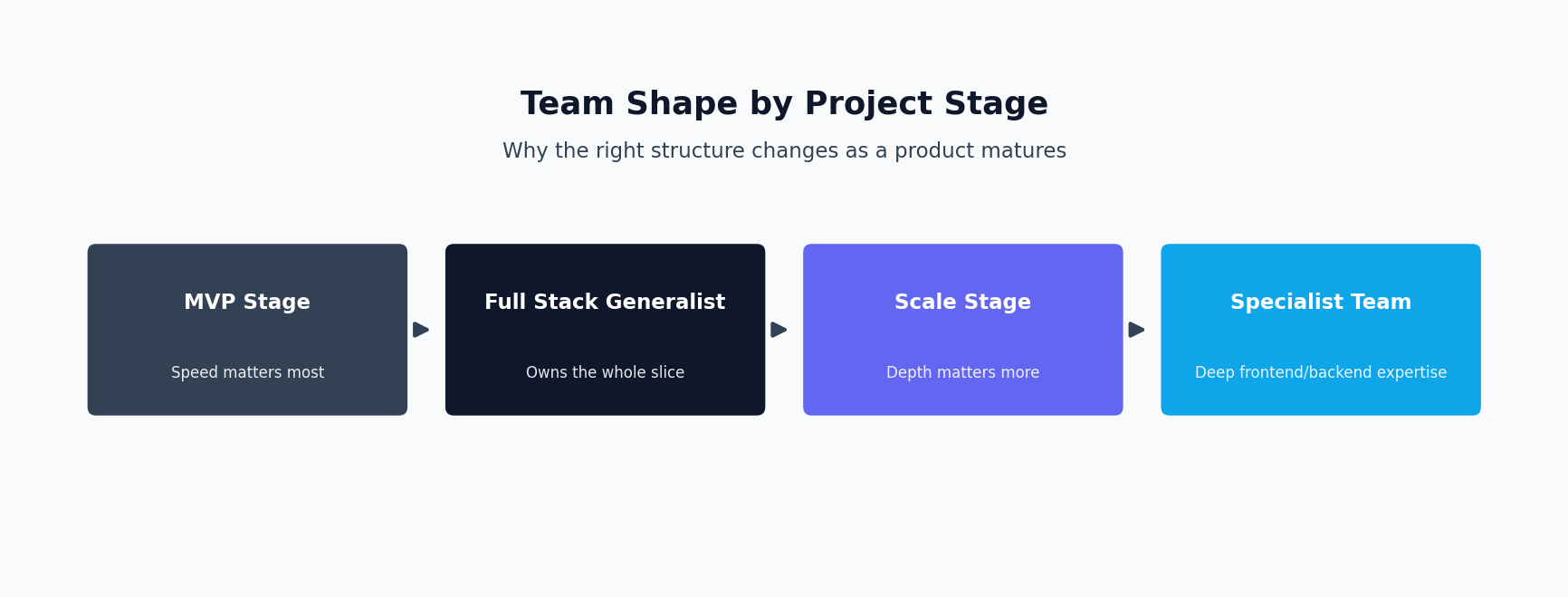
Project stage is probably the single strongest predictor of which model will serve you better, more so than team size or even budget. In the earliest phase of a product, when you are still validating whether anyone wants what you are building, the dominant cost is not code quality, it is speed of iteration and the cost of coordination itself. A founder testing a new idea does not yet know which features will survive contact with real users, and every day spent synchronizing two specialists on a contract for a feature that might get thrown away next week is a day not spent learning something. This is exactly the environment where a full stack developer earns their keep: one person, one Slack channel, one person who can pivot a feature’s data model and UI simultaneously without waiting on anyone else’s availability.
The vertical-slice ownership model also matters more than people give it credit for at this stage. When a single developer owns the whole feature, they can make small tradeoffs across the frontend/backend boundary that a split team would need a conversation to agree on, denormalizing a bit of data to avoid an extra network round trip, for instance, or shaping an API response around exactly what one screen needs rather than something generically reusable. Those micro-optimizations rarely matter for correctness, but they compound into meaningfully faster shipping velocity when you are trying to get to a defensible MVP before runway runs out.
As a product moves past validation and starts absorbing real usage, the calculus shifts, sometimes quite sharply. Two kinds of complexity tend to appear, often around the same time. On the frontend, state management complexity grows as the product accumulates more interactive surfaces, real-time updates, and edge cases around optimistic UI, offline behavior, and accessibility, the kind of work that genuinely benefits from someone who lives and breathes frontend architecture rather than someone context-switching between layers. On the backend, throughput and reliability concerns start to dominate: query performance under real load, caching strategy, queueing and background job design, and security hardening that a generalist can learn but a backend specialist has usually already encountered before. This is the point where a full stack developer’s breadth, an asset during the MVP phase, starts to look more like a ceiling. Not because the person is unskilled, but because true depth in high-scale backend systems or intricate frontend state management usually requires a level of specialization that is hard to sustain while also owning the other half of the stack.
It is worth being honest that this transition is rarely a single clean cutover. Most products live in a messy middle for a while, where some parts of the system have genuinely outgrown generalist ownership while others are still simple enough that splitting them across two specialists would be overkill. Recognizing which parts of your system have crossed that threshold, rather than making a single binary decision for the whole team, is often the more sophisticated move.
Cost and Hiring-Market Tradeoffs
The financial comparison between these two models is not just about total compensation, though that is part of it, it is about what you are buying with that spend. A full stack developer is a single hire and a single cost center. You interview one person, onboard one person, and manage one person’s ramp-up curve. In aggregate, a specialist team, one frontend hire plus one backend hire, will typically cost more than a single full stack hire, simply because you are paying for two salaries, two sets of benefits, and two people’s worth of management overhead instead of one. For an early-stage company watching runway closely, that arithmetic alone can be decisive.
But the comparison is incomplete if it stops at headcount cost. A full stack developer, by definition, is spreading their expertise across a wider surface area, which usually means they are not as deep in frontend architecture as a dedicated frontend specialist, and not as deep in backend systems design as a dedicated backend specialist. For a lot of products, especially in the early and middle stages, that tradeoff is entirely acceptable, the depth a specialist would bring simply is not needed yet. But for a product where either layer has genuine complexity, undervaluing that depth gap can be more expensive in the long run than the salary difference would suggest, because the cost shows up later as rework, performance problems, or a rebuild.
The hiring market itself adds another layer to this tradeoff. Specialist roles, particularly senior backend engineers with experience in high-throughput systems or frontend engineers with deep expertise in complex state management, tend to have narrower candidate pools and longer time-to-hire, especially if you are being selective about seniority. Hiring two specialists well, rather than just filling two seats, is a longer and more demanding search than hiring one strong full stack developer, and that time cost is easy to underestimate when planning a roadmap around when features will actually ship. There is also a coordination cost that persists well after hiring is done: two specialists need to be managed as a functioning pair, which means either a technical lead who can speak both languages, or a process overhead a single full stack hire does not require. None of this means specialists are a bad investment, it means the true cost of a specialist team includes hiring friction and ongoing coordination, not just two salaries.
Hybrid Models That Actually Work in Practice
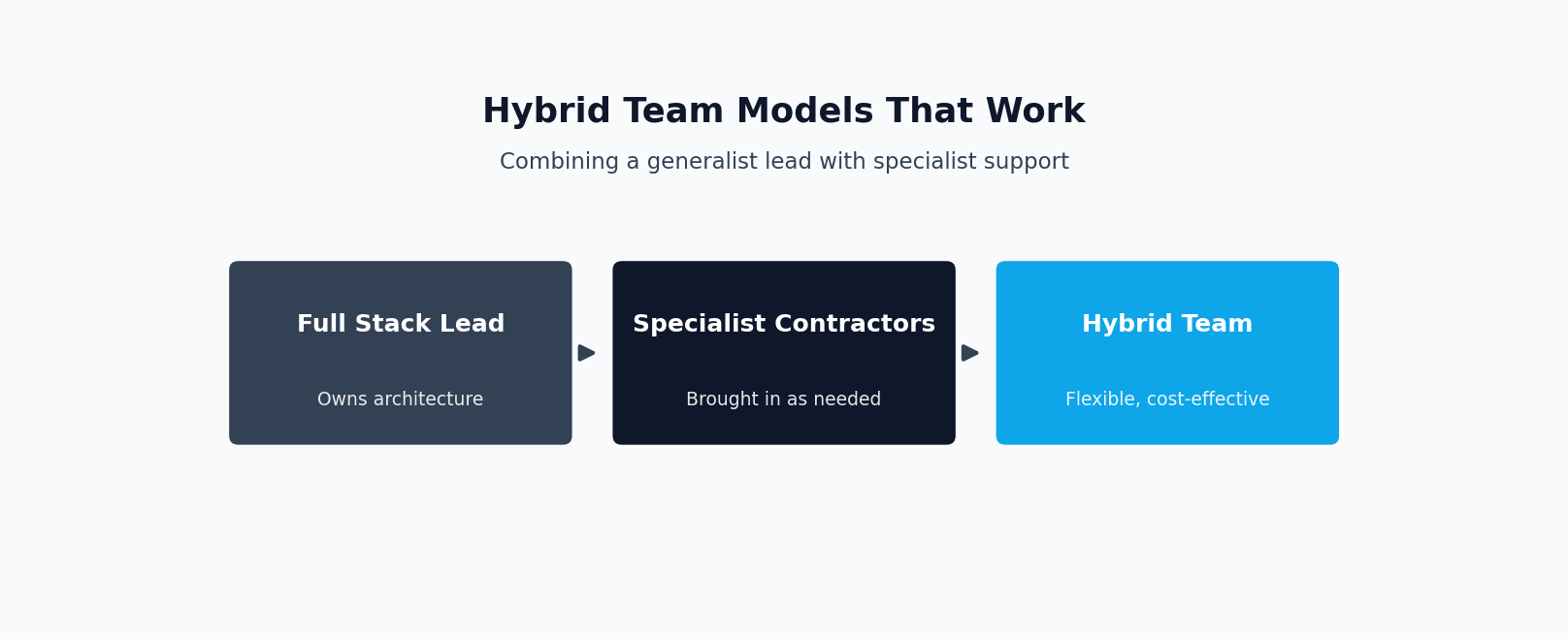
In practice, most successful teams do not pick one model and stay there forever, they blend the two in ways that capture the speed of generalist ownership without giving up access to real depth when it is needed. One pattern that works well is treating a full stack developer as the connective tissue of the team, the person who owns most of the day-to-day build across the stack, while bringing in a specialist for a specific, well-scoped deep problem. A backend specialist might be brought in for a few weeks to design a caching and queueing strategy for a system that is about to hit real scale, or a frontend specialist might be brought in to solve a genuinely hard state management or performance problem in a complex dashboard, while the full stack developer continues to own everything else and absorbs the specialist’s work back into the broader codebase once it is handed off.
A closely related pattern is using a full stack developer for the majority of the build and contracting a frontend or backend specialist for a clearly defined scope of work rather than an open-ended engagement. This works especially well when the scope is genuinely bounded, a payments integration that needs backend security expertise, a marketing site redesign that benefits from frontend polish and animation work, a data pipeline that needs to be re-architected for higher volume. Because the engagement has a defined start and end, the coordination overhead is contained to that window rather than becoming a permanent tax on every future feature.
What makes these hybrid arrangements work is usually less about the org chart and more about clarity of ownership. The teams that struggle with hybrid models are the ones where it is unclear who owns a decision when the full stack developer and the specialist disagree, or where the specialist’s contracted scope quietly expands until they are, in effect, a second full-time hire without anyone having decided that deliberately. The teams that succeed treat the specialist engagement as a project with a beginning and an end, with the full stack developer or a technical lead responsible for integrating the specialist’s work back into the main codebase so that institutional knowledge does not walk out the door when the contract ends. Documentation and code review at the handoff point matter more in this model than in almost any other, precisely because the specialist will not be there indefinitely to answer questions about the decisions they made.
Signals and Questions to Decide Which Model Fits Your Project
Rather than defaulting to whichever model is more familiar or more fashionable, it is worth running through a short set of honest questions before committing to a hiring plan. The answers, taken together, usually point fairly clearly toward one model or the other.
Full Stack Developer vs Specialist: The Questions That Actually Matter
Start with team size and stage. If you have a small team, a limited budget, and a product that has not yet found strong signal with real users, a full stack developer is very likely the right call, the priority right now is iteration speed and low coordination overhead, not depth in any one layer. If you already have a team of five or more engineers and a product with established usage, the calculus starts to shift, and it becomes worth asking the next set of questions more seriously.
Next, look honestly at expected traffic and scale. If your backend is handling a modest, predictable load and your data model is straightforward, a full stack developer can carry that layer comfortably for a long time. If you are anticipating, or already experiencing, high-throughput demands, complex data consistency requirements, or systems that need to scale horizontally under unpredictable load, that is a strong signal that backend depth is worth paying for specifically.
Then assess frontend UX complexity on its own terms. A handful of CRUD screens and standard forms do not require a dedicated frontend specialist. A product built around real-time collaboration, complex client-side state, heavy data visualization, or an interface that needs to feel exceptional rather than merely functional is a different story, and that kind of polish is usually where generalist breadth starts to show its limits.
Ask the same question about backend domain complexity. Is the business logic relatively simple, mostly standard authentication, CRUD operations, and third-party integrations, or does it involve genuinely intricate domain rules, financial calculations, complex permissioning, or data pipelines that need to be correct under edge cases most engineers will not have encountered before? The more intricate the domain logic, the more a specialist’s accumulated pattern recognition starts to pay for itself.
Finally, be honest about budget and timeline constraints, not as an afterthought but as a real input to the decision. If you need to ship an MVP in a matter of weeks with a constrained budget, the hiring time and coordination cost of a specialist team can quietly eat the runway you were trying to protect. If you have a longer runway and a product with genuine long-term scale ambitions, front-loading some specialist depth, even in the hybrid form described above, can prevent expensive rework later. Very few teams need to answer all five of these questions the same way, and that is exactly why blended models exist.
The Risk of Getting This Decision Wrong in Either Direction
It is worth being direct about the fact that this decision carries real risk on both sides, not just one. Hiring a full stack generalist for a problem that genuinely needed deep specialist expertise tends to produce systems that work under demo conditions but crack under real-world pressure. A backend built by someone without deep systems experience can look perfectly fine until traffic doubles and the query patterns that were fine at low volume start timing out, or a caching strategy that was never really designed as a strategy starts causing subtle data inconsistency bugs that are hard to trace. On the frontend side, an interface built without deep state management expertise can accumulate tangled component state, inconsistent data flow, and performance issues that get progressively harder to unwind as more features are layered on top. The failure mode here is not a dramatic outage, it is a slow accumulation of under-engineered decisions that eventually requires a costly rebuild, often right when the product is gaining traction and can least afford the disruption.
The opposite mistake is just as real and, in early-stage companies, arguably more common: hiring separate frontend and backend specialists for a project that is still simple enough to be handled comfortably by one generalist. The symptom here is not a broken system, it is a slow one. Every feature requires a contract negotiation between two people before it can start, every ambiguity in requirements turns into a back-and-forth instead of a single judgment call, and the specialists themselves, hired for depth, often end up spending a meaningful share of their time on coordination rather than the deep work they were brought in to do. Budget gets consumed by two salaries and the overhead of keeping two specialists aligned, while the product is not yet complex enough to need that depth in the first place. This mismatch is especially damaging for startups, where the core competitive advantage is speed, not architectural purity, and where a product over-engineered for a scale it has not reached yet is really just a slower, more expensive MVP.
The practical takeaway is that this decision deserves to be revisited periodically rather than made once and forgotten. A model that was correct at ten users can become wrong at ten thousand, and a specialist team assembled for an ambitious scale target can become unnecessary overhead if the product pivots toward something simpler. Treating team structure as something to reassess at each major stage, rather than a permanent org chart decision, is the single best protection against both failure modes described above.
For teams trying to strike this balance without overcommitting too early, one effective starting point is to bring on a strong generalist who can own the full vertical slice of the product while you learn what your real scale and complexity requirements are, and only add specialist depth once those requirements are concrete rather than hypothetical. If you are at that stage, it is worth exploring options to hire a senior full stack developer who can carry your product through its early build phase while leaving room to bring in specialists later, once the shape of your scale and complexity problems is actually known. Team structure is not a fashion choice, it is an engineering decision like any other, and it deserves the same evidence-based thinking you would apply to choosing a database or a hosting provider. For a broader look at how skill breadth versus depth plays out across engineering careers, the concept of the T-shaped skills model is a useful frame for how individual engineers, not just teams, balance generalist range against specialist depth over a career.
Frequently Asked Questions
Is hiring a full stack developer instead of a specialist team just a budget decision?
No. It’s a decision about communication patterns, code ownership, and how bugs get triaged months later, not just headcount cost. Founders often treat it as a line item, but it structurally changes how the product gets built and how fast the team can move.
Should an MVP be built with a full stack developer or a specialist team?
Generally a full stack developer, or a small number of them, fits MVP-stage work better because early-stage products need speed and low coordination overhead more than deep expertise in any one layer. Specialist teams tend to pay off once the product has scaled and the frontend or backend problems have become complex enough to need dedicated depth.
What are hybrid staffing models that actually work in practice?
Common patterns include a full stack developer handling most feature work with a specialist brought in for a specific hard problem (like a complex data pipeline or a performance-critical UI), or full stack developers early on transitioning to specialist roles as the team and codebase grow. The key is matching the model to actual complexity rather than picking one structure permanently at company founding.
What questions actually help decide between a full stack developer and a specialist team?
How complex is the frontend independently of the backend (and vice versa), how much coordination overhead can the organization tolerate, and where is the product in its lifecycle. The answers to these determine whether generalist speed or specialist depth is the bigger constraint on shipping.
What’s the risk of choosing the wrong model?
Choosing specialists too early adds coordination overhead a small, fast-moving MVP can’t afford, slowing everything down. Sticking with generalists too long after the product has scaled means nobody has the depth to solve increasingly complex frontend or backend problems well, and technical debt accumulates in both directions.
Does a full stack developer produce lower-quality code than a specialist?
Not inherently — code quality depends on the individual’s experience and the complexity of the problem, not the job title. The real tradeoff is depth versus breadth: a specialist goes deeper into one layer’s edge cases, while a full stack developer trades some of that depth for the ability to own a feature end to end without handoffs.
