The AI Agent Ecosystem 2026: An Engineering Map, Not a Market Report
Most content ranking for AI agent ecosystem 2026 right now is written for investors and executives. It’s full of adoption percentages, market-size estimates, and framework popularity charts. That’s a fine starting point, but it doesn’t answer the question an engineering team actually has. The real question is narrower and more useful: given everything shipping right now, what should we actually build? What should we buy or adopt off the shelf? And where are the failure modes that turn a promising agent prototype into a production incident? The Model Context Protocol specification is the emerging standard most of this ecosystem is converging on.
Key Takeaways
- The 2026 agent ecosystem is consolidating around a few durable layers: models, orchestration frameworks, tool-connection protocols (like MCP), and observability/eval tooling.
- Most agent projects that get canceled fail on production concerns, not model quality: unclear tool boundaries, missing human-in-the-loop checkpoints, and no structured logging.
- A practical production pattern is to keep tool definitions narrow, add human approval gates for risky actions, log every step, and roll out changes in stages rather than all at once.
- Protocol standardization (MCP and similar) is what turned “an agent that calls one API” into “an agent that can discover and use many services” without custom glue code for each one.
- Treat this as an engineering map, not a hype-driven trend report: the categories that matter are the ones that affect reliability, cost, and how safely an agent can act on its own.
Table of Contents
This post maps the AI agent ecosystem 2026 landscape from that angle — architecture patterns, protocol standardization, the orchestration frameworks actually seeing adoption, and the specific engineering decisions that separate the agent deployments quietly running in production from the pile of projects getting quietly canceled.
Why the AI Agent Ecosystem 2026 Looks Different From 2024’s Hype Cycle
Two structural things changed that make this year’s version of the agent ecosystem materially different from the chatbot-wrapper wave that preceded it. First, tool use and function calling matured from an experimental feature into a standardized, reliable capability across major model providers, which made multi-step agent workflows practical instead of brittle.
Second, the Model Context Protocol (MCP) gave the ecosystem something it badly lacked before: a common way for an agent to discover and call tools across different services without every integration being bespoke. Resources like the AI Agents Landscape directory now track that shift in real time, and that kind of protocol standardization is exactly the pattern that turned isolated computers into an internet — a connective layer, not a single flashy application.
The result is an ecosystem that looks less like a collection of demo chatbots and more like a genuine software category: orchestration frameworks, a standardized tool-calling protocol, dedicated evaluation and observability tooling, and — increasingly — production incidents and postmortems, which is usually the clearest sign a technology has moved past the hype phase into the “now we have to operate this reliably” phase.
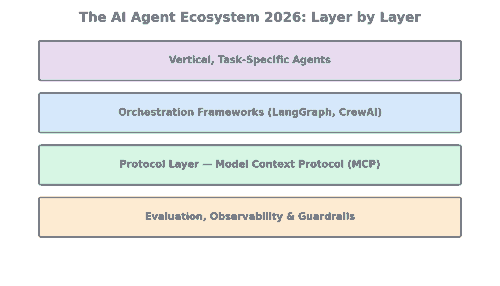
Mapping the AI Agent Ecosystem 2026: The Layers That Matter
Orchestration frameworks
LangGraph, built as a stateful orchestration layer for complex multi-step agent work, has become something close to a default choice for teams building non-trivial agent workflows, with adoption numbers in the tens of millions of downloads. CrewAI has carved out the fastest-growing niche specifically in multi-agent, role-based delegation setups — multiple specialized agents handing work to each other rather than one agent doing everything. Neither has “won” outright; they solve different shapes of problem, and picking between them is a genuine architecture decision, not a coin flip.
The protocol layer: MCP and tool standardization
This is arguably the most consequential layer of the AI agent ecosystem 2026, and the one least covered in market-size-focused content. Before a standard protocol, every agent-to-tool integration was custom code, tightly coupled to one specific model provider’s function-calling format.
MCP decouples that: a tool exposed as an MCP server can be called by any compliant agent framework or assistant, which is the same category of shift that turned proprietary networking protocols into the open web. If you’re building new agent tooling in 2026 without at least evaluating an MCP-native design, you’re very likely rebuilding integration work that the ecosystem has already standardized.
Evaluation, observability, and safety tooling
As agents moved from demos to production, a whole tooling layer grew up around answering “is this agent actually working correctly, and how do we know.” This includes trace-level observability (what tool calls did the agent make and why), automated eval suites that run before every deployment, and guardrail layers that constrain what actions an agent is allowed to take autonomously versus what requires human approval. Teams skipping this layer are, almost without exception, the ones showing up in the “agentic project got canceled” statistics.
Vertical, task-specific agents
Underneath the general-purpose frameworks, a large and fast-growing layer of the AI agent ecosystem 2026 is narrow, task-specific agents built for one job — a customer-support triage agent, a code-review agent, a logistics-scheduling agent. These tend to be far more reliable in production than general-purpose “do anything” agents, precisely because their tool surface and failure modes are small enough to actually test and constrain.
Why a Large Share of Agent Projects Are Getting Canceled
Industry trackers following the AI agent ecosystem 2026 have flagged a consistent pattern: a large share of agentic AI initiatives started in the last two years are being quietly shut down, not because agents don’t work, but because of a specific, repeatable set of engineering and organizational failures.
- No clear ROI measurement from day one. Teams ship an agent, generate enthusiasm in a demo, and never instrument the metric that would tell them whether it’s actually saving time or money once real usage patterns show up.
- Data integration underestimated. An agent is only as good as the systems it can reliably read from and act on — and connecting it to messy, inconsistent, or poorly documented internal data sources is consistently underestimated in project planning.
- Unbounded autonomy shipped too early. Giving an agent broad, unreviewed write access to production systems before its failure modes are well understood is the single fastest way to generate an incident that kills executive confidence in the whole initiative.
- Cost scaling that wasn’t modeled up front. Multi-step agent workflows that call a model several times per task scale token costs differently than a single request-response chatbot, and teams that don’t model this before launch get an unpleasant surprise on the first real invoice.
None of these are reasons to avoid building agents — they’re reasons to build them the way you’d build any other production system: with instrumentation, staged rollout, and bounded scope from the start, not retrofitted after the first incident.
A Practical Architecture Pattern for Production Agents
Teams successfully operating in the AI agent ecosystem 2026 without becoming a cancellation statistic tend to converge on a similar shape, regardless of which specific framework they use:
- Narrow tool definitions, not broad autonomy. The same principle that applies to a well-designed connector applies to an entire agent: specific, purpose-built tools with constrained inputs beat a general-purpose “do anything” capability, both for reliability and for auditability.
- A human-in-the-loop gate on high-stakes actions. Reversible, low-stakes actions (drafting a message, generating a summary) can run autonomously. Irreversible or high-stakes actions (sending an email externally, modifying billing data, deleting records) should route through an explicit approval step until the agent’s reliability on that specific action is well established.
- Structured logging of every decision and tool call. When an agent takes an unexpected action, you need a server-side record of what it called and why — not just the model’s own retrospective explanation, which can be an unreliable account of its actual reasoning process.
- A staged rollout by task type, not a single launch. Roll out autonomy incrementally per task category as you build confidence, rather than launching full autonomy across every workflow the agent could theoretically handle on day one.
This pattern shows up across the codebase and architecture work we do directly — it’s the same thinking behind designing safe boundaries for production agent tool use and behind multi-tenant AI SaaS architecture that isolates one customer’s agent actions from another’s data. It’s also the same reasoning behind the tool-scoping advice in our technical guide to Claude Connectors, since a connector is really just a specific, narrow kind of agent tool. The AI agent ecosystem 2026 has matured enough that these patterns are becoming best practice rather than bleeding-edge caution.
How Big Is the AI Agent Ecosystem 2026, Actually
Take any specific market-size figure circulating about the AI agent ecosystem 2026 with a healthy amount of skepticism — estimates vary widely by analyst firm and methodology, and figures like “enterprise investment surpassing \$600 billion” or “a billion agents in operation” are directional signals of a fast-growing category, not precise, independently verifiable counts. What’s more consistently reported and easier to sanity-check is the shape of enterprise adoption: analysts tracking enterprise software broadly agree that task-specific agents are moving from a small minority of enterprise applications toward a meaningfully larger share by the end of the year, concentrated heavily in customer service, software development assistance, content operations, logistics, and banking workflows — domains with repeatable tasks and existing structured data to work from.
That concentration pattern is more useful for planning than any single aggregate dollar figure, because it tells you where the ecosystem’s tooling, evaluation practices, and failure-mode knowledge are most mature right now, versus where you’d be operating with comparatively little precedent to learn from.
Getting Started: A Checklist for Entering the AI Agent Ecosystem 2026
If your team is deciding whether and how to start building agent capability rather than just observing the ecosystem from the outside, a short pre-build checklist avoids most of the common early mistakes:
- Pick one narrow, repeatable task, not a broad mandate. “An agent that handles tier-1 support tickets for password resets” is a project. “An agent that handles customer support” is a mission statement, and missions don’t ship.
- Define the success metric before writing any code. Resolution rate, time saved, escalation rate — pick the number that will tell you objectively whether the pilot worked, and instrument it from the first deployment, not after leadership asks for a status update.
- Decide your autonomy boundary explicitly. Write down, before launch, which actions the agent can take unsupervised and which require human approval — don’t let this get decided implicitly by whatever the framework defaults to.
- Budget for the token-cost shape of multi-step workflows. Model this against expected volume before launch, not after the first invoice, since multi-call agent workflows scale cost differently than single-turn chat features.
- Plan your evaluation set alongside the build, not after. A set of realistic test cases you can re-run every time you change a prompt, a tool, or a model version is what separates teams that catch regressions early from teams that discover them via a customer complaint.
What to Build vs. What to Adopt
A recurring, expensive mistake in the AI agent ecosystem 2026 is teams building custom orchestration infrastructure that a mature open-source framework already solves well, while under-investing in the genuinely custom part of their problem: their own domain-specific tools, data integrations, and evaluation criteria.
| Layer | Build or adopt |
|---|---|
| Multi-step orchestration / state management | Adopt (LangGraph, CrewAI, or similar) unless you have a very specific reason not to |
| Tool-to-service integration | Adopt an MCP-compatible pattern where a connector already exists |
| Domain-specific tools and business logic | Build — this is where your actual product value lives |
| Evaluation criteria and success metrics | Build — generic benchmarks won’t reflect your specific task distribution |
| Guardrails and approval workflows | Build the policy, adopt the plumbing where available |
Where the AI Agent Ecosystem 2026 Goes From Here
The clearest signal for where this is heading is the same signal that marked previous infrastructure shifts. Three things are happening at once: consolidation around a small number of protocols and orchestration patterns, increasing investment in the boring-but-critical layer (observability, evals, guardrails), and a shift in what counts as valuable engineering work. The hard question used to be “can we make an agent do this at all.” Now it’s “can we make this agent reliable enough to trust with production data and money.” Teams that treat this moment as a chance to build durable, well-scoped agent capability tend to fare much better than teams chasing whichever framework is trending this quarter.
Frequently Asked Questions
Is it too late to start building agents in the AI agent ecosystem 2026?
No — the protocol and tooling layer has matured enough that starting now is easier than it was two years ago, not harder. The teams struggling are mostly the ones who started early with unbounded scope, not the ones starting now with a narrow, well-defined use case.
Do I need to use MCP for my agent project?
Not strictly, but if you expect to integrate with more than a couple of external tools or services, an MCP-compatible design saves you from rebuilding bespoke integration code that the ecosystem has already standardized.
What’s the biggest predictor of an agent project surviving past the pilot stage?
Clear, instrumented success metrics defined before launch, combined with a narrow enough tool scope that failures are easy to detect and diagnose. Broad-scope, unmeasured pilots are the ones most likely to get quietly canceled.
Should a small team build its own orchestration framework?
Almost never. The orchestration layer is exactly the kind of infrastructure problem mature open-source frameworks already solve well — a small team’s engineering time is far better spent on domain-specific tools and evaluation than on reinventing state management for multi-step agent workflows.
How does the AI agent ecosystem 2026 differ for regulated industries like healthcare or finance?
The core architecture patterns — narrow tool scope, human-in-the-loop gates, structured logging — apply just as strongly, but the bar for what counts as an acceptable autonomy boundary is higher, and audit-trail requirements tend to be a compliance obligation rather than a best practice. Teams in regulated industries generally need to treat the logging and approval-gate layer as a first-class requirement from the design phase, not something added after a pilot succeeds.
What team composition works best for an early agent project?
A small, cross-functional group — one engineer who understands the underlying data and systems the agent will touch, one person who owns the success metric and can evaluate outputs against real business criteria, and one person thinking specifically about failure modes and guardrails — tends to outperform a larger team organized purely around model or prompt engineering skill.
Will smaller, cheaper models replace the need for careful agent architecture?
No — if anything, cheaper inference makes careless architecture more dangerous, not less, because it lowers the cost barrier to deploying an under-scoped agent widely before its failure modes are understood. The engineering discipline covered throughout this piece matters more, not less, as the cost of running an agent drops and the temptation to skip careful scoping grows.
The Bottom Line
The AI agent ecosystem 2026 is less interesting as a market-size statistic than as an architecture problem that’s finally starting to stabilize: a real protocol layer, real orchestration frameworks with genuine production track records, and a growing, well-documented set of failure modes to design around. Teams that engage with it at that level — narrow tool scope, staged autonomy, real instrumentation — are the ones still running their agents a year from now instead of writing the postmortem for why the project got canceled.
