Table of Contents
Every SaaS product that adds an AI feature eventually runs into the same wall: the demo worked fine with one user and one API key, but the product has hundreds of tenants, and nothing about a single-tenant AI integration survives contact with that reality. Tenant A’s data should never leak into tenant B’s context window.
Tenant A’s runaway usage shouldn’t degrade the experience for everyone else on the same plan. And when a customer’s compliance team asks “can you prove our data never touched another customer’s AI request,” the honest answer needs to be yes, backed by architecture, not by a promise.
Multi-tenant AI SaaS architecture isn’t a separate discipline from multi-tenant SaaS architecture in general — it’s the same isolation problem (data, compute, cost, blast radius) applied to a new layer that happens to be probabilistic, expensive per-call, and unusually easy to leak information through if you’re not deliberate about it. This post covers the patterns that actually hold up in production: how to structure the shared model layer, how to isolate tenant context and retrieval data, and how to keep per-tenant usage from turning into a shared incident.
Why “Just Call the API” Isn’t Enough at Multi-Tenant Scale
This section lays out where a naive integration and a real multi-tenant AI SaaS architecture start to pull apart.
A single-tenant AI feature is refreshingly simple: one API key, one system prompt, one set of documents to retrieve from. Every additional tenant is where a single-tenant design and a true multi-tenant AI SaaS architecture start to diverge. Multi-tenant SaaS breaks every one of those assumptions at once. You now have many customers, each expecting their data to stay theirs, each generating a different volume and shape of usage, and each potentially on a different plan with different feature access and different cost tolerance.
The naive approach — one shared API key, one shared vector index, tenant ID passed around as just another parameter — works in a demo and creates real risk in production. A single query bug or a badly scoped retrieval filter doesn’t just return wrong results; it can return someone else’s results, which for an AI feature usually means their actual business data surfaced in another tenant’s response.
This is exactly the class of bug a well-designed multi-tenant AI SaaS architecture is meant to prevent by construction. That’s not a UX bug, it’s a security incident, and it’s the specific failure mode multi-tenant AI architecture exists to prevent.
The Three Layers: Shared Model, Tenant Isolation, Per-Tenant Governance
These three layers are the backbone of any production-grade multi-tenant AI SaaS architecture, and skipping one usually shows up later as an incident rather than a code review comment.
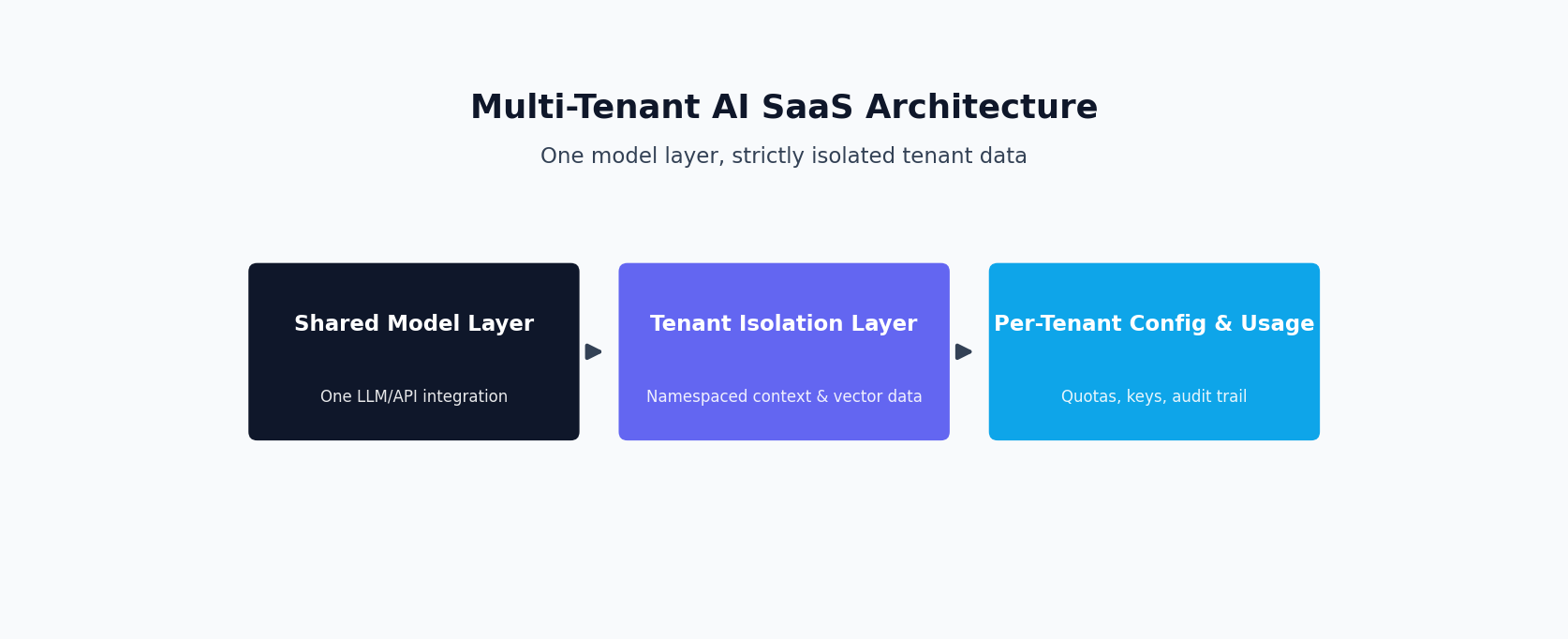
The pattern that scales cleanly separates three concerns into three layers, each with a distinct responsibility:
The shared model layer is your one integration with OpenAI, Anthropic, or whichever provider you’ve standardized on — authentication, retries, rate-limit handling, and the abstraction layer between your application code and the vendor’s actual API shape. This layer knows nothing about tenants; it just executes model calls reliably. Sharing it across tenants is not a compromise, it’s the correct design — you don’t want N separate integrations with N separate failure modes to maintain.
The tenant isolation layer sits between your application and the shared model layer, and its entire job is making sure no request crosses tenant boundaries. This is where tenant-scoped context assembly, tenant-scoped retrieval, and tenant-scoped rate limiting live. If this layer has a bug, the blast radius is a cross-tenant data leak — which is why it deserves more test coverage than almost anything else in the AI feature.
The per-tenant governance layer handles what varies by customer: usage quotas, which AI features their plan includes, cost attribution, and audit logs scoped to their account. This is the layer product and billing decisions plug into, deliberately kept separate from the isolation logic so that a pricing change never has to touch the code responsible for keeping tenant data apart.
Keeping these three layers structurally separate — not just conceptually separate in a diagram, but actually separate in code, with the isolation layer unable to be bypassed by a shortcut from the application layer — is the single highest-leverage decision in a multi-tenant AI architecture.
Isolating Prompts and Context Per Tenant
The most common way tenant data ends up where it shouldn’t is context assembly: pulling together the system prompt, retrieved documents, and conversation history that get sent to the model. If that assembly logic ever queries “recent documents” or “conversation history” without a mandatory, non-optional tenant filter, a bug anywhere upstream can result in another tenant’s content ending up in the context window.
The practical fix is to make the tenant filter structural rather than conventional. Instead of a query that should include a tenant ID clause that a developer remembers to add, build your data access layer so a query without a tenant scope simply can’t compile or execute — a repository pattern where every read method requires a tenant identifier as its first argument, enforced by the type system or by a runtime guard that throws rather than silently returning unscoped results.
This turns “someone forgot the WHERE clause” from a possible production incident into a caught bug in code review or CI.
It’s also worth logging, per request, exactly which tenant’s context was assembled and what document IDs were included — not the document contents, just the identifiers. That log is what lets you answer “did this response ever include another tenant’s data” definitively during an incident review, instead of trying to reconstruct it after the fact.
Tenant Isolation for Vector Stores and RAG
Vector store isolation is frequently the weakest link in an otherwise solid multi-tenant AI SaaS architecture, so it deserves the same rigor as the API and data layers.
Retrieval-augmented generation adds a second place tenant boundaries can fail: the vector store. Getting this boundary right is central to any serious multi-tenant AI SaaS architecture that handles retrieval or embeddings. There are three common isolation patterns, in increasing order of isolation strength and increasing order of operational overhead:
Shared index, metadata filter (the default starting point for most multi-tenant AI SaaS architecture builds). All tenants’ embeddings live in one vector index, with a tenant ID stored as metadata and every query required to filter on it. This is the cheapest and most common pattern, and it’s fine — as long as the filter is enforced at the data-access layer, not left to the calling code to remember. The risk here isn’t the pattern itself, it’s a query path that skips the filter.
Namespaced or partitioned indexes. Most managed vector databases (Pinecone namespaces, Qdrant collections, Weaviate tenants) support a lighter-weight partition within the same underlying infrastructure. This gets you a stronger isolation boundary than a metadata filter — a bug has to actively target the wrong namespace rather than just omit a filter — without the operational cost of fully separate infrastructure per tenant.
Fully separate indexes per tenant (the strictest option, and often the one enterprise buyers of a multi-tenant AI SaaS architecture ask about directly). The strongest isolation, and the right call for enterprise customers with contractual or regulatory requirements around data segregation. The operational cost is real — you’re now managing potentially hundreds of indexes — so this is usually reserved for a top tier of customers rather than applied uniformly.
A pattern that works well in practice: default every tenant to namespaced isolation, and offer fully separate infrastructure as an explicit, priced tier for customers who need to see it in a security questionnaire. That way the isolation strength matches what the customer is actually paying for and asking about, rather than either under- or over-building for the whole customer base. This tiered approach is the practical core of a defensible multi-tenant AI SaaS architecture: isolation strength matched to actual risk, not applied uniformly across every customer. In short, a mature multi-tenant AI SaaS architecture treats isolation as a spectrum, not a single switch.
Per-Tenant Rate Limits, Quotas, and Cost Attribution
Cost attribution is one of the most overlooked pieces of a mature multi-tenant AI SaaS architecture, and it’s just as important as isolation. AI API calls cost real money per request, which makes a problem that’s mostly theoretical for a typical CRUD SaaS feature into a real operational risk for an AI feature: one tenant’s usage spike can inflate your entire month’s provider bill, and if your rate limiting isn’t tenant-aware, that same tenant can also degrade response times for everyone else sharing your API keys.
Three things need to exist before an AI feature ships to more than a handful of customers:
Per-tenant rate limits, not just a global one. A global rate limit protects your provider relationship; it does nothing to stop one noisy tenant from consuming the entire budget before quieter tenants get their share. Bucket limits by tenant ID, not just by API key or IP.
Cost attribution per tenant, tracked as a real metric, not an afterthought. If you can’t answer “what did tenant X cost us in model calls last month” without digging through raw logs, you can’t price the feature sustainably, and you can’t spot an anomaly — a runaway loop, a misconfigured integration, a bug generating repeated calls — before it shows up as a surprise on the provider invoice.
A defined behavior for what happens at the limit. A tenant hitting their quota needs a clear, product-defined experience — a graceful “you’ve reached this month’s AI usage” state, not a raw provider rate-limit error surfacing in your UI. Decide this before launch, not while triaging a support ticket from an annoyed customer.
Audit Logging and Compliance Across Tenants
Enterprise customers evaluating an AI feature will ask, in some form, “show me that our data can’t end up somewhere it shouldn’t.” The answer that actually satisfies that question is an audit trail: every AI request logged with which tenant initiated it, which data was included in context (by identifier, not content), which model and provider handled it, and what was returned — retained for whatever period your compliance obligations require and queryable per tenant on request.
This is also, practically, your incident-response tool. If a customer reports something that looks like a cross-tenant leak, an audit log that lets you reconstruct exactly what was in a specific request’s context is the difference between a same-day root-cause and a multi-week forensic exercise that erodes trust regardless of what you eventually find.
Choosing Shared vs. Dedicated Model Deployments Per Tenant
Most multi-tenant SaaS products should default to a shared model deployment — one API relationship with the provider, serving every tenant through the isolation layer described above. It’s simpler, cheaper, and for the overwhelming majority of customers, entirely sufficient.
Dedicated deployments — a separate fine-tuned model, a dedicated inference endpoint, or in rare cases a customer-specific self-hosted model — become a real conversation for a narrow slice of customers: those with data residency requirements that a shared multi-tenant API can’t satisfy, or those large enough that a fine-tuned model meaningfully improves their specific results. Treat this as a premium, individually-scoped offering rather than a default architecture decision, since building dedicated infrastructure per tenant as a baseline turns an already-complex system into an unmaintainable one.
A Practical Rollout Checklist
Before an AI feature goes live across your tenant base, these are the checks worth running deliberately rather than assuming:
Every context-assembly and retrieval query path requires a tenant ID that can’t be omitted or defaulted. Rate limits and usage quotas are enforced per tenant, not just globally. Cost attribution per tenant is a queryable metric, not something you’d have to reconstruct from raw logs. Vector store isolation matches what you’ve actually told customers about their data segregation — don’t market fully separate indexes if you’re running a shared index with a metadata filter. Audit logs capture enough to answer a “was our data ever exposed” question definitively, without needing to store the actual content of every request.
Where This Fits With the Rest of Your Architecture
Multi-tenant isolation for an AI feature isn’t a bolt-on concern that lives only in the AI code — it’s an extension of the same multi-tenancy discipline that should already exist in your database layer, your auth system, and your background job queues. If your SaaS product’s underlying tenancy model is already solid — tenant-scoped database queries, tenant-aware background workers, tenant-scoped auth tokens — extending that same discipline into the AI layer is a natural continuation of work you’ve already done, not a new architecture from scratch.
This is exactly the kind of cross-cutting design work that AI integration services engagements are built around: making sure the AI layer inherits the isolation guarantees the rest of the product already has, instead of becoming the one part of the system where tenant boundaries are enforced by convention rather than architecture.
If you’re building this on a Laravel-based SaaS product specifically, the multi-tenancy patterns — tenant-scoped Eloquent queries, tenant-aware middleware, per-tenant database connections or shared-schema row isolation — are worth getting right before the AI layer goes on top of them; see my Laravel SaaS development page for how that foundation typically gets structured.
Testing Tenant Isolation Before It Ships
Most teams test an AI feature’s output quality and forget to test its isolation boundary, which is backwards — a mediocre response is a product problem, a cross-tenant leak is a trust problem. Before an AI feature reaches more than one real customer, it’s worth writing tests that specifically try to break isolation rather than just confirming it works under normal conditions.
Concretely: create two test tenants with distinct, clearly-labeled data, then write tests that call the AI feature as tenant A while deliberately attempting to reference or retrieve tenant B’s identifiers, documents, or conversation history. A correct implementation should return nothing from tenant B regardless of how the request is shaped. Run this as an actual automated test in CI, not a manual check done once before launch — isolation logic tends to erode quietly as new features and query paths get added, and a regression here is exactly the kind of bug that’s invisible until a customer notices something wrong.
It’s also worth load-testing the per-tenant rate limiting specifically, not just the feature’s happy path. Simulate one tenant sending a burst of requests and confirm that a second tenant’s requests are unaffected — that’s the actual guarantee the architecture is supposed to provide, and it’s the kind of thing that’s easy to assume works and expensive to discover doesn’t.
FAQ
Do I need separate vector database indexes for every tenant?
No — for most SaaS products, a namespaced or metadata-filtered shared index is sufficient and considerably cheaper to operate. Reserve fully separate indexes for enterprise tenants with specific contractual or regulatory data-segregation requirements.
How do I stop one tenant’s usage spike from affecting others?
Enforce rate limits and quotas keyed by tenant ID, not just globally or by API key. A global limit protects your provider relationship but does nothing to protect other tenants from one noisy account.
What’s the biggest source of cross-tenant data leaks in AI features?
Context assembly and retrieval queries that don’t enforce a mandatory tenant filter at the data-access layer. This is the single most common way a multi-tenant AI SaaS architecture ends up leaking data between customers. Making the tenant scope structurally required — not just conventionally expected — is the single highest-leverage fix.
Should every tenant get the same AI model, or can this vary by plan?
Sharing one model deployment across tenants through a proper isolation layer is the right default. That’s the baseline nearly every multi-tenant AI SaaS architecture should start from before considering dedicated models. Dedicated or fine-tuned models per tenant are worth offering as a premium tier for customers who specifically need it, not as a baseline architecture.
What should audit logs for an AI feature actually capture?
Which tenant made the request, which document or context identifiers were included (not the content itself), which model handled it, and what was returned — retained long enough to satisfy your compliance obligations and queryable per tenant on demand. Getting this consistently right across every tenant is what separates a compliant multi-tenant AI SaaS architecture from one that merely claims to be.
Getting the Isolation Boundary Right the First Time
Choosing a model provider is a smaller decision than getting tenant isolation right — a provider swap is a config change behind a good abstraction layer, but a tenant isolation bug discovered after your first enterprise customer’s security review is a much harder conversation. If you’re adding an AI feature to a multi-tenant AI SaaS architecture and want the isolation layer designed correctly before it ships to your full customer base rather than retrofitted after an incident, that’s exactly the kind of architecture work worth scoping properly upfront.
If you’re evaluating your own multi-tenant AI SaaS architecture and want a second set of eyes on the isolation boundary, that’s exactly the kind of conversation this call is for.
Book a Free 30-Minute Call
Faisal Nadeem writes and builds around multi-tenant AI SaaS architecture, with a focus on isolation, cost control, and compliance for production SaaS platforms.
About Faisal Nadeem
Faisal Nadeem is a skilled Full-Stack Developer with over 6+ years of experience building robust web and mobile applications. He specializes in Laravel, Vue.js, React, Node.js, and .NET, delivering scalable solutions with a focus on performance, usability, and client satisfaction.
Related Reading
Need help architecting a system like this? See our guide to hiring a Laravel developer, or browse case studies of production SaaS platforms we’ve built.
