If you have started collecting quotes for your project, you already know the frustrating part: two developers with nearly identical resumes can quote wildly different numbers, and neither quote tells you why. Understanding full stack developer rates in 2026 means understanding what actually drives the price, because the sticker number alone tells you almost nothing about the value you are getting. A founder comparing three proposals side by side is not really comparing prices — they are comparing risk, speed, communication overhead, and the odds that the project gets finished the way it was scoped. This guide breaks down the real variables behind full stack developer rates so you can budget with confidence and read a quote the way an experienced buyer does, rather than just picking the middle number and hoping for the best.
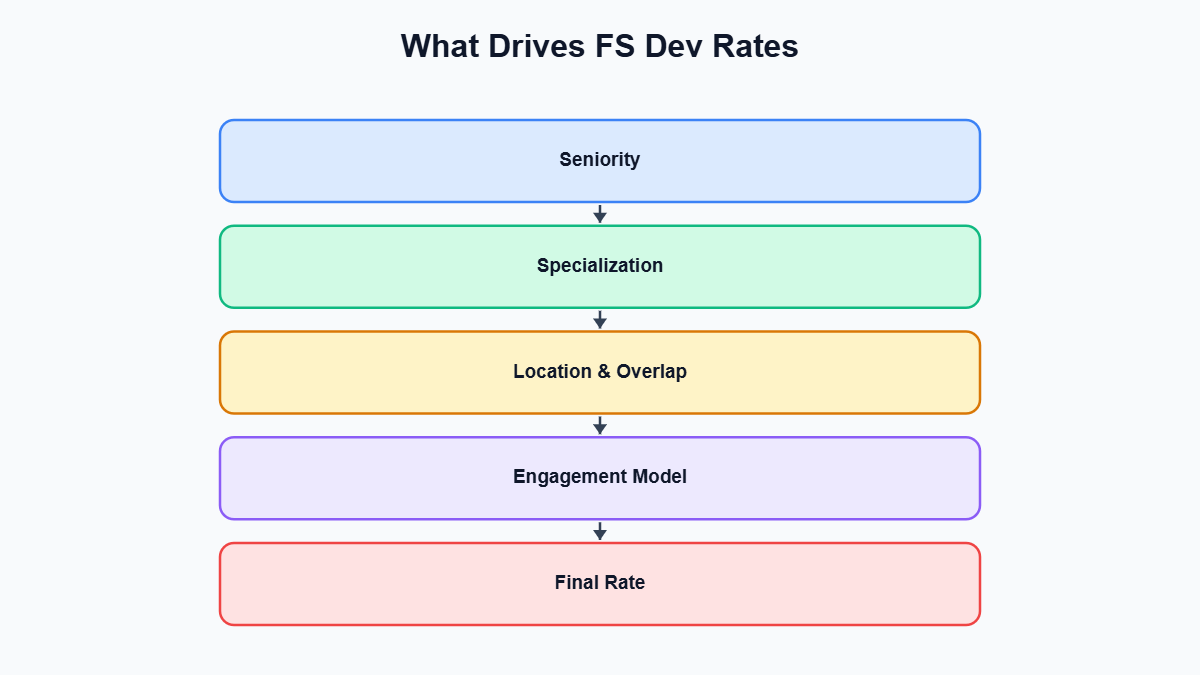
What Actually Determines Full Stack Developer Rates
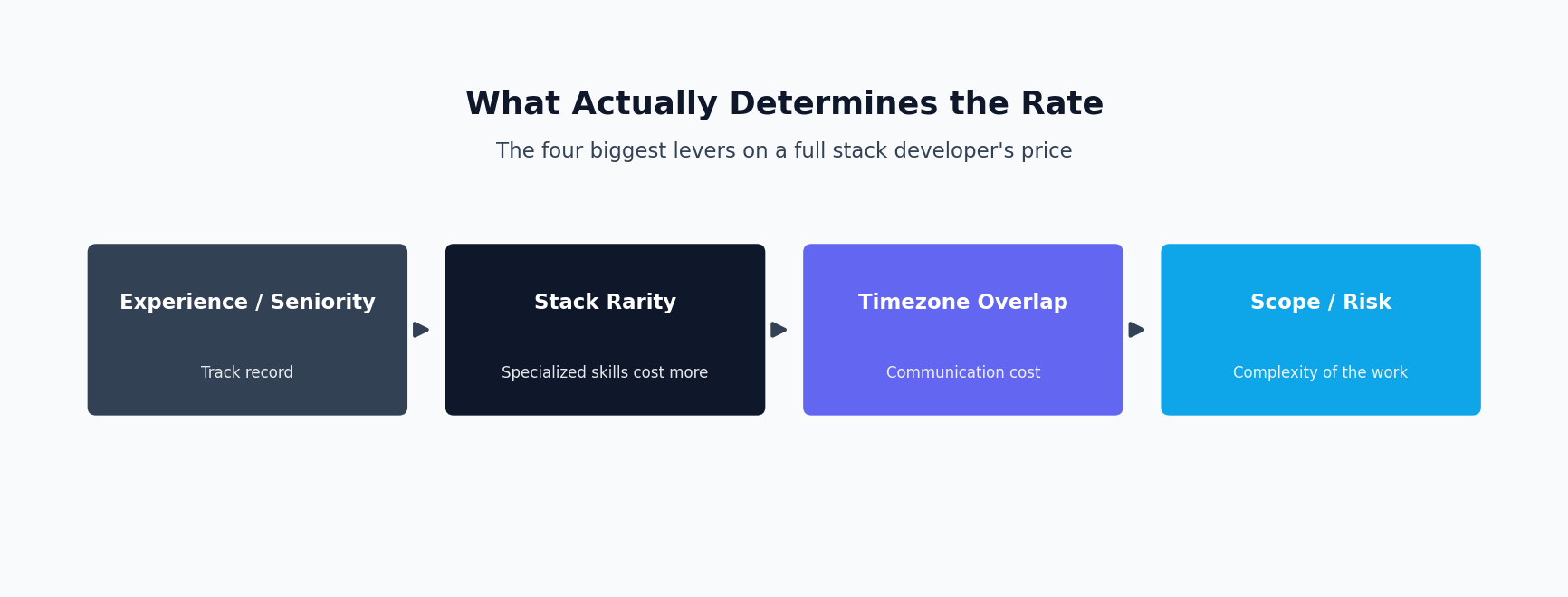
Rates are not set by a formula, but they are also not random. In practice, six factors explain most of the spread you will see between quotes for what looks, on paper, like the same job.
Experience and Seniority
The single biggest lever on full stack developer rates is genuine seniority — not years of tenure on a resume, but the ability to make architectural decisions that hold up under real-world load, catch problems before they become expensive, and work with minimal supervision. A developer who has shipped and maintained production systems for several years brings judgment that a junior or mid-level developer simply has not had time to develop yet. That judgment shows up as fewer rewrites, fewer security gaps, and fewer late-stage surprises. It is also the reason a senior hire often costs less over the life of a project than a cheaper developer who needs constant correction. When you evaluate a rate, ask what “senior” means to that specific provider — request examples of systems they built end to end, not just a list of technologies they have touched.
Tech Stack Rarity and Specialization
Not all full stack work is priced the same. A developer fluent in common, high-demand combinations — for example, a modern JavaScript framework paired with a mainstream backend language and a standard cloud provider — operates in a large, competitive talent pool, which tends to moderate rates. A developer with deep expertise in a niche or legacy stack, or in a specialized domain like payment infrastructure, healthcare data compliance, or high-throughput real-time systems, is pulling from a much smaller pool of qualified people. Scarcity pushes the rate up regardless of general seniority. If your project genuinely requires that kind of specialization, expect to pay a premium for it — and be wary of a generalist who claims deep expertise in a narrow domain at a generalist’s price.
Timezone, Location, and Communication Overlap
Where a developer is based still matters, though not for the reason most people assume. Cost of living in a developer’s home market plays a role in their baseline pricing, which is why full stack developer rates vary across regions. But the more practical driver for a business owner is overlap: how many working hours per day you actually share with your developer. A team with four or five hours of daily overlap can run live standups, pair on tricky bugs in real time, and resolve blockers same-day. A team with little or no overlap can still do excellent work, but coordination shifts to asynchronous updates, and timelines stretch when quick clarifications turn into next-day replies. Neither model is inherently better — it depends on how hands-on you need to be — but it is a real cost that belongs in your evaluation, not just the hourly number.
Engagement Model
Whether you are hiring for a single sprint, a defined project, or an ongoing relationship changes the economics. Short, one-off engagements carry a pricing premium because the developer has to account for ramp-up time and the uncertainty of not knowing your codebase or business context. Longer engagements and retainers typically come with somewhat lower effective rates because the relationship amortizes the learning curve and gives the developer predictable, planned work instead of feast-or-famine gaps between clients.
Scope Complexity and Risk
A well-defined feature with clear acceptance criteria is priced very differently from an ambiguous “build me an app like X” request. Complexity is not just about how much code gets written — it is about how much uncertainty the developer has to absorb. Integrations with third-party systems, compliance requirements, data migrations, and unclear requirements all increase the effective cost, because the developer has to price in the risk of scope creep, rework, and the extra discovery time needed to de-risk the unknowns before writing a line of code.
Agency or Team vs. Solo Freelancer
A solo freelancer usually has a lower headline rate because there is no overhead beyond their own time. An agency or a small team costs more per hour, but that premium typically buys you redundancy (the project does not stall if one person is sick or leaves), a broader bench of skills for different parts of the stack, project management, and some form of quality review before code reaches you. Neither structure is automatically the right choice — a solo senior full stack developer can be the fastest, most cost-effective option for a well-scoped project, while a team makes more sense for larger, multi-disciplinary builds where a single person’s bandwidth becomes the bottleneck.
Hourly vs. Fixed-Price vs. Retainer: The Real Tradeoffs
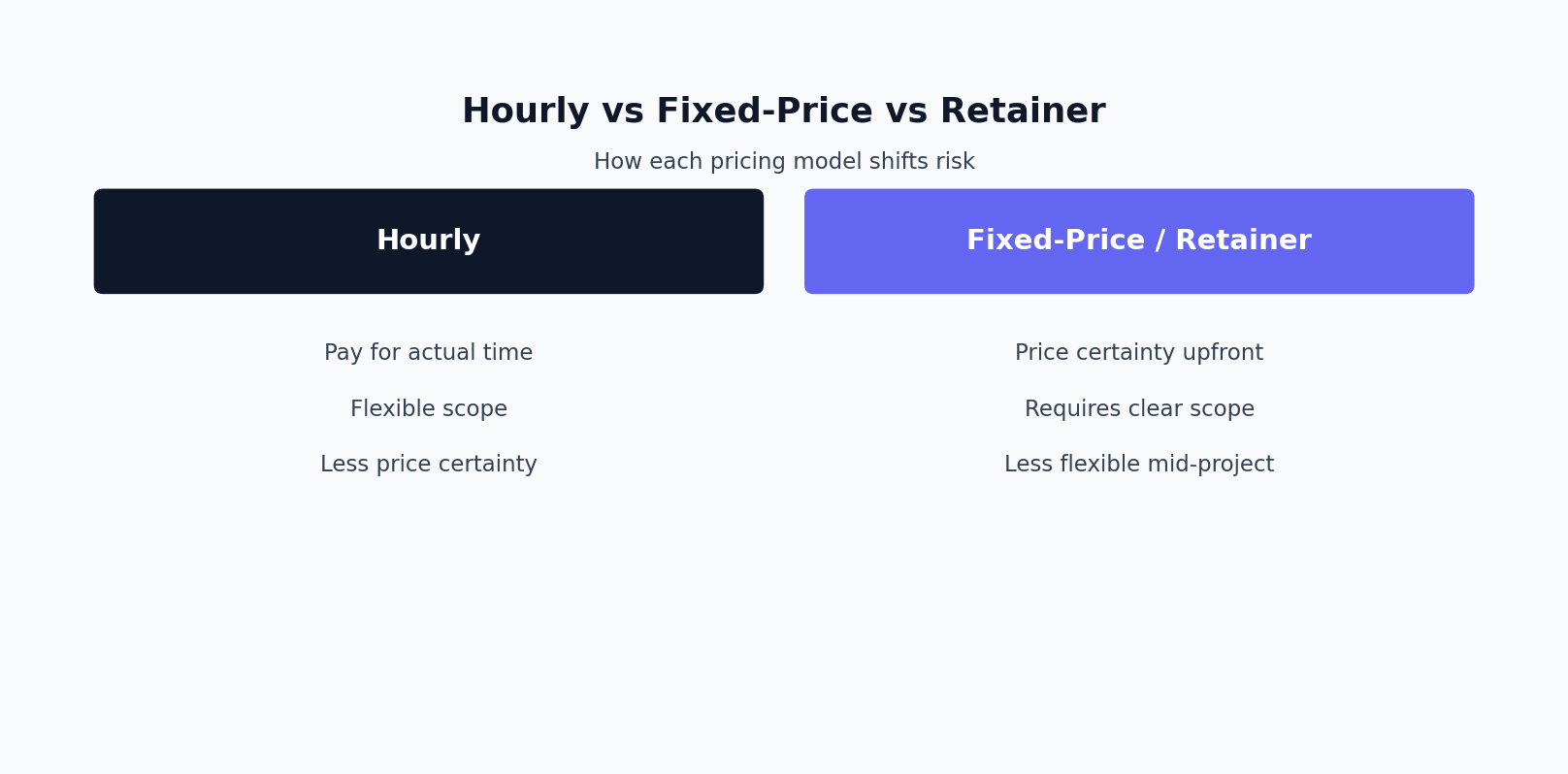
Most quotes fall into one of three pricing structures, and each shifts risk between you and the developer in a different way.
Hourly billing is the most flexible model. You pay for time actually worked, which is ideal when requirements are still evolving or when you need ongoing, variable-effort support. The tradeoff is that you carry the risk of scope and timeline uncertainty — if the work takes longer than expected, the bill grows with it. Hourly arrangements work best when paired with clear reporting, regular check-ins, and a not-to-exceed estimate so surprises are caught early rather than at invoice time.
Fixed-price billing shifts that risk to the developer. You agree on a scope, a deliverable, and a total price up front, which makes budgeting predictable. The catch is that fixed pricing only works when the scope is genuinely well-defined — vague specifications lead either to padded quotes (the developer builds in a buffer for the unknowns) or to disputes later, when “that wasn’t in scope” becomes the most common sentence in the relationship. Fixed-price is a strong fit for discrete, well-specified projects like a defined MVP feature set, and a poor fit for open-ended product development.
Retainers are built for ongoing relationships — maintenance, incremental feature development, or having a senior full stack developer effectively on call for your product. You commit to a recurring block of hours or a monthly fee, which typically comes with a better effective rate than pure hourly billing because it gives the developer predictable, planned work. Retainers make the most sense once you have moved past the initial build and need steady, dependable capacity rather than a one-time delivery.
None of these models is objectively cheaper — each one is a different way of allocating risk between you and the person doing the work. The right choice depends on how well-defined your requirements are and how much ongoing capacity you actually need.
How Full Stack Developer Rates Vary by Region
It is realistic, not controversial, to say that full stack developer rates differ meaningfully by market. Developers based in North America and Western Europe generally command higher rates, reflecting higher local costs of living and, in many cases, easier real-time collaboration for clients in those same regions. Developers based in South Asia, Southeast Asia, and much of Eastern Europe are frequently able to offer substantially more competitive rates for comparable skill levels, which is a major reason distributed and remote hiring has become so common for full stack work.
Rather than quoting specific numbers — actual market rates shift constantly with demand, currency movement, and specialization, and any figure printed today would likely be stale within a year — it is more useful to think in terms of illustrative, not exact, ranges. As a purely illustrative framing (not a quote you should hold anyone to), you might see senior full stack talent in higher-cost Western markets priced at a level two to four times higher than comparably senior talent in lower-cost regions, for the same general scope of work. That gap narrows as specialization or scarcity increases, since a rare skill set commands a premium no matter where the developer sits.
The practical takeaway is not “cheaper is always smarter” or “expensive is always safer.” It is that geography is one input among several, and it should be weighed against communication overlap, specialization, and track record rather than treated as the deciding factor on its own. A well-vetted senior full stack developer in a lower-cost market can easily outperform a mediocre one in an expensive market — and vice versa.
Red Flags in Pricing
Some pricing signals are worth treating as warnings rather than opportunities.
- A rate that is dramatically below every other quote you received. This usually means one of a few things: the developer is inexperienced and underpricing to win work, the quote does not actually cover the full scope you described, or the engagement will be handed off to a less experienced person after the sales conversation.
- No clear scope behind the number. If a fixed price is quoted without a written breakdown of what is included — features, revisions, testing, deployment, post-launch support — the number is close to meaningless. You cannot compare quotes that are not pricing the same thing.
- Reluctance to explain how the rate was calculated. A credible developer or agency can walk you through why a project falls into a given range: the complexity drivers, the estimated hours, the assumptions baked into the estimate. Vague answers are a signal the number was picked to look competitive rather than derived from the actual work.
- Pressure to sign quickly at a “special” rate. Urgency tactics are far more common in low-quality service sales than in legitimate technical engagements, where a rate is a rate regardless of when you sign.
- No mention of ongoing costs. A quote that covers only the build but says nothing about maintenance, hosting, or post-launch support can look artificially attractive next to a more complete proposal.
None of these red flags mean a low rate is automatically dishonest — plenty of legitimate developers are simply less expensive because they are earlier in their career, based in a lower-cost market, or intentionally pricing competitively to build a portfolio. The flag is the combination of a low number with an unclear or unexplained scope, not the low number by itself.
Evaluating a Quote’s Value, Not Just the Number
The number on a quote is the least informative part of it. What actually determines whether you got a good deal is what happens after the contract is signed. A few questions do more to reveal true value than any rate comparison:
What is actually included? Does the quote cover testing, documentation, deployment, and a reasonable window of post-launch bug fixes, or is every one of those a separate line item you will discover later? A higher rate that includes all of this can be cheaper in total than a lower rate that nickel-and-dimes each stage.
How is communication structured? A developer who provides regular updates, flags risks early, and is reachable when something breaks is worth more than one who disappears between milestones, even at an identical rate.
What happens if the estimate is wrong? Every estimate carries uncertainty. Ask how overruns are handled — is there a cap, a check-in before extra hours are billed, or an open-ended “we’ll let you know”? The answer tells you how much financial risk you are actually taking on.
Can they show, not just tell? Portfolios and references matter more than self-reported experience. Ask to speak with a past client, or look for verifiable public work. Independent sources of signal — like the patterns described in large-scale industry surveys such as the Stack Overflow Developer Survey — can also help you sanity-check general market expectations around tooling, experience levels, and how developers describe their own work, separate from anything a specific vendor tells you.
What is the real hourly cost of managing them? A cheap developer who needs heavy oversight from you or your team is not actually cheap once your own time is factored in. Factor in how much project management, code review, or hand-holding a given rate implicitly requires.
A Practical Framework for Comparing Quotes
When you have multiple proposals in front of you, resist the urge to rank them by price alone. Instead, run each one through the same short checklist:
- Normalize the scope first. Before comparing numbers, confirm each quote is pricing the same deliverable, with the same assumptions about revisions, testing, and support. A quote that looks 30 percent cheaper is not actually cheaper if it excludes work another quote includes.
- Separate the rate from the estimate. An hourly rate and a total project estimate are different things. A higher hourly rate with a tighter, more accurate estimate can cost less overall than a lower rate paired with an inflated hour count.
- Weigh seniority against your own bandwidth. If you have limited time to manage the engagement closely, lean toward the option with stronger seniority and communication, even at a higher rate — the oversight cost of a cheaper option can erase the savings.
- Ask what happens after launch. A rate that excludes any transition to maintenance or ongoing support is only pricing part of the real cost of the project. Factor in what comes next, not just the initial build.
- Check the pricing model against your own uncertainty. If your requirements are still evolving, an hourly or retainer model with regular check-ins will serve you better than locking into a fixed price that is likely to trigger change orders. If your scope is genuinely fixed, a fixed-price quote gives you budget certainty.
- Trust verifiable signals over sales pitches. Portfolios, references, and a clear written breakdown of the estimate are worth more than confident claims in a sales call. If a provider cannot show you evidence of past comparable work, treat the quote as unverified regardless of how attractive the number looks.
Running every quote through this same framework turns an apples-to-oranges comparison into something you can actually reason about, rather than defaulting to whichever number is smallest.
Budgeting Realistically for Your Project
Once you understand the variables above, budgeting becomes less about finding a magic number and more about defining your own priorities clearly enough that a developer can price against them accurately. Start by writing down what you actually need: the core features, any compliance or integration requirements, your timeline flexibility, and how much ongoing support you expect to need after launch. The more precisely you can describe this, the tighter and more comparable the quotes you receive will be, and the less room there is for a low headline number to hide missing scope.
It also helps to budget in ranges rather than a single figure, and to build in a contingency — most software projects, even well-scoped ones, encounter some amount of the unexpected. A contingency of roughly ten to twenty percent above your baseline estimate is a common, conservative planning practice, not a guarantee that you will need it, but a buffer that keeps a normal amount of scope discovery from becoming a budget crisis. If you are unsure how to translate your requirements into a realistic estimate, a short scoping conversation with an experienced senior full stack developer before you request formal quotes can save you from comparing proposals that were never actually pricing the same project in the first place.
For broader context on how the profession itself is trending — tools in use, experience distribution, and how developers describe compensation expectations in aggregate — resources like the U.S. Bureau of Labor Statistics’ occupational outlook for software developers can offer a useful, independently sourced baseline, separate from any individual vendor’s pitch. Use sources like this to calibrate your expectations in general terms, not to extract a precise number you then hold every quote to — the point is context, not a price tag.
Bringing It Together
There is no single correct answer to “what should I pay?” because full stack developer rates are the output of several independent variables — seniority, specialization, location and timezone overlap, engagement model, scope complexity, and whether you are hiring an individual or a team. A quote that ignores most of these factors and reduces everything to one number is giving you less information than you need to make a good decision. The founders who get the best outcomes are not the ones who find the lowest rate; they are the ones who understand what is driving each quote, ask precise questions about scope and process, and choose the pricing model that matches how well-defined their project actually is. Treat the number on a proposal as a starting point for a conversation, not the final word — and you will make far better hiring decisions than anyone chasing the cheapest full stack developer rates they can find.
Frequently Asked Questions
Why do two developers with similar resumes quote wildly different rates?
Because the sticker number reflects six variables at once: experience and seniority, tech stack rarity, timezone overlap, engagement model, scope complexity and risk, and whether you’re hiring an agency or a solo freelancer. Two quotes rarely weight those factors the same way, even when the developers look interchangeable on paper.
Is it fair that developers in different regions charge different rates for the same work?
Yes, and it isn’t controversial: developers in North America and Western Europe generally command higher rates due to cost of living and easier real-time overlap, while developers in South Asia, Southeast Asia, and Eastern Europe often offer more competitive rates for comparable skill. Specific dollar figures shift constantly with demand and currency, so thinking in relative, illustrative ranges is more useful than chasing an exact number.
What’s a red flag that a full stack developer’s quote is unreliable?
A rate dramatically below every other quote you received, a fixed price with no written scope breakdown, or reluctance to explain how the number was calculated. Vague answers to “why does this cost what it costs” usually mean the number was picked to look competitive rather than derived from actual estimated hours.
Should I choose hourly, fixed-price, or retainer for my project?
It depends on how well-defined your scope is. Fixed-price works when requirements are stable and well understood, hourly suits exploratory or evolving work, and retainers fit ongoing maintenance relationships. Each model shifts risk between you and the developer differently, which is part of why identical work can be priced differently under each structure.
How do I compare quotes that don’t have the same rate structure?
Don’t compare the headline number alone — compare what’s actually included: scope, revisions, testing, deployment, and post-launch support. A framework that normalizes quotes against the same deliverables tells you far more about real value than lining up hourly rates side by side.
Does a solo freelancer charging less than an agency mean lower quality?
Not necessarily. Agencies carry overhead for project management, backup coverage, and account handling that solo freelancers don’t, which shows up in the rate rather than in code quality. The tradeoff is usually about risk and redundancy (what happens if one person is unavailable) rather than raw skill.
Related Reading
For a specific stack, see our guide to hiring a Laravel developer, and browse real case studies covering the kind of production work these rates apply to.
