If you want to hire a saas developer who can walk into a subscription product and immediately spot where the billing logic will break under real-world conditions, here’s exactly what that looks like.
Most SaaS bugs that actually cost money aren’t UI bugs. They’re state bugs. A webhook retry that double-bills a customer because nobody built idempotency into the payment handler. A subscription downgrade that updates the invoice but never revokes the premium feature flags, so the customer keeps free access to what they stopped paying for. A multi-tenant query that’s missing a tenant_id filter and quietly leaks one customer’s dashboard data into another’s. A failed-payment flow with no dunning logic at all, so a card that expires in March just churns the customer in April with nobody notified, and nobody finding out until the revenue report looks wrong.
I’m Faisal Nadeem, a full-stack and AI integration engineer with 6+ years of experience and 50+ shipped projects, working remotely from Lahore, Pakistan with clients across the EU and US. I hold an MCS from the University of Management and Technology (UMT) Lahore and a BSc from the University of the Punjab. Most of the last several years have been spent inside exactly this kind of problem: subscription billing correctness, multi-tenant architecture, and, increasingly, AI features layered into SaaS products. If that’s the kind of developer you’re trying to hire, the rest of this page is the specifics, not the pitch.
What a SaaS Developer Should Actually Build
A lot of “SaaS developer” listings are generic full-stack listings with the word SaaS added on. Before you hire a saas developer, it helps to know what the job actually involves once you’re past the marketing site and into the parts of the product that touch money and access.
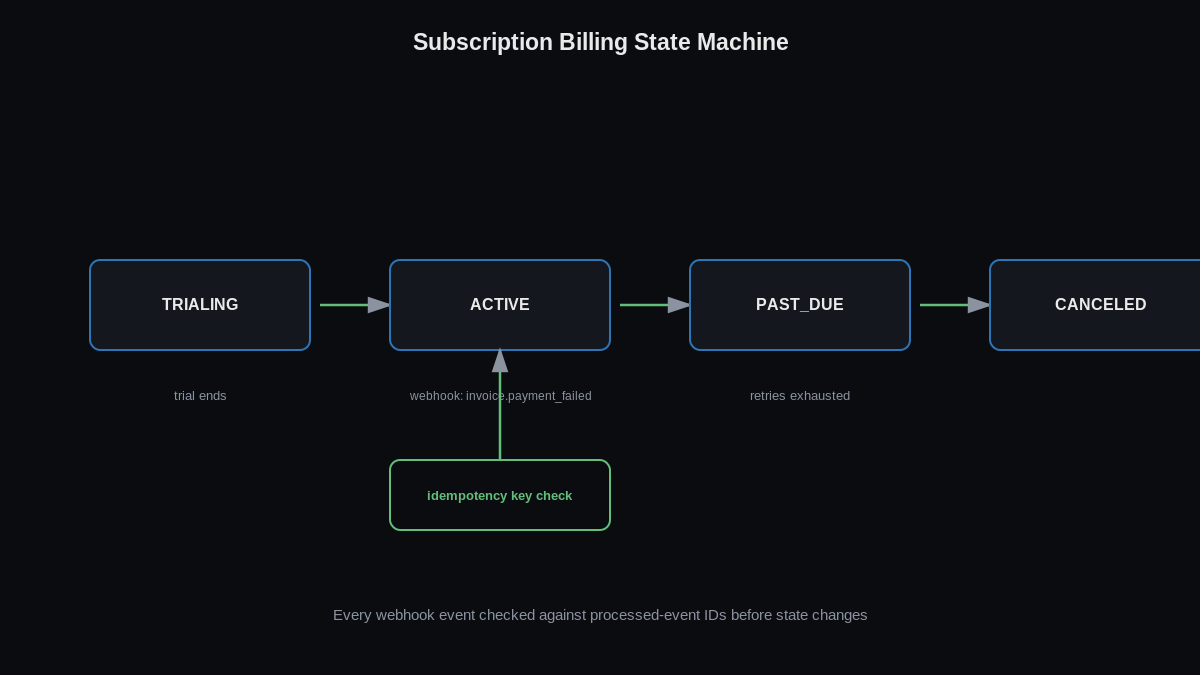
Subscription Billing & Payment Integration (Stripe, Reepay, Fenerum)
This covers the full lifecycle: plan selection at signup, proration math when a customer changes plans mid-cycle, invoice generation, tax handling, and — the part most junior implementations get wrong — treating the payment provider as the source of truth for subscription state instead of trusting whatever the frontend last cached.
Every webhook handler needs to be idempotent. Stripe, Reepay, and Fenerum will all redeliver events if your endpoint is slow to respond or times out, and if your handler isn’t built to recognize “I’ve already processed this event” versus “this is new,” you will eventually double-bill someone or apply the same credit twice. Stripe documents this directly in its own webhook and idempotency guidance, and it’s worth reading before you assume your queue will “probably be fine.”
Multi-Tenant Architecture & Data Isolation
Multi-tenancy isn’t a checkbox, it’s a discipline that has to be enforced at every layer: the database (row-level tenant scoping, schema-per-tenant, or database-per-tenant, depending on scale and compliance needs), the cache (a Redis key without a tenant prefix is a leak waiting to happen), and background jobs (a queued job that loses its tenant context when it’s picked up by a worker is just as dangerous as an unscoped SQL query).
The failure mode here is rarely dramatic. It’s usually a support ticket that says “I’m seeing someone else’s data,” and by the time that ticket lands, you want to already know exactly which layer failed.
Plan Changes, Upgrades, Downgrades & Access Control
When a customer upgrades, downgrades, or cancels, three things have to move in lockstep: the billing provider’s record of what they’re paying for, your app’s entitlement/feature-flag state, and the timing of when access actually changes. An upgrade should usually unlock access immediately with prorated billing. A downgrade often shouldn’t revoke access until the end of the current billing period — but if your code doesn’t explicitly model that distinction, you’ll either grant free premium access past the period you should have cut it off, or cut someone off before they’ve been fully refunded, both of which generate support tickets and chargebacks.
Failed-Payment Handling & Dunning
A declined card is not one failure mode, it’s several: insufficient funds, an expired card, a bank fraud flag, an issuer temporarily blocking the charge. Each of those should trigger a different retry schedule and a different customer-facing message. Dunning is the system that manages all of this automatically — retry timing, email sequences, grace periods before a hard lock — instead of a subscription silently lapsing with no one told.
On a product like WingWarranty, this isn’t just a churn-prevention nicety. A mishandled payment there means a real lapse in someone’s insurance or warranty coverage, not just an inconvenience inside an app, which is why the idempotent webhook handling and dunning logic had to be treated as core product safety, not a nice-to-have.
AI Features Layered Into SaaS Products
More SaaS roadmaps now include an AI layer: retrieval-augmented generation (RAG) over a customer’s own documents, LLM-assisted workflows inside the product, AI-generated summaries or recommendations. The part that generic AI tutorials skip is that in a multi-tenant SaaS product, the same isolation discipline that applies to your database has to apply to your embeddings and retrieval context — one tenant’s documents should never surface in another tenant’s AI-generated answer, and token usage needs cost controls per tenant, not just globally.
Why Hire a Full-Stack Engineer for SaaS Instead of a Generic Web Developer
A generic web developer builds CRUD screens, forms, and admin panels, and that’s genuinely useful work. But a SaaS product has a layer underneath all of that: billing state machines, entitlement logic, tenant isolation, webhook processing, background jobs, and the AI layer increasingly sitting on top of it. If you hire saas developers whose experience stops at CRUD, that underlying layer tends to get built ad hoc, and ad hoc billing logic is where the expensive bugs live.
It’s also worth being clear-eyed about what most search results for “hire a saas developer” are actually selling: staffing agencies and freelancer marketplaces offering a fast match with a rotating pool of vetted engineers. That’s a reasonable option if you need headcount fast. It’s a different thing from working with one engineer who’s personally built and maintained the subscription lifecycle of a live product, and can show you exactly what that looked like.
For clients whose stack is specifically Laravel, there’s a deeper breakdown of that angle here: Laravel SaaS development.
Businesses that hire a saas developer for a subscription product need someone who treats billing correctness as core scope, not an afterthought bolted onto CRUD work.
Tech Stack
| Layer | Technologies |
|---|---|
| Backend | Laravel, Node.js, PHP |
| Frontend | Vue.js, React |
| Billing & Subscriptions | Stripe, Reepay, Fenerum |
| Infrastructure | AWS |
| Interactive/Graphics (product customization) | Fabric.js, Three.js |
| AI / LLM Layer | RAG pipelines, LLM API integration |
| Compliance Tooling | GDPR consent tooling, WordPress |
If you’re comparing candidates to hire a saas developer, ask each one how they’d prevent webhook double-processing — the answer reveals real production experience with billing systems.
Proof
When you hire a saas developer for a subscription product, the case studies that matter are the ones with real billing complexity behind them, not just a plan-selection screen. Here’s what I’ve actually shipped.
Custimoo — Sports-Apparel Customization SaaS
Custimoo is a SaaS platform for customizing sports apparel, built on Laravel, Vue.js, React, Fabric.js, and Three.js for the design/customization layer, with Stripe handling billing on AWS infrastructure. I worked across the full subscription lifecycle: signup and plan selection, recurring billing, plan changes and upgrades, handling failed payments and dunning, and — the part that’s easy to underestimate — keeping the app’s own view of what a customer’s account was allowed to access in sync with what Stripe’s records actually said they were paying for. When those two views drift apart, customers either lose access they’ve paid for or keep access they’ve canceled, and both are expensive mistakes.
WingWarranty — Car Insurance & Warranty SaaS
WingWarranty is a car-insurance/warranty SaaS platform built around recurring subscription billing, using Laravel, Vue, and Node.js, with Reepay handling subscription billing. Because a missed or mishandled payment here means an actual lapse in someone’s vehicle coverage rather than just a broken app feature, the billing layer had to treat correctness as a safety requirement. That meant building idempotent webhook handling so that a delayed or retried event from Reepay could never double-bill a customer or, worse, show a lapsed policy as still active. Getting that wrong in either direction — overcharging a customer or letting a lapsed policy appear valid — has real consequences outside the software itself.
Seers — GDPR Compliance SaaS
Between 2020 and 2021, I worked on Seers, a GDPR compliance SaaS platform built with Laravel, Vue.js, WordPress, React, and AWS. Seers handles cookie consent banners, compliance audits, and policy generators for websites needing to meet GDPR requirements — a different flavor of SaaS complexity, where correctness means the compliance logic itself has to be right, not just the billing around it.
This is the checklist I use whenever a client wants to hire a saas developer for billing work: webhook idempotency, multi-tenant isolation, entitlement sync, and dunning logic, all owned by one engineer.
How Engagements Work
- 1. Discovery call. We walk through your current billing/subscription setup, or your plans if you’re starting from scratch, and identify where the real risk is.
- 2. Scoping. I define whether this is a new SaaS build, a fix to broken billing or multi-tenancy on an existing product, or an AI feature layered onto what you already have.
- 3. Architecture proposal. A written plan covering the billing provider, tenancy model, and entitlement/access model before any code is written.
- 4. Build in scoped increments. Work is delivered in reviewable chunks, tested in staging with webhook replay and retry simulations before anything touches production billing.
- 5. Handoff documentation. You get a written breakdown of the billing state machine, tenant isolation rules, and dunning schedule so the logic isn’t locked in one person’s head.
- 6. Ongoing support. Available as a retainer for teams that want continued coverage rather than a one-off project.
When you hire a saas developer for a fixed-scope billing fix, get the webhook handling, tenancy model, and entitlement logic named in the written scope up front.
What It Costs to Hire a SaaS Developer
What you pay to hire a saas developer depends heavily on whether billing correctness is a core requirement or an afterthought. Generic marketplace rates for full-stack CRUD work often sit in the $20-40/hr range, but that pricing doesn’t reflect the risk profile of subscription billing, multi-tenant data isolation, or compliance-adjacent work, where a mistake has direct financial or legal consequences. Realistic 2026 ranges for that kind of work look like this:
| Engagement Type | Typical Range |
|---|---|
| Billing/architecture audit (hourly) | $60 – $90/hr |
| Fixed-scope feature (e.g., dunning flow, webhook idempotency fix) | $2,000 – $6,000 |
| New subscription billing system build | $8,000 – $25,000+ |
| Multi-tenant architecture retrofit | $5,000 – $20,000 |
| AI feature integration (RAG/LLM layer) | $4,000 – $15,000 |
| Monthly retainer | $3,000 – $7,000/month |
Exact numbers depend on scope, existing codebase quality, and how much of the billing logic already exists versus needs to be built from zero. A short discovery call is usually enough to give you a real number instead of a range.
Most teams that hire a saas developer only think about features; the ones that also plan billing state and tenant isolation from day one avoid the expensive bugs described above. Ready to hire a saas developer for your subscription product? The discovery call below maps your actual requirements.
Frequently Asked Questions
How much does it cost to hire a saas developer for subscription billing work?
It ranges from a few thousand dollars for a fixed-scope fix (like adding idempotent webhook handling) up to $25,000+ for a full subscription billing system built from scratch. See the pricing table above for a fuller breakdown by engagement type.
Why hire a saas developer instead of a general full-stack developer?
A general full-stack developer is usually strong at CRUD, forms, and admin panels. SaaS products have a layer underneath that — billing state machines, entitlement logic, multi-tenant isolation, webhook processing — that requires specific experience to get right the first time instead of discovering the gaps after a customer complains.
What’s the difference between hiring a saas developer directly and using a marketplace to hire saas developers?
Marketplaces match you quickly with a pool of vetted, largely interchangeable developers. Hiring one engineer directly means you can see their specific case studies — what they built, on what stack, and what problems they solved — before you commit.
Do I need to hire a saas developer if I’m just using Stripe’s off-the-shelf billing?
Stripe (or Reepay, or Fenerum) handles the payment processing, but your app still has to correctly interpret and act on what the provider tells it — syncing plan changes, revoking or granting access at the right moment, and handling webhook retries without double-processing. That integration logic is where most billing bugs actually live.
What should I look for before I hire a saas developer for a multi-tenant product?
Ask them to walk through how they’d prevent one tenant’s data from leaking into another’s — at the database layer, the cache layer, and in background jobs. If they can only answer for the database, that’s a gap.
Can you fix an existing SaaS product’s billing bugs, or only build new ones?
Both. A lot of engagements start as an audit of an existing product’s billing/subscription code to find where state can drift, followed by targeted fixes rather than a rebuild.
Do you work with Reepay and Fenerum, or just Stripe?
All three. Reepay was the billing engine behind WingWarranty’s subscription lifecycle, and Stripe behind Custimoo’s. The underlying problems — proration, dunning, webhook idempotency — are the same regardless of provider.
How do you handle webhook idempotency in practice?
Every incoming webhook event is checked against a stored record of already-processed event IDs before any billing action is taken, so a retried or duplicate delivery from Stripe or Reepay can’t trigger a double charge or flip a subscription’s state incorrectly.
What happens to a customer’s access when they downgrade mid-cycle?
That’s a product decision that has to be modeled explicitly — usually access stays at the higher tier until the end of the paid period, then drops at renewal. The important part is that the app’s entitlement logic and the billing provider’s record of what’s owed stay in sync the entire time.
How do you prevent one tenant’s data from leaking into another tenant’s dashboard?
By enforcing tenant scoping at every layer that touches data — database queries, cache keys, and background job context — rather than relying on the frontend or a single middleware check to catch everything.
Do you build AI features into SaaS products, or is that a separate service?
It’s part of the same work. RAG and LLM integration are increasingly part of SaaS roadmaps, and the multi-tenant isolation discipline that applies to your database has to extend to embeddings and retrieval context too.
What’s your tech stack for SaaS builds?
Laravel, Vue.js, React, and Node.js on the application side; Stripe, Reepay, or Fenerum for billing; AWS for infrastructure; and Fabric.js/Three.js where a product needs interactive customization or visualization.
How long does it take to hire a saas developer and get started?
Usually a discovery call happens within a few days of first contact, with a scoped proposal following shortly after. Actual build timelines depend on scope — a fixed-scope fix can start almost immediately, a full billing system build takes longer to architect properly.
Do you work with EU/US clients remotely from Pakistan?
Yes. I’m based in Lahore, Pakistan, and have worked with clients across the EU and US throughout my 6+ years of experience, including in my current senior/lead role at Tech Scale since 2022.
What industries have you built SaaS billing systems for?
Sports-apparel e-commerce customization (Custimoo), auto insurance/warranty (WingWarranty), and GDPR compliance tooling (Seers) — different industries, but the same underlying billing and multi-tenancy discipline applies across all of them.
Do you offer ongoing support after launch, or only project-based work?
Both. Some clients need a single scoped fix or build; others prefer an ongoing monthly retainer for continued coverage as the product evolves.
What’s dunning, and why does it matter?
Dunning is the automated process of retrying failed payments and communicating with the customer before their account is locked or canceled. Without it, failed payments turn into silent churn — the customer never gets a warning, and you never get paid or find out why they left.
How do I get started?
Book a 30-minute call and bring whatever context you have — an existing product with billing bugs, a new SaaS idea, or an AI feature you want layered onto what already exists.
Ready to Hire a SaaS Developer Who Treats Billing as a First-Class Feature?
If the backend also needs a broader data pipeline or AI integration beyond billing and multi-tenancy, hiring a Python developer covers that side. And if hiring across time zones is part of the decision, hiring remote developers covers how the engagement and overlap-hours model works.
If you’re ready to hire a saas developer who treats subscription billing correctness, multi-tenant isolation, and AI features as core engineering problems rather than afterthoughts, let’s talk specifics on a call.
Book a free 30-minute call: Book a Free 30-Minute Call
