If you want to hire a mobile app developer who treats the API and the app as one system instead of two separate contracts, here’s exactly what that looks like: someone who designs the backend endpoints before the screens are final, builds pagination and offline sync in from day one, tracks whether a push notification actually reached the device instead of assuming it did, and closes the token-refresh race condition that silently logs users out mid-session. That’s the work. Most people looking to hire a mobile app developer get quoted on the UI — the login screen, the feed, the animations — and never get asked how the app will behave the third time the network drops mid-sync.
I’m Faisal Nadeem, a full-stack and AI integration engineer based in Lahore, Pakistan, working remotely with EU and US clients for 6+ years across 50+ projects. I hold an MCS from the University of Management and Technology (UMT) Lahore and a BSc from the University of the Punjab. I’m currently a senior/lead developer at Tech Scale, with earlier roles at Cityscape Technology Corporation and Seers, a GDPR compliance SaaS. This page is about what I actually build when a client wants to hire a mobile app developer for a real product — not a marketing pitch about a talent pool, because there isn’t one. It’s me.
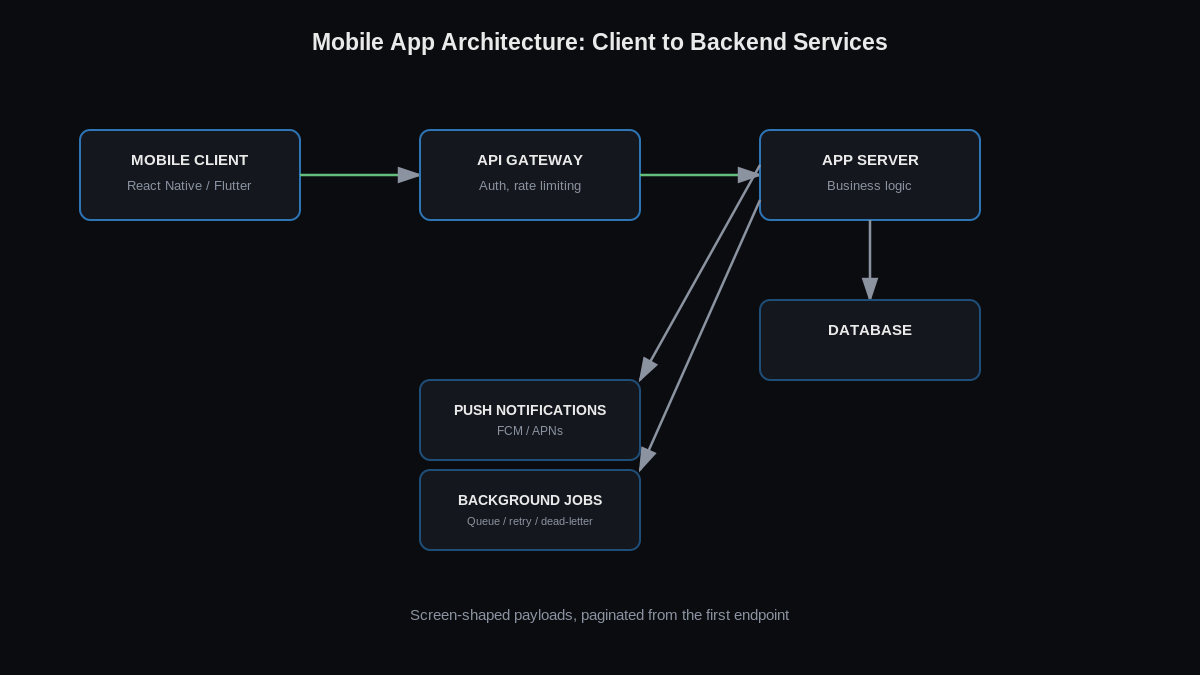
What a Mobile App Developer Should Actually Build
“Build the app” is not a spec. A mobile app is a UI layer sitting on top of a backend that has to handle intermittent connectivity, background execution limits, push delivery guarantees, and session state across two operating systems that behave differently. When you hire a mobile app developer, you’re really hiring someone to own all of the following, not just the parts that show up in a screenshot.
Cross-Platform UI Approach — React Native / Flutter
For most business apps, native Swift/Kotlin on two separate codebases is a cost decision, not a technical requirement. I build in React Native or Flutter depending on the team’s existing stack and the app’s performance needs — React Native when the team is JavaScript-heavy and wants to share logic with a web app, Flutter when UI consistency across platforms matters more than reusing existing web code. Either way, the platform choice gets made against the actual constraints of the project, not a default.
Backend API & Data Sync
This is where most mobile projects quietly fail. An endpoint that returns a full user object when the screen needs four fields is a bandwidth and battery problem on a phone in a way it never is on a browser. I design endpoints around what the screen actually renders, with pagination built in from the first version of the API — not retrofitted after the app is slow with 10,000 records. Offline sync gets a written strategy up front: what happens when a user edits a record offline, then reconnects and finds the server copy has changed. That’s a conflict-resolution decision, not an afterthought, and getting it wrong corrupts local data silently.
Push Notifications
A push notification that silently fails to deliver is one of the most common and hardest-to-debug problems in mobile apps, because the client never receives an error — it just never receives anything. I build delivery tracking into the notification pipeline: log every send attempt, record the provider’s delivery receipt where available (APNs/FCM), and give the backend a way to answer “did this specific user actually get this notification” instead of “we called the API and it returned 200.”
Authentication & Session Handling
Access tokens expire. On mobile, multiple screens or background tasks can hit the API at the same moment the token expires, and if the refresh logic isn’t centralized, you get a race: two requests both detect the expired token, both fire a refresh call, one invalidates the other’s new token, and the user gets logged out mid-session for no reason they can see. I build a single, serialized refresh path so only one refresh happens at a time and every in-flight request waits on it rather than triggering its own.
To hire a mobile app developer who fits your project, match the platform choice (React Native, Flutter, or native) to your team’s existing stack rather than picking a framework first and forcing the backend to adapt.
App Store Deployment
Getting an app into the App Store or Play Store is its own workload — provisioning profiles, signing certificates, privacy manifest requirements, review rejections over permission usage descriptions, staged rollouts. I handle submission end to end and build to the current platform guidelines, including the Apple App Store Review Guidelines, so the app doesn’t stall in review over an avoidable policy issue.
Why Hire a Full-Stack Engineer for Mobile Instead of a UI-Only Specialist
A UI-only mobile developer can build a beautiful screen that has nowhere reliable to send its data. The backend — the API contract, the auth flow, the sync strategy, the notification pipeline — is at least half the actual engineering risk in a mobile app, and it’s the half that’s invisible until it breaks in production. When you hire a mobile app developer who also owns the backend, you eliminate the handoff gap where the app team blames the API team and vice versa, because it’s one person who understands both sides of every request.
This also changes how problems get diagnosed. If a screen loads slowly, a full-stack engineer can tell within minutes whether it’s a rendering problem, a payload-size problem, or a database query problem — because they wrote all three layers. A UI specialist can only tell you the screen is slow.
To be direct about scope: I don’t have a single named case study of a fully published, end-to-end consumer app I built solo from idea to App Store listing. What I have is deeper and more directly relevant to most client engagements — production mobile backend systems that real apps depend on, including multiple mobile app APIs built for a live mental-health safety product. If your priority is a rock-solid API layer and a competent, correctly-integrated mobile front end on top of it, that’s exactly the work below.
Businesses that hire a mobile app developer for a customer-facing product need someone who treats the backend as core scope, not an afterthought to the UI. That’s the standard I build to on every engagement.
Tech Stack
| Layer | Technologies |
|---|---|
| Mobile UI | React Native, Flutter, Kotlin (Android native where needed) |
| Backend API | Node.js (Express/NestJS), ASP.NET Core |
| Data & sync | PostgreSQL, MongoDB, Redis for caching, background job queues |
| Push notifications | Firebase Cloud Messaging (FCM), Apple Push Notification service (APNs) |
| Auth | JWT access/refresh token flows, OAuth2, session management |
| Real-time sync | WebSockets, polling, sync-on-resume strategies chosen per use case |
| Deployment | CI/CD pipelines, TestFlight, Google Play Internal Testing, App Store Connect |
| AI integration | LLM API integration for in-app assistant/automation features |
If your app’s backend leans more heavily toward Node.js, see my dedicated Node.js development page for backend-specific depth. If it’s an ASP.NET Core shop, see ASP.NET Core development.
If you’re comparing candidates to hire a mobile app developer, ask each one how they’d handle the token-refresh race condition and offline conflict resolution described above — the answer tells you a lot about their actual production experience.
Proof
Minplan — Mobile App APIs for a Mental Health Safety Tool
Minplan is a digital safety-planning tool for individuals at risk of mental health crises — the kind of product where an API bug isn’t just an inconvenience, it’s a reliability risk for someone in a vulnerable moment. I built multiple mobile app APIs for Minplan using ASP.NET Core, extending app functionality and improving the user experience on the mobile client. This is my strongest direct proof point for anyone looking to hire a mobile app developer for a product where the backend has to be correct, not just fast to ship: the endpoints had to return consistent, well-structured data to a mobile client under real usage, with the kind of care that a sensitive-use-case product demands.
Clients who hire a mobile app developer through a fixed-scope engagement get the clearest budget certainty.
Node.js Mobile Backend Patterns
Across Node.js-based mobile backends, I’ve applied a consistent set of patterns that solve the failure modes described above:
- Screen-shaped endpoints: API responses are designed around what a specific screen needs to render, not a generic “return the whole object” pattern — with pagination built in from the first version of every list endpoint.
- Push delivery tracking: every notification send is logged with its delivery status from FCM/APNs, so “did the user get this” is answerable, not assumed.
- Real-time sync strategy chosen deliberately: polling for low-frequency updates, WebSockets for live data, sync-on-resume for apps where background battery cost matters more than instant updates — picked per feature, not applied uniformly out of habit.
This is the checklist I use whenever a client wants to hire a mobile app developer for a production app: cross-platform UI approach, backend API design, offline sync strategy, push delivery tracking, and session/auth handling — all owned by one person.
How Engagements Work
- Discovery call. We talk through what the app needs to do, what already exists (backend, designs, an existing app to extend), and what “done” looks like for the first release. Book this at Book a Free 30-Minute Call.
- Written scope and estimate. You get a scoped breakdown of the mobile UI work, the backend API work, and the integration points between them, with a realistic timeline.
- Sprint-based build. Mobile UI and backend API are built in parallel where possible, with working builds shared regularly rather than one big reveal at the end.
- Internal testing. Builds go through TestFlight (iOS) and Google Play’s Internal Testing track (Android) so you and your team can use the app before it’s public.
- Store submission. I handle App Store and Play Store submission, including the metadata, privacy declarations, and review-guideline compliance that cause most rejections.
- Post-launch support. Crash monitoring, backend performance checks, and a support window for issues that only show up under real user load.
When you hire a mobile app developer for a fixed-scope MVP, make sure sync strategy, push delivery tracking, and auth token handling are named in the written scope up front — these are the areas that quietly expand budgets when left undefined.
What It Costs to Hire a Mobile App Developer
Marketplace and agency rates for mobile app developers vary widely by seniority and engagement model. Here’s a realistic 2026 range for independent senior engineers versus agency staffing:
| Engagement type | Typical rate (2026) | Notes |
|---|---|---|
| Junior/mid freelance developer | $25–$50/hr | UI-only work, limited backend ownership |
| Senior independent full-stack mobile engineer | $50–$90/hr | End-to-end ownership of app + API, this is where I price |
| Boutique agency (small team) | $75–$150/hr blended | Includes project management overhead |
| Fixed-scope MVP (simple app + API) | $8,000–$25,000 | Depends on backend complexity and platform count |
| Ongoing retainer / long-term feature work | Monthly retainer, scoped per sprint | Common for apps in active growth |
These ranges reflect the broader freelance and agency market for 2026; your actual quote depends on scope, backend complexity, and whether you’re extending an existing codebase or starting fresh. When you hire a mobile app developer on a fixed-scope basis, get the API design decisions (pagination, sync strategy, auth flow) written into the scope explicitly — that’s usually where budget overruns start.
Most teams that hire a mobile app developer only think about the screens; the ones that also plan the backend from day one ship fewer post-launch fires.
Ready to hire a mobile app developer for your next release? The discovery call below is where we map your actual requirements against the engagement model that fits.
Frequently Asked Questions
Q: What does it actually cost to hire a mobile app developer for a small business app?
A: A simple app with a basic backend typically runs $8,000–$25,000 fixed-scope, or $50–$90/hr for a senior independent engineer working hourly. Complexity in the backend — sync, offline support, integrations — moves this more than UI polish does.
Q: Should I hire a mobile app developer who only does React Native, or one who also builds the backend?
A: If your backend already exists and is solid, a UI-focused developer can work. If you’re building both from scratch, hiring one person or team who owns both removes the finger-pointing gap between “the app is slow” and “the API is slow” — they’re the same root cause either way.
Q: Do you build native iOS and Android apps, or only cross-platform?
A: I primarily build with React Native and Flutter, with Kotlin for Android-specific native work when needed. For most business apps, cross-platform is the right cost/performance tradeoff.
Q: Have you published an app to the App Store under your own name?
A: Not a solo end-to-end consumer app under my own name — I’m upfront about that. My strongest mobile proof is backend API work for live products, including Minplan, a mental-health safety-planning app, where I built multiple mobile APIs in ASP.NET Core. If you need someone to own the API and infrastructure a mobile app depends on, that’s my deepest, most verifiable experience.
Q: What is Minplan and what did you build for it?
A: Minplan is a digital safety-planning tool for people at risk of mental health crises. I built multiple mobile app APIs for it using ASP.NET Core, extending the app’s functionality and improving the mobile user experience.
Q: How do you handle offline mode and data sync?
A: I define the sync strategy before writing code — what happens when a record is edited offline and the server version has since changed, whether last-write-wins is acceptable or a merge/conflict UI is needed, and how the app queues offline writes for replay when connectivity returns.
Q: What happens when a push notification doesn’t reach the user?
A: This is a known failure mode, not an edge case — devices go offline, tokens expire, OS-level throttling happens. I build delivery tracking against FCM/APNs receipts so the backend can detect and retry failed sends instead of assuming every notification arrived.
Q: What’s a token refresh race condition, and why does it matter?
A: It happens when multiple API calls detect an expired access token at the same time and each independently tries to refresh it — one refresh invalidates the other’s new token, and the user gets logged out with no clear cause. I serialize refresh logic so only one refresh happens at a time, with other requests queued behind it.
Q: Do you use polling or WebSockets for real-time features?
A: Depends on the feature. Polling is simpler and fine for low-frequency updates; WebSockets suit genuinely live data like chat or live status; sync-on-resume is often the right call for background battery efficiency when instant updates aren’t critical. I choose per feature rather than defaulting to one pattern.
Q: Can you take over an existing mobile app and backend?
A: Yes — a large share of engagements are exactly this: inheriting an existing React Native/Flutter app and Node.js or ASP.NET Core backend, auditing the sync and auth logic, and fixing or extending from there.
Q: What backend languages do you work in for mobile APIs?
A: Primarily Node.js and ASP.NET Core, chosen based on the client’s existing stack or the project’s needs. See my dedicated Node.js development and ASP.NET Core development pages for backend-specific depth.
Q: How long does it take to build and launch a mobile app?
A: A focused MVP with a scoped feature set typically takes 8–14 weeks including backend, UI, internal testing, and store submission. More complex sync or integration requirements extend that.
Q: Do you handle App Store and Play Store submission?
A: Yes, including provisioning, signing, privacy declarations, and review-guideline compliance for both platforms, referencing current Apple App Store guidelines and Google Play policy requirements.
Q: Can you integrate AI features into a mobile app?
A: Yes — as a full-stack and AI integration engineer, I build LLM-backed features (in-app assistants, content generation, automation) into the backend API layer the mobile app consumes.
Q: What if I already have a designer and just need the app and API built?
A: That’s a common and efficient setup — you bring the UI/UX designs, I build the mobile app and the backend API it needs, including auth, sync, and push notification handling.
Q: How do you price a project — hourly or fixed scope?
A: Both, depending on how well-defined the requirements are. A clear, scoped MVP works well as fixed-price; ongoing feature work or unclear scope works better hourly or as a retainer.
Q: Why hire an independent engineer instead of an agency?
A: You get direct access to the person actually writing the code and making architecture decisions — no account manager layer, no junior developer rotation mid-project. When you hire a mobile app developer directly, technical decisions get made by the person accountable for them.
Q: Are you available for EU/US time zone overlap?
A: Yes — I work remotely from Lahore, Pakistan with established overlap patterns for EU and US clients, and adjust call scheduling to your working hours.
Most mobile projects lean toward one framework or another. If you’re set on React Native, hiring a React developer covers that side, and hiring a Flutter developer covers the Flutter side. If hiring across time zones is part of the decision, hiring remote developers covers how the engagement and overlap-hours model works.
If you’re ready to hire a mobile app developer who will own the app and the API underneath it — not just the screens — book a call and we’ll go through your project’s actual requirements: Book a Free 30-Minute Call.
