Short answer: AI governance paralysis is when an organization forms committees and drafts policies yet still cannot ship, or ships without real oversight; engineering teams do not need to wait for a perfect framework before putting practical controls in place.
AI governance paralysis is what happens when an organization knows it needs to govern its AI systems. It forms the committees, drafts the policies — and still can’t ship anything, or ships without any real oversight at all. It is not a failure of ambition. Most teams have the budget and the mandate. It’s a failure of where governance actually lives.
According to Deloitte’s 2026 State of AI report, nearly three in four companies plan to deploy agentic AI within two years. Yet only one in five report having a mature governance model for autonomous systems. That gap is AI governance paralysis, and it is quietly becoming one of the most expensive failure points in enterprise AI adoption.
Search “AI governance paralysis” today and you’ll find no shortage of diagnoses. Snowflake has written about the causes and consequences of governance paralysis. CIO.com has documented why most AI governance programs fail to enforce anything real. Databricks has published a comprehensive framework for building governance programs. Singapore’s government has gone further than almost anyone by shipping the world’s first public-sector framework for agentic AI.
All of this is useful. Almost none of it answers the question an engineering team actually has: what do I change in the system I’m building today so this doesn’t happen to us?
That’s the gap this piece is trying to close. We’ll walk through why AI governance paralysis happens, and survey what the best existing frameworks already get right. Then we’ll get specific about the part almost nobody writes about — the engineering patterns that turn governance from a committee decision into a property of the system itself.
Table of Contents
Why AI Governance Paralysis Happens
Paralysis rarely comes from one cause. It’s usually two or three pressures compounding at once.
The Ownership Illusion
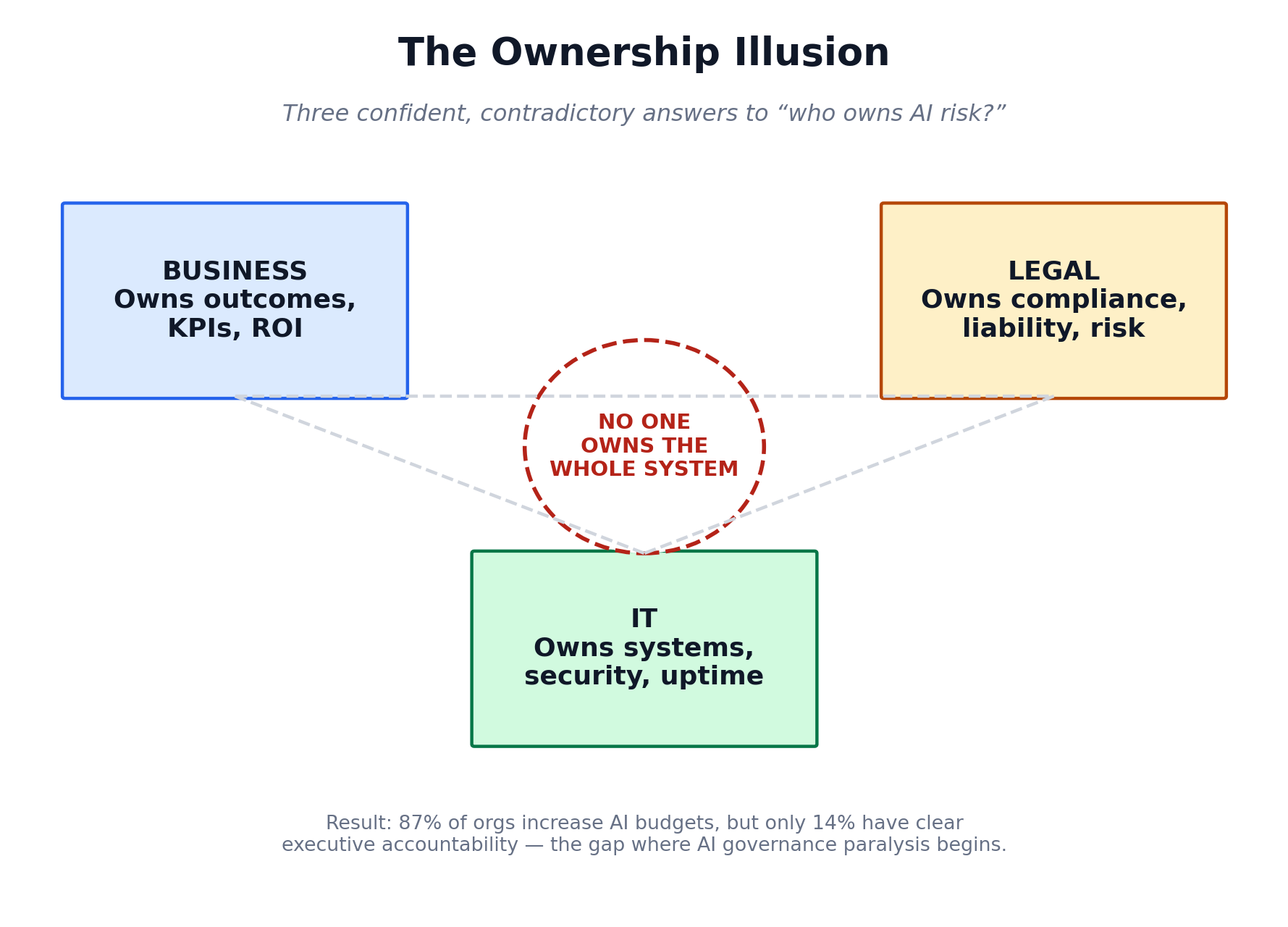
Ask a business leader, a CIO, and general counsel who owns AI risk at their company, and you’ll typically get three confident, contradictory answers. Business leaders own outcomes and KPIs. IT owns infrastructure, uptime, and security. Legal owns compliance and liability. Each is correct from their own vantage point — and collectively, no one owns the whole system.
Research cited by Techwave found that while 87% of organizations are increasing AI budgets, only 14% have clear executive accountability for AI decisions. That’s a 73-point gap between investment and ownership. When everyone owns a piece of the decision, decisions stop getting made. Nearly half of AI initiatives that fail cite this kind of internal friction as the reason, not the technology itself.
Regulatory Uncertainty and Data Immaturity
The pace mismatch between AI development and regulatory policy is real. A model can be retrained in a sprint; a regulation takes years to finalize. Snowflake’s research notes that by the time a governance framework accounts for existing law, the technology it was written for has often already moved on. Layered on top of that, many organizations simply don’t have the data maturity to govern AI with any confidence. They lack clean lineage, defined ownership, and auditable pipelines.
Leaders hesitate to approve systems they can’t explain or audit, and that hesitation compounds month over month.
Governance Theater
Perhaps the most corrosive driver of AI governance paralysis is what practitioners now call “governance theater” — committees, policy documents, and review checklists that exist to demonstrate oversight without actually shaping any decision.
A useful diagnostic: how long does it take your organization to deploy a low-risk model after it’s technically ready? If the answer is months, the bottleneck isn’t the model. If an AI-assisted decision caused harm tomorrow, could you trace exactly who was accountable for it? If the answer is no, the governance you have is decorative, not functional. And decorative governance is exactly what produces AI governance paralysis.
What Paralysis Actually Costs You
Organizations don’t stay neutral while they wait for perfect governance. CIO.com’s reporting on enterprise AI governance found that 65% of organizations have experienced at least one AI-agent-related incident in the past year. Nearly half have tied confirmed or suspected data leaks to unauthorized generative AI use.
The uncomfortable truth about AI governance paralysis is that it doesn’t prevent risk — it just relocates it.
Shadow AI fills the vacuum. When approval takes too long, employees don’t stop using AI — they stop asking permission. Surveys cited by Techwave found 98% of organizations have employees using unsanctioned AI tools. 60% openly admit to bypassing IT to hit deadlines. Shadow AI isn’t a discipline problem; it’s a predictable response to governance that can’t keep pace with the work.
Retirement debt accumulates invisibly. The Cloud Security Alliance found that only 21% of organizations have a formal process for decommissioning AI agents once they’re no longer needed. An agent that’s never turned off doesn’t sit idle. It still holds live credentials and standing system access, quietly widening the attack surface with nobody watching it.
Silent failures surface late and cost more. By the time a biased outcome or a compliance breach becomes visible, the handoffs and assumptions that caused it are long buried. Ownership is nearly impossible to reconstruct. These are the most expensive failures precisely because nobody learns from them until they repeat.
The Frameworks Already Out There — And Where They Stop
Credit where it’s due: the governance frameworks getting attention right now as responses to AI governance paralysis are genuinely well thought out. Two are worth understanding before you build anything of your own.
Triad Ownership + RACI. Rather than asking “who owns AI,” this model asks “who owns which dimension.” Business owns outcomes, IT owns systems and security, legal owns risk boundaries, and the decision to actually ship — the “when” — requires agreement across all three. RACI (Responsible, Accountable, Consulted, Informed) then maps that structure onto specific decisions so nobody’s guessing who signs off.
Singapore’s Model AI Governance Framework for Agentic AI. Rather than trying to legislate a moving target, Singapore’s IMDA built a framework designed to evolve. It’s sector-agnostic, principle-based, and versioned every six months rather than fixed for years. It assesses agents by two concrete dimensions: action-space (what the agent can actually touch — read-only vs. write access) and autonomy (how independently it decides). That specificity is exactly what most governance documents lack.
Databricks’ operationalized lifecycle. Databricks’ framework goes further than principles. It defines checkpoints across the AI development lifecycle — scope definition, data documentation, evaluation criteria, release gates, and post-deployment monitoring — so governance isn’t a single sign-off but a running process.
Here’s the pattern across all three: they’re excellent at defining who decides and when they should decide. What none of them fully solve is where that decision actually gets enforced once it’s made. A RACI chart doesn’t stop a misconfigured agent from writing to a production database at 2 a.m. A risk tier on a whiteboard doesn’t audit itself. That’s the layer this article exists to add.
The Missing Layer: Governance as Architecture, Not Policy
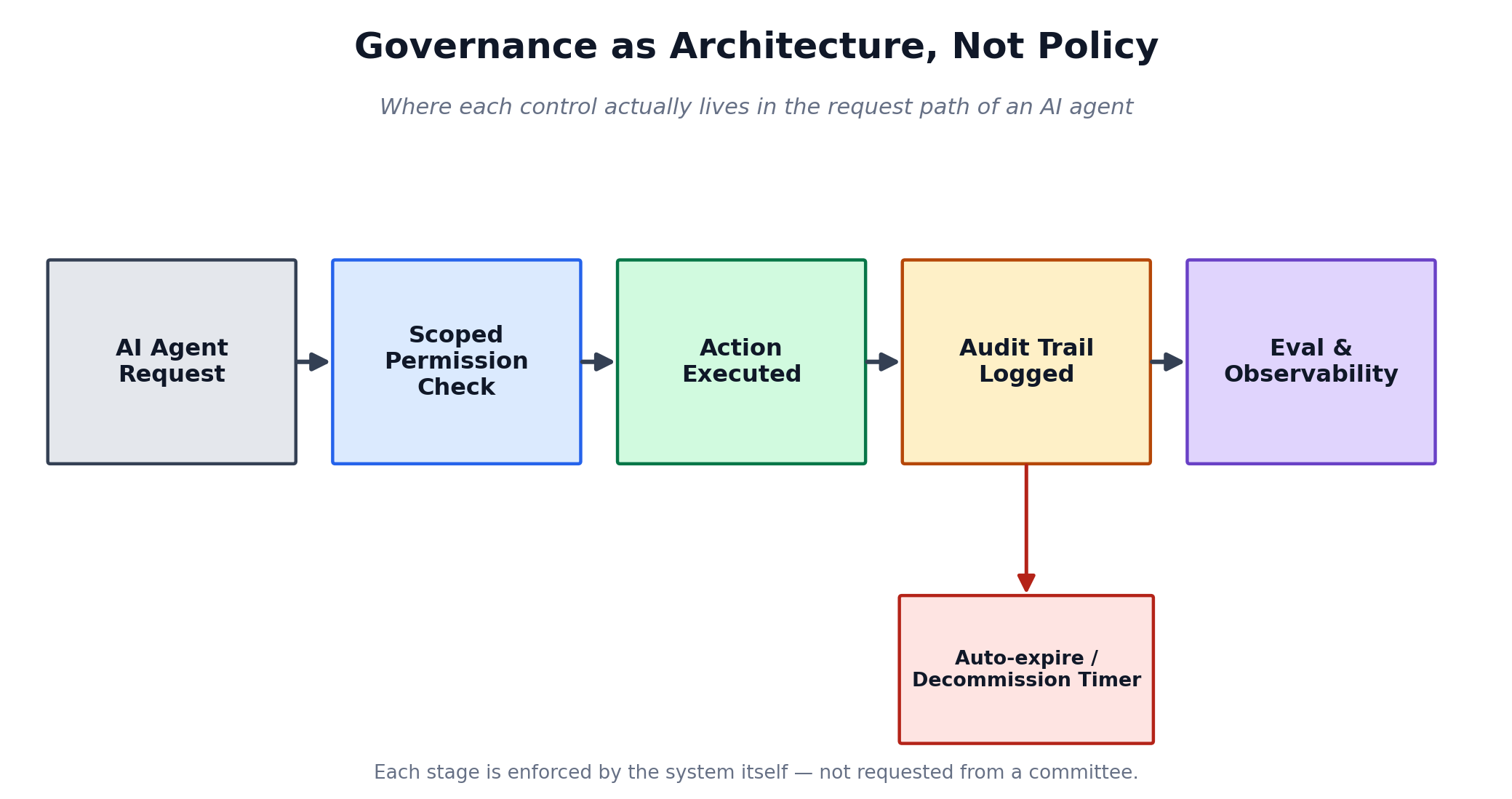
Paralysis persists because governance usually lives in documents and meetings, disconnected from the code paths where AI systems actually act. The fix isn’t more committees. It’s moving specific governance decisions out of policy and into the system itself, so they get enforced automatically instead of requested politely.
Audit Trails as Infrastructure, Not an Afterthought
If you can’t reconstruct who approved a system, what data it touched, and why it produced a given output, you don’t have governance — you have a policy document and a hope. Audit trails need to be a first-class part of the architecture. Every prompt, every tool call, and every data access should be logged with enough context to answer a regulator’s question six months later without a scramble.
This is the same discipline that already applies to handling sensitive data in production APIs. See our breakdown of securing sensitive data in ASP.NET Core APIs for the access-control and logging patterns that carry over directly to AI systems handling regulated data.
Scoped Permissions, Not Blanket Agent Access
Singapore’s framework asks whether an agent has read-only or write access, and whether it acts independently or waits for approval. That distinction needs to be enforced in code, not just documented in a risk assessment. An agent that can draft an email is a different risk than one that can send it unsupervised. An agent that can query a database is different from one that can write to it.
We’ve written in detail about how to design these boundaries technically in AI agent tool use: designing safe boundaries for production automation. The short version: permission scoping belongs in the tool-calling layer itself, with explicit allow-lists per action, not in a policy that trusts the agent to self-restrict.
Policy-as-Code Release Gates
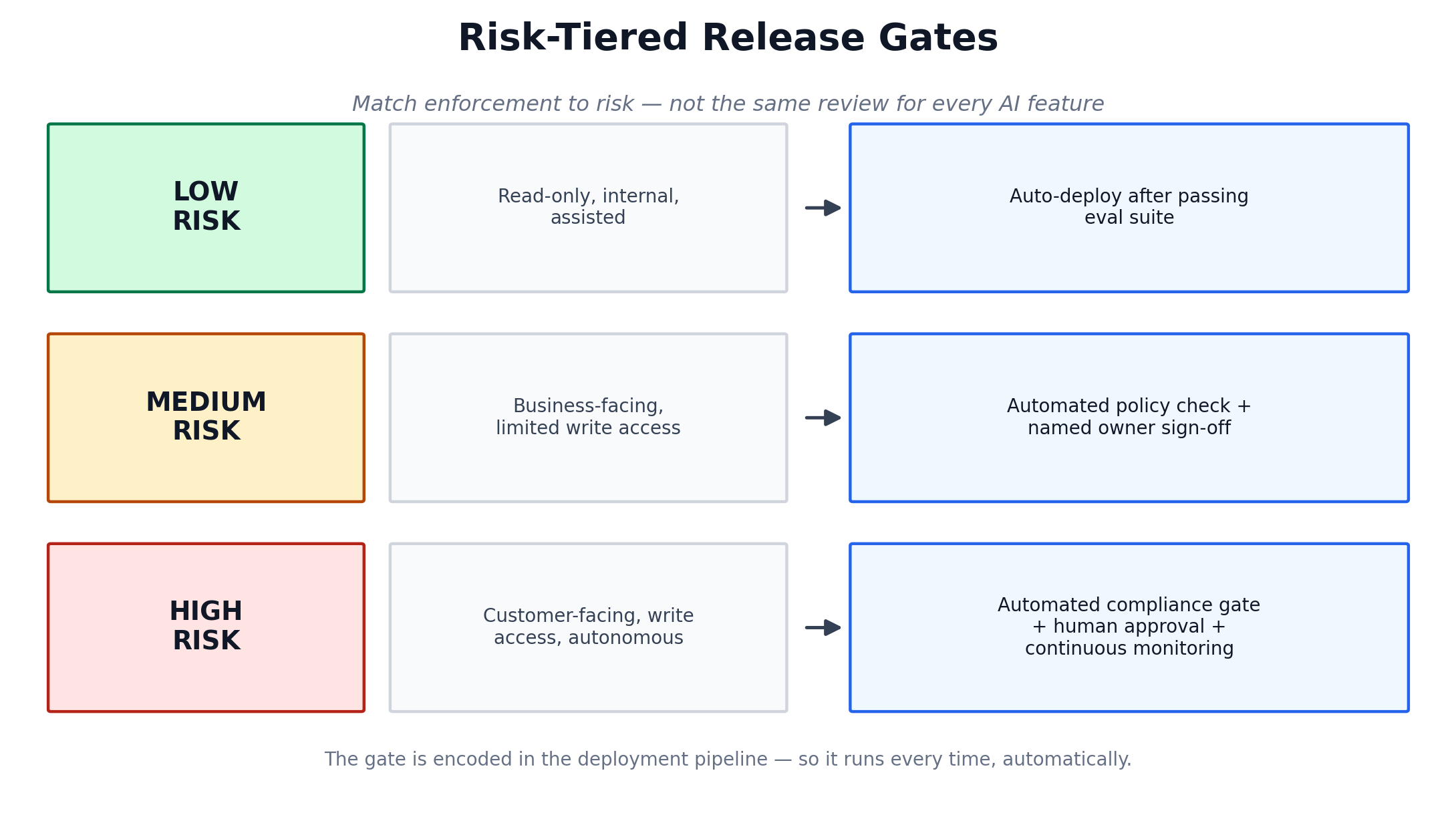
Databricks’ lifecycle model calls for release gates tied to risk tier. The paralysis-inducing version of this is a manual sign-off queue that stalls for weeks. The version that actually works is encoded directly into your deployment pipeline. A low-risk internal tool auto-deploys after passing its eval suite. A customer-facing agent with write access to billing data requires an automated compliance check plus a named human approver before it can reach production. The gate still exists — it just doesn’t depend on someone remembering to convene a meeting.
Automated Decommissioning
Retirement debt exists because turning something off requires someone to notice it’s no longer needed, and nobody’s job is to notice that. The fix is mechanical. Every agent and credential gets a default expiration or a scheduled access review baked into provisioning. Decommissioning becomes the default state that has to be actively extended, not a task that has to be actively remembered.
Evals and Observability as the Feedback Loop
One of the more useful ideas to come out of recent CIO reporting is that governance without measurement is just opinion with a calendar invite. Every AI capability needs a standard set of evaluation tasks and a scoring rubric that runs continuously, not just at launch. That’s what turns a decommissioning call, a rollback, or a scope change from a political argument into a decision the data made.
It’s also where model and vendor choice matters. The operational and cost tradeoffs between providers directly affect how much room you have for this kind of continuous evaluation — something we cover in our comparison of OpenAI vs. Anthropic APIs for production SaaS features.
A Practical Playbook: Breaking AI Governance Paralysis in Five Steps
- Inventory what’s already running. You can’t govern — or decommission — what you can’t see. Start with a real accounting of every AI feature and agent in production, sanctioned or not.
- Assign risk tiers, not blanket rules. Classify by action-space (read vs. write) and autonomy (assisted vs. independent), and match oversight to that tier instead of applying uniform review to everything.
- Move enforcement into the pipeline. Encode your risk-tier gates as automated checks in CI/CD, not as a manual approval queue. Reserve human sign-off for the tier that actually needs it.
- Build permission scoping and audit logging into the architecture from day one. This is far cheaper at design time than retrofitted after an incident — a point Singapore’s own framework makes explicitly.
- Give every system an expiration date. Default to time-boxed access and scheduled reviews so decommissioning happens automatically instead of depending on someone remembering.
None of these steps require a new committee. They require engineering time — which is exactly why they tend to get skipped in favor of another policy document that feels like progress but changes nothing.
What This Looks Like on an Actual SaaS Team
Picture a mid-size SaaS company bolting an AI assistant onto its product — summarizing customer tickets, drafting responses, eventually taking actions like updating account records. The governance-theater version of this project spends six weeks in a steering committee arguing about ownership, then produces a 40-page policy document. It ships the feature anyway because sales already promised it to a customer, with none of the policy actually enforced in the code.
The architecture-first version looks different. The ticket-summarization capability (read-only, assisted) ships immediately behind a lightweight eval suite — no committee needed, because the risk tier says it doesn’t require one. The account-update capability (write access, higher autonomy) is scoped to a specific, allow-listed set of fields. It’s gated behind a human-approval step encoded directly in the deployment pipeline, and every action it takes is logged with enough detail to reconstruct exactly what happened and why.
If usage patterns shift or the eval scores drop, the system flags it automatically instead of waiting for a customer complaint. This is the same multi-layered thinking that applies to access control generally — the kind of role and permission boundaries covered in our piece on Laravel Sanctum vs. Passport for API authentication maps directly onto how you’d scope what an AI agent is allowed to touch. It’s this kind of architecture that keeps AI governance paralysis from creeping back in as the product grows.
Nobody in this version is arguing about who owns AI risk in the abstract. The risk tiers and enforcement points were decided once, encoded into the system, and now apply automatically to every new capability that gets added.
Frequently Asked Questions About AI Governance Paralysis
Is AI governance paralysis the same thing as analysis paralysis? They’re related but not identical. Analysis paralysis is an individual decision-maker overthinking a single choice. AI governance paralysis is organizational. It happens when ownership is fragmented across business, IT, and legal, so that no single decision-maker exists to overthink in the first place. The fix for analysis paralysis is better individual judgment. The fix for governance paralysis is a structural one — clear decision rights enforced by the system, not just agreed to in a meeting.
How do we know if our organization has AI governance paralysis? A few diagnostic questions work well: How long does it take to deploy a low-risk, technically-ready model? If the answer stretches into months, the bottleneck is organizational, not technical. Could you name the specific person accountable if an AI-assisted decision caused harm tomorrow? If not, accountability is diffused past the point of being real.
Do you know how many AI agents are currently running in production, sanctioned or otherwise? Most organizations that answer confidently are wrong, per Cloud Security Alliance research showing a large majority discover unknown “shadow” agents every year despite high confidence in their visibility.
Do small companies and startups need to worry about this, or is it just an enterprise problem? Smaller teams are actually better positioned to avoid governance paralysis, not worse — they don’t have the entrenched committee structures that create the ownership illusion in the first place. The risk for smaller teams isn’t paralysis so much as skipping governance entirely because “we’re too small for that.”
The engineering patterns in this article — scoped permissions, audit logging, automated release gates — cost very little to build in from the start. They become exponentially more expensive to retrofit once a product has scaled, which is precisely the lesson Singapore’s government drew from building agentic AI governance into new digital infrastructure rather than bolting it on later.
What’s the single highest-leverage fix if we can only do one thing? Build the audit trail first. Every other fix — risk-tiered gates, scoped permissions, automated decommissioning — depends on being able to answer “what did this system do, and who approved it?” after the fact. Without that, even a well-designed governance framework is unenforceable, because there’s no record to enforce it against.
The Real Fix Isn’t More Meetings
AI governance paralysis is a real, well-documented problem. The organizations writing about it — Snowflake, Databricks, CIO, Singapore’s IMDA — have done serious work diagnosing why it happens and who should own what. But ownership charts and risk frameworks only end paralysis if they’re backed by something that enforces them without a human needing to remember to. That enforcement layer is architecture: audit trails that exist by default, permissions scoped in code rather than policy, release gates that run automatically, and decommissioning that happens unless someone actively extends it.
Engineering teams don’t have to wait for the perfect governance framework to arrive from legal or the board. The patterns above can be built into the next AI feature you ship, regardless of where your organization’s committee structure currently stands. And unlike a policy document, they actually stop the failure modes they’re designed to prevent.
Building something similar? See my AI integration services or hire a senior full-stack developer for your project.
