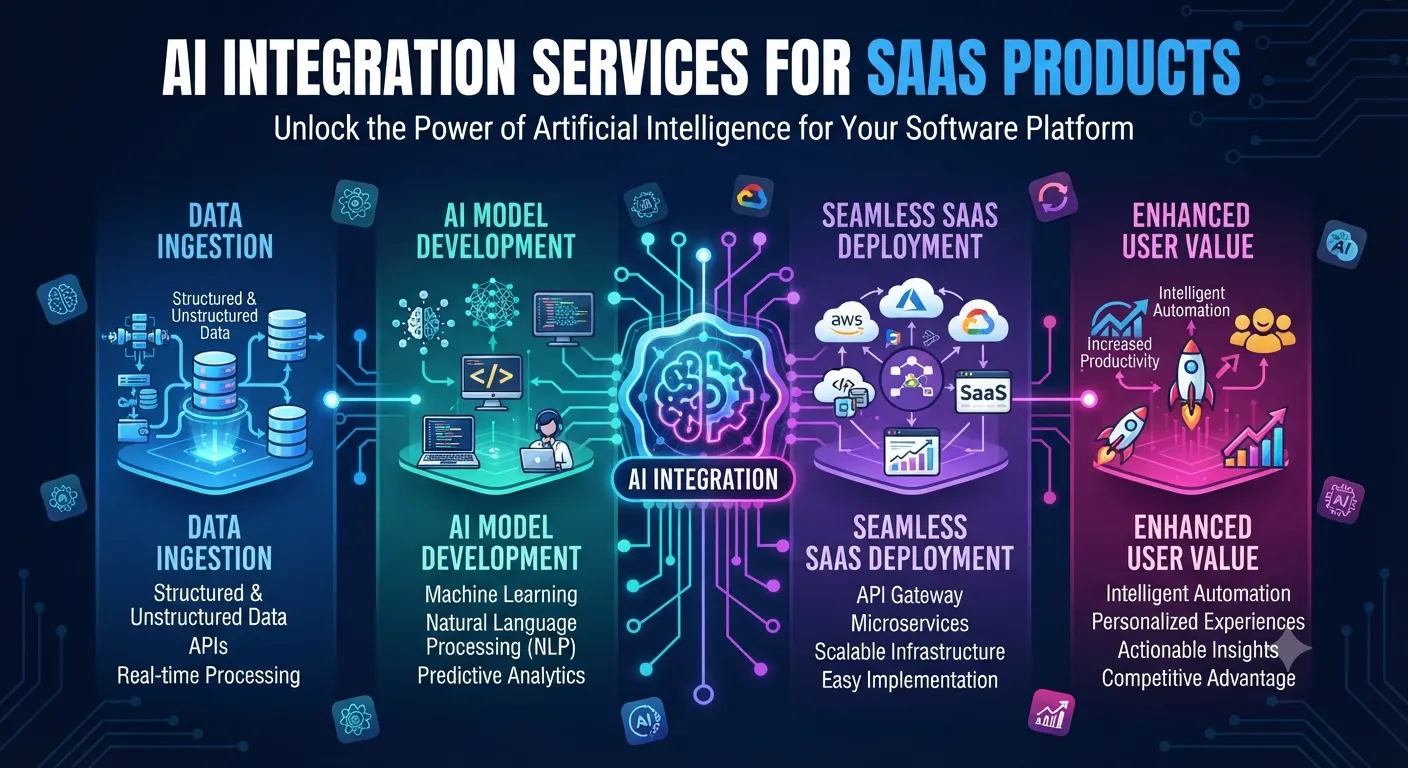
Looking for AI integration services that actually hold up in production? If you’re reading this page, you’ve probably already tried the fast path: a weekend with an LLM API and a demo that looked great until real users, real data, and real edge cases showed up. That gap — between “the model can do this” and “this reliably works in production” — is where most AI integration work actually happens, and it’s the part most teams underestimate.
I’m Faisal Nadeem, a full-stack and AI integration engineer based in Lahore, Pakistan, working remotely with EU and US clients for the past 6+ years. My core background is production SaaS engineering — Laravel, Node.js, ASP.NET Core, and Python, with Vue.js, React, and Next.js on the frontend. I’ve built subscription billing flows on Custimoo and WingWarranty, secure Azure AD-authenticated APIs for Specsavers’ Lonely Planet booking app, and backend systems for Minplan, a mental-health application where data sensitivity and uptime weren’t optional extras.
Over the last stretch of that work, I’ve specialized in the layer that sits on top of that foundation: retrieval-augmented generation with Qdrant and Neo4j, Claude Code agents and subagents, Model Context Protocol (MCP) servers, and OpenAI/Anthropic API integration. This page walks through what I actually build, how I think about the engineering underneath it, and how a project with me typically runs — no inflated case studies, just a clear account of the skills and the process.
What My AI Integration Services Build
RAG Pipelines (Qdrant + Neo4j Hybrid Retrieval)
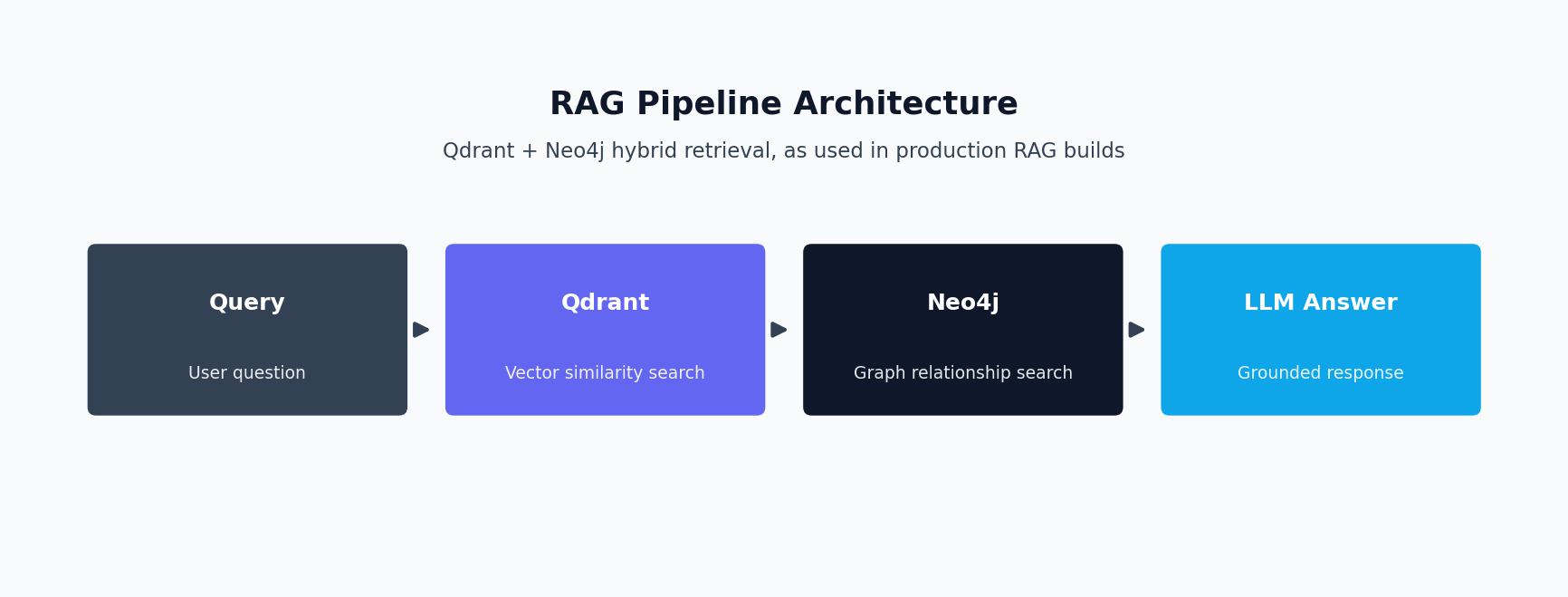
As one of the core AI integration services I offer, retrieval-augmented generation sounds abstract until you see the failure mode it fixes: an LLM that answers confidently and wrongly because it has no access to your actual data. A RAG pipeline gives the model a retrieval step before it generates a response, so answers are grounded in your documents, your database, your product — not just whatever the model memorized during training.
In practice, I build this as a hybrid system rather than a single vector lookup. Qdrant handles dense vector search — embedding chunks of your content and finding semantically similar passages fast, even across large document sets. But pure vector similarity misses relationships: “which contracts reference this vendor” or “what’s connected to this customer across three systems” isn’t a similarity question, it’s a graph question. That’s where Neo4j comes in — modeling entities and their relationships explicitly, so the retrieval step can traverse connections a vector search alone would never surface.
This is the part of my AI integration services that actually matters. The real engineering work is in between: chunking strategy that doesn’t destroy context, metadata filtering so retrieval respects permissions and tenancy, re-ranking so the top results are actually the most relevant, and assembling the final context window so the LLM gets what it needs without drowning in noise. Done well, this is what separates a RAG demo from a RAG system users trust with real questions.
AI Agents & Automation (Claude Code, Subagents, Tool Use)
Agent development is another pillar of my AI integration services. An AI agent, in the sense I build them, is an LLM given tools, a defined scope, and the ability to take multiple steps toward a goal instead of producing one static response. I work extensively with Claude Code’s agent and subagent architecture — designing systems where a primary agent delegates well-scoped subtasks to specialized subagents, each with its own tool access and context, rather than asking one model to do everything in one shot.
This matters for automation that needs to touch real systems: an agent that can query your database, call an internal API, trigger a Puppeteer script to interact with a third-party site without an API, or push a job onto a Bull queue for async processing — with guardrails on what it’s allowed to do and clear logging of what it did. Tool use is the mechanism that turns an LLM from a text generator into something that can actually execute work, and designing the tool boundaries correctly is most of the job: too permissive and you’ve built a liability, too narrow and the agent can’t do anything useful.
I also build hooks into these systems — pre- and post-execution checks that validate agent output before it touches production data, or that route certain actions to human approval. An agent that automates a workflow but has no circuit breaker isn’t automation, it’s a risk you haven’t priced yet.
MCP Server Development
MCP server development is a growing part of my AI integration services. Model Context Protocol (MCP) is a fairly new open standard — think of it as a universal adapter that lets an AI assistant (Claude, or others that adopt it) connect to your tools and data sources in a consistent way, instead of every integration being a one-off custom build. If you’ve used Claude Desktop or Claude Code and connected it to a database, a file system, or an internal API, that connection was very likely running through an MCP server.
For a business, this translates into something concrete: an MCP server exposing your product’s data or actions means any MCP-compatible AI client can safely query or operate on your system, with permissions and scope you define. That’s relevant whether you’re building an internal tool (your team’s Claude instance can now check order status or run a report) or a product feature (your customers’ AI assistants can interact with your platform directly).
It’s also, frankly, an area with real opportunity right now — the standard is new enough that well-built, well-documented MCP servers are still uncommon, and demand for people who understand both the protocol and how to secure it against a production system is ahead of supply. I build MCP servers with the same discipline I’d apply to any public-facing API: authentication, rate limiting, input validation, and scoped permissions, not just a demo that works when nothing goes wrong.
LLM API Integration (OpenAI, Anthropic, and Production Realities)
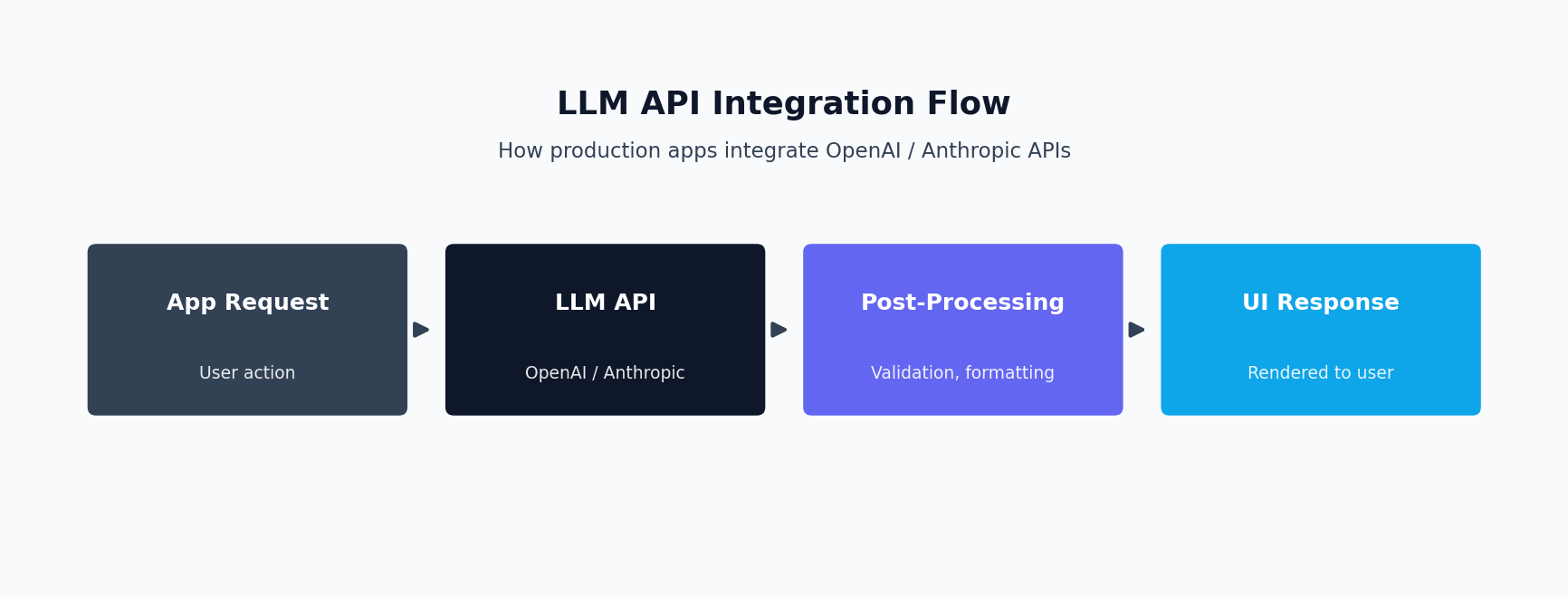
LLM API integration rounds out my AI integration services offering. Calling an LLM API is the easy 10%. The other 90% is what makes it production-grade: streaming responses so users aren’t staring at a spinner for 20 seconds, function calling / structured outputs so the model’s response can actually drive your application logic instead of requiring a human to parse prose, and fallback handling for when the API times out, rate-limits you, or returns something malformed.
Cost control is a real engineering concern for AI integration services, not an afterthought — token usage adds up fast at scale, and I build in prompt caching, context trimming, and model selection logic (using a smaller/cheaper model for simple tasks, escalating to a stronger one only when needed) so the AI feature doesn’t quietly become the biggest line item on your infra bill.
Evaluation is part of every AI integration services engagement. I also build evals — structured test sets that measure whether a prompt or pipeline change actually improved output quality, rather than relying on “it looks better to me.” Without evals, you’re tuning prompts blind, and regressions slip into production unnoticed. This is the same instinct as automated testing in traditional software engineering, applied to a component that’s inherently less deterministic.
Why a Full-Stack Engineer for AI Integration Services
The model is not the hard part anymore. OpenAI and Anthropic have made the raw intelligence a commodity you access through an API call. The hard part — the part that determines whether an AI feature actually ships and keeps working — is everything around it: authentication so the right users can access the right data, webhooks so your AI feature stays in sync with the rest of your system, queues (I use Bull regularly) so long-running AI tasks don’t block your app or time out mid-request, and billing logic so AI-powered features fit into your existing subscription model without breaking Stripe, Reepay, or Fenerum integrations you already have running.
This is exactly the layer I’ve spent 6+ years in before specializing in AI integration services. I’ve built subscription billing on two SaaS platforms from the ground up, secured APIs behind Azure Active Directory for a healthcare-adjacent booking system, and built backend infrastructure for an application where a bug isn’t just an inconvenience — it’s Minplan, a suicide-prevention app, where reliability and data handling had to be right the first time.
I don’t have a flagship “AI case study” with a client logo on it yet — I’m being direct about that rather than dressing up a side project as something it isn’t. What I do have is the harder-to-fake asset: years of shipping production SaaS systems where auth, payments, and uptime actually mattered, now paired with focused, hands-on depth in RAG, agents, and MCP. If your AI feature needs to survive contact with real users, real load, and a real billing system, that combination is the point.
How AI Integration Services Projects Typically Work
1. Discovery call. A free, no-obligation conversation about what you’re trying to build, what data or systems it needs to touch, and what “working” looks like for your users. This is where I ask the questions that determine feasibility, not just scope.
2. Feasibility & scoping. I assess whether the idea is a good fit for RAG, an agent, a direct API integration, or some combination — and flag early if something is genuinely hard (real-time low-latency requirements, highly sensitive data, unrealistic accuracy expectations) rather than promising it’s easy and finding out later. You get a written scope and a recommendation on hourly vs. fixed-price before anything starts.
3. Build. Development happens in visible increments — you’re not waiting six weeks for a reveal. For agent or RAG work specifically, I build the retrieval or tool-use layer first and validate it against real examples before layering on UI or polish.
4. Eval & iterate. I test against a defined set of realistic queries or scenarios, not just happy-path demos. This is where prompt tuning, retrieval tuning, and cost tuning happen — with measurable comparisons, not guesswork.
5. Handover. Documentation, a walkthrough of how the system works and where its limits are, and a clear picture of what it costs to run at your expected volume. If you want ongoing support after that, we set up a retainer; if not, you own a system you actually understand.
Engagement & Pricing
I haven’t published flat-rate pricing for my AI integration services because the work varies too much in scope to make a single number honest — a small proof-of-concept and a production RAG pipeline serving thousands of users are not the same job, and pretending otherwise upfront usually means someone gets a bad surprise later. Here’s how I actually structure it:
Hourly — best for exploratory work: a feasibility spike, a technical audit of an existing AI feature, or early-stage work where the scope is still taking shape. You’re paying for expertise applied to an open question, not a fixed deliverable.
Fixed-price — best once we’ve scoped a defined build: a specific RAG pipeline, a specific MCP server, a specific agent workflow with clear inputs and outputs. This comes after a scoping conversation, not before — I don’t quote a fixed price on something neither of us has fully defined yet.
Retainer — best for ongoing work: ongoing eval maintenance, model/prompt updates as APIs evolve, feature additions to an existing AI system, or general availability for a team that wants an AI-focused engineer on call without a full-time hire.
Every engagement starts with a free scoping call so pricing for AI integration services is based on your actual project, not a generic rate card.
For background on the open standard referenced above, see the official Model Context Protocol specification. If your project needs backend work alongside these AI integration services, see my Laravel SaaS development, Node.js development, and ASP.NET Core development pages.
FAQ
Do I need a data scientist or ML engineer instead of AI integration services?
Usually not, unless you’re training or fine-tuning your own models from scratch. Most business AI features — chat over your data, an automation agent, an AI-powered feature inside your existing product — use pretrained models like Claude or GPT through an API. The engineering challenge is integration, retrieval, and reliability, which is a software engineering problem more than a data science one.
What’s the difference between a chatbot and a RAG pipeline?
A chatbot without retrieval is answering from general training knowledge and will confidently hallucinate details about your specific business. A RAG pipeline retrieves relevant, current information from your actual data before generating a response, so answers are grounded in something real and traceable.
Can you work with our existing tech stack, or do we need to rebuild?
I integrate into existing systems rather than requiring a rebuild — that’s the point of specializing in Laravel, Node.js, ASP.NET Core, and Python plumbing alongside the AI layer. If your product runs on one of these stacks (or a compatible one), the AI features get built into it, not bolted on as a separate system.
How do you keep AI API costs under control?
Through prompt caching, context trimming, model tiering (cheaper models for simple tasks, stronger ones only when needed), and monitoring token usage against defined budgets. This gets planned during scoping, not discovered after the first invoice.
What is MCP and do I actually need it?
Model Context Protocol is a standard way for AI assistants to connect to tools and data. You need it if you want an AI assistant (internal or customer-facing) to safely query or act on your system, or if you’re building a product feature meant to work with AI clients like Claude. If you just need a single chatbot feature, a direct API integration may be simpler — this gets decided during the scoping call.
How do you handle sensitive or regulated data?
With the same discipline I’ve applied to healthcare-adjacent and mental-health-application backends: scoped access, minimal data exposure to the model, audit logging, and explicit conversations upfront about what data can and can’t leave your infrastructure or be sent to a third-party API.
Do you offer ongoing support after the project ships?
Yes, structured as a retainer. AI APIs and models change faster than typical software dependencies, so ongoing eval checks and prompt/version maintenance are worth planning for rather than treating the build as a one-time deliverable.
How long does a typical RAG or agent project take?
It depends heavily on data volume, integration complexity, and how well-defined the scope is going in — which is exactly why scoping happens before a timeline is committed to, not after.
What exactly do your AI integration services include?
My AI integration services cover the full stack: RAG pipelines built on Qdrant and Neo4j, MCP server development, Claude Code agents and subagents, and production-grade LLM API integration with OpenAI and Anthropic. Unlike a narrow AI consultancy, these AI integration services also include the surrounding engineering — auth, billing, and queues — that most standalone AI integration services leave for you to bolt on afterward.
Who are your AI integration services a good fit for?
SaaS teams and founders who already have a working product and want to add a genuinely useful AI feature, not a chatbot bolted on for the sake of it. My AI integration services are built for teams that need the AI layer to hold up under real traffic, real data, and real billing logic, not just a demo that impresses in a meeting and breaks in production.
How are your AI integration services priced?
Hourly for exploratory work, fixed-price once a specific build is scoped, or a retainer for ongoing AI integration services after launch — see the Engagement & Pricing section above for the full breakdown of how each option works.
Do AI integration services replace my existing development team?
No — my AI integration services are designed to plug into your existing engineering, not replace it. I work alongside in-house teams as often as I work solo, handing off documented, maintainable AI integration services rather than a black box only I can touch.
AI Integration Services — Let’s Scope Your Project
If you’re evaluating whether AI integration services are actually feasible for your product, or you already know you need a RAG pipeline, an MCP server, or an agent workflow built properly, the first step is a free consultation call — no obligation, and no pressure to commit before we’ve defined the scope together. I’ll tell you directly if something isn’t a good fit rather than take on work that won’t hold up in production.
