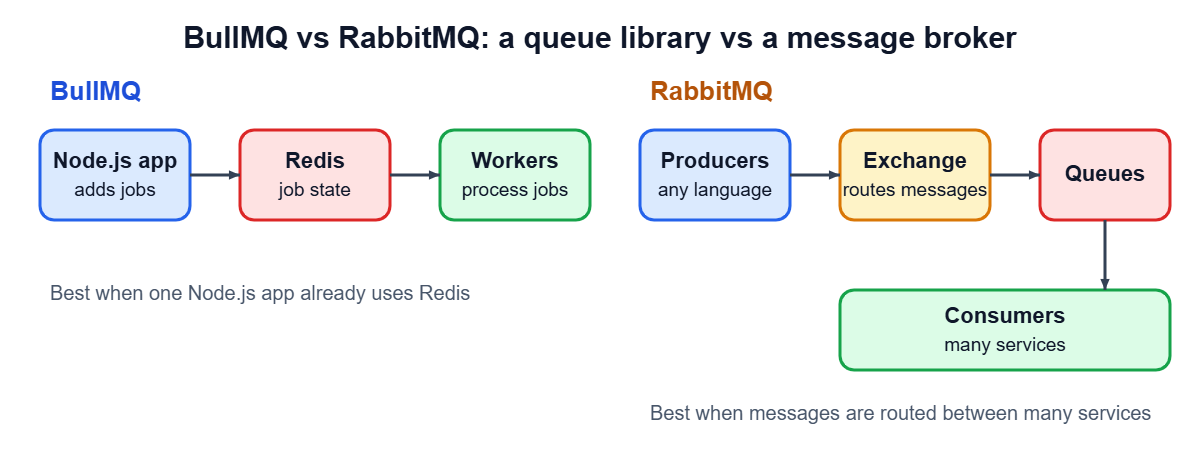
Short answer: For BullMQ vs RabbitMQ: if you run a Node.js application (or a few Node.js services) and already have Redis, use BullMQ. If messages must be routed between many services, written in different languages, through a standalone broker that you operate on its own, use RabbitMQ. They overlap on “do this work later”, but they are different kinds of tools.
For the details of each tool, see the BullMQ documentation and the RabbitMQ documentation.
Table of Contents
BullMQ and RabbitMQ solve different problems
BullMQ is a Node.js library that stores jobs in Redis. You create a queue, add jobs, and run workers that process them. It comes with what background jobs usually need: retries with backoff, delayed jobs, priorities, rate limiting, repeatable jobs and parent-child job flows. The queue lives inside your application stack, and the only extra dependency is Redis.
RabbitMQ is a general-purpose message broker. Producers publish messages to exchanges, bindings route them to queues, and consumers read from those queues, usually over AMQP. It does not care what language the producer or consumer is written in, and Node.js talks to it through a client such as amqplib. What it gives you is routing, fan-out and decoupling between systems. It is not a ready-made job-processing framework.
That difference decides most of the comparison: BullMQ is a job queue you embed, and RabbitMQ is infrastructure you run. If you are still choosing between queue libraries, my comparison of Bull and BullMQ covers that side of the decision.
BullMQ vs RabbitMQ at a glance
| BullMQ | RabbitMQ | |
|---|---|---|
| Type | Node.js job queue library | Standalone message broker (AMQP) |
| Storage | Redis | Its own durable queues (classic, quorum, streams) |
| Languages | Node.js first; ports to a few other languages exist | Any language with an AMQP client |
| Delivery | Job is held until a worker finishes it; stalled jobs are retried | Message is held until a consumer acknowledges it; unacknowledged messages are redelivered |
| Retries | Built in: attempts and backoff per job | Not built in: negative acknowledgements, dead-letter exchanges, retry queues |
| Delayed and scheduled work | Built in: delayed jobs, repeatable jobs, schedulers | No native delay (TTL plus dead-letter exchange, or a plugin); no built-in cron |
| Rate limiting | Built in: limiter on the worker | Not built in: limit concurrency with consumer prefetch |
| Routing and fan-out | One queue per job type | Exchanges, bindings, topics and fan-out |
| High availability | Depends on how you run Redis | Clustering; quorum queues replicate data across nodes |
| What you operate | Redis, which you may already run | A broker and its Erlang runtime |
| Best for | Background jobs inside a Node.js system | Messaging and integration between services |
Reliability: acknowledgements, retries and duplicates
In practice both systems give you at-least-once processing. A job or message that a worker started but never finished will come back, so your handler can run twice. Neither tool gives you exactly-once processing, which means idempotency is your job: use a unique key per operation and check it before you charge a card, send an email or write a record.
In BullMQ, a job is active while a worker holds its lock. If the worker crashes, or blocks the event loop for too long, the job is treated as stalled and goes back to the wait list. You set attempts and backoff per job, and failed jobs are kept so you can inspect and retry them. Set removeOnComplete and removeOnFail, otherwise finished jobs pile up in Redis.
In RabbitMQ, a consumer reads a message and acknowledges it only after the work succeeds. If the connection drops first, the broker redelivers it. For failures you choose the policy: reject the message into a dead-letter exchange, or republish it to a retry queue with a delay. That is more work than a single attempts option, but it gives you more control over where failed messages end up. For durability, declare queues as durable, publish messages as persistent, and use publisher confirms so you know the broker has taken responsibility for each message.
BullMQ is only as durable as your Redis configuration. With default snapshotting you can lose the most recent jobs after a crash, so enable append-only persistence if jobs matter, and set the eviction policy to noeviction so Redis never drops queue data to free memory.
Delays, scheduling and rate limiting
This is where BullMQ saves the most code. Delayed jobs, repeatable (cron-style) jobs, priorities and a rate limiter are options on the queue or worker, and flows let one job wait for others. Some advanced features, such as group-based rate limiting, belong to the commercial BullMQ Pro.
RabbitMQ can delay messages, but not natively. The usual patterns are a per-message TTL on a holding queue that dead-letters into the real queue, or the delayed message exchange plugin. There is no cron scheduler, so scheduled work needs something else to publish messages on time. Rate limiting is also indirect: prefetch caps how many unacknowledged messages a consumer holds, which limits concurrency but is not a requests-per-second limiter. Priority queues exist, but you declare a maximum priority up front and they work best when kept simple.
Routing and multiple consumers
If one event must reach several independent services, RabbitMQ is the better fit. A fanout or topic exchange copies the message to every bound queue, and each service consumes at its own pace. Consumers can be written in different languages, and you can add a new one without touching the producer.
BullMQ models work, not events. A job goes to one queue and is processed once by one worker. You can imitate fan-out by adding the same job to several queues, but then you are rebuilding what an exchange already does. BullMQ is also designed around Node.js. Ports for a few other languages exist, but the Node.js library is the mature one.
What you have to run
Many Node.js teams already run Redis for caching or sessions. BullMQ adds a dependency on it but no new server, which keeps operations simple for a small team. Treat that Redis as important infrastructure if jobs matter, because persistence, memory limits and the eviction policy all affect how safe your queue is.
RabbitMQ is another stateful service to deploy, monitor, secure and upgrade. It ships with a management interface and mature tooling, and quorum queues give you replicated, durable queues across a cluster. That is real value when several teams depend on the broker, and real overhead when a single application only needs background jobs.
The same task in both
Here is a “send a welcome email” job with retries, first in BullMQ.
import { Queue, Worker } from 'bullmq';

const connection = { host: '127.0.0.1', port: 6379 };

export const emailQueue = new Queue('emails', { connection });

// Producer: add a job with retries and clean-up rules
await emailQueue.add(
  'welcome',
  { userId: 42 },
  {
    attempts: 5,
    backoff: { type: 'exponential', delay: 2000 },
    removeOnComplete: 1000,
    removeOnFail: 5000,
  },
);

// Worker: process up to 10 jobs at a time
const worker = new Worker(
  'emails',
  async (job) => {
    await sendWelcomeEmail(job.data.userId); // must be idempotent
  },
  { connection, concurrency: 10 },
);

worker.on('failed', (job, err) => {
  console.error('Job failed', job?.id, err.message);
});
And the same job with RabbitMQ and amqplib.
import amqp from 'amqplib';

const conn = await amqp.connect(process.env.AMQP_URL);
const ch = await conn.createConfirmChannel();

await ch.assertQueue('emails', { durable: true });

// Producer: persistent message, confirmed by the broker
ch.sendToQueue(
  'emails',
  Buffer.from(JSON.stringify({ userId: 42 })),
  { persistent: true },
);
await ch.waitForConfirms();

// Consumer: limit unacknowledged messages, acknowledge after success
await ch.prefetch(10);
await ch.consume('emails', async (msg) => {
  if (!msg) return;
  try {
    const { userId } = JSON.parse(msg.content.toString());
    await sendWelcomeEmail(userId); // must be idempotent
    ch.ack(msg);
  } catch (err) {
    // requeue = false sends it to a dead-letter exchange if one is configured
    ch.nack(msg, false, false);
  }
});
Look at what you still write yourself. In BullMQ, retries and backoff are one option. In RabbitMQ, the retry policy (dead-letter exchange, retry queue, delay) is yours to design. In both, the idempotency check is yours.
BullMQ vs RabbitMQ: which one should you choose?
- One Node.js app or monolith, Redis available, jobs like emails, PDFs, imports and webhooks: BullMQ.
- You need delayed jobs, cron-style schedules, per-job retries and a simple dashboard: BullMQ.
- Several services in different languages must exchange messages: RabbitMQ.
- One event must reach many consumers, or you need routing by topic: RabbitMQ.
- You want a broker with its own replication that is operated separately from your application cache: RabbitMQ.
- Very high-volume event streams that consumers replay: look at Kafka or RabbitMQ streams instead of either default.
- Small team with nobody to run another stateful system: start with BullMQ, and add RabbitMQ when integration needs justify it.
Common BullMQ vs RabbitMQ mistakes
- Assuming exactly-once processing. Make every handler idempotent.
- Letting Redis evict or lose queue data. Use
noevictionand enable persistence. - Never cleaning up finished jobs. Set removal options so Redis memory stays bounded.
- Blocking the event loop inside a worker. Long CPU work stalls jobs, so move it to a sandboxed processor or a separate process.
- Using RabbitMQ with automatic acknowledgements. Messages are lost if the consumer crashes, so acknowledge manually.
- Leaving prefetch unbounded. One consumer can grab every message while the others sit idle.
- Choosing RabbitMQ for simple background jobs and then rebuilding retries, delays and scheduling by hand.
For the failure-handling side of queue code, see Node.js error handling patterns for production queue systems and why unhandled promise rejections silently kill jobs.
Frequently asked questions
Can BullMQ replace RabbitMQ?
For background jobs inside a Node.js system, often yes. For messaging between services in different languages, routing and fan-out, no.
Is RabbitMQ better than a Redis queue?
Not in general. RabbitMQ is better at routing and decoupling between systems, while a Redis-backed queue is simpler for jobs inside one application. Choose by the problem you have.
Can I use both?
Yes, and many systems do. RabbitMQ carries events between services, and each service uses BullMQ for its own background work.
Conclusion: BullMQ vs RabbitMQ
Pick BullMQ when you need a job queue for a Node.js application, and RabbitMQ when you need a broker between systems. If your honest answer is “we need both”, that is a sign the architecture is growing up, not a mistake. If you want a second opinion on a queue design for a production system, I build Node.js backends with queues, integrations and AI features. You can see how I work on the Node.js developer page.
Related reading: how to test BullMQ workers in Node.js · BullMQ rate limiting in Node.js.
