Short answer: Production Node.js error handling needs more than try/catch: handle errors centrally, make failures in queue workers visible and retryable, and log enough context to debug them, so one failed job never fails silently.
Most articles about Node.js error handling stop at try/catch and a stack trace in the console. That advice falls apart the moment you move from handling an HTTP request to processing a background job. In a queue system, there is no client waiting on the other end of a socket to receive your 500 response — there is a worker process, a job payload, a retry counter, and potentially thousands of jobs behind it in the pipeline. Get the error handling wrong and you don’t just fail one request; you can stall an entire queue, silently drop jobs, or crash a worker that was supposed to be running unattended at 3 a.m. This post focuses specifically on the patterns that matter for production queue and worker systems built with tools like BullMQ, Bull, or a hand-rolled job runner — not the basics you already know.
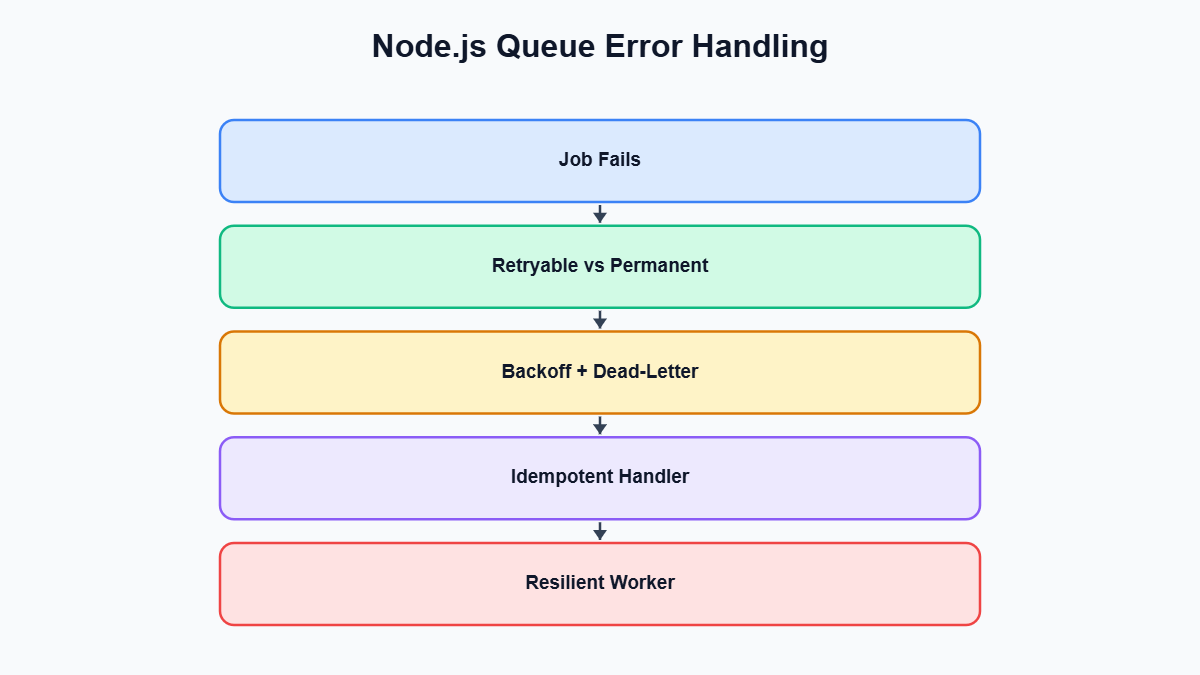
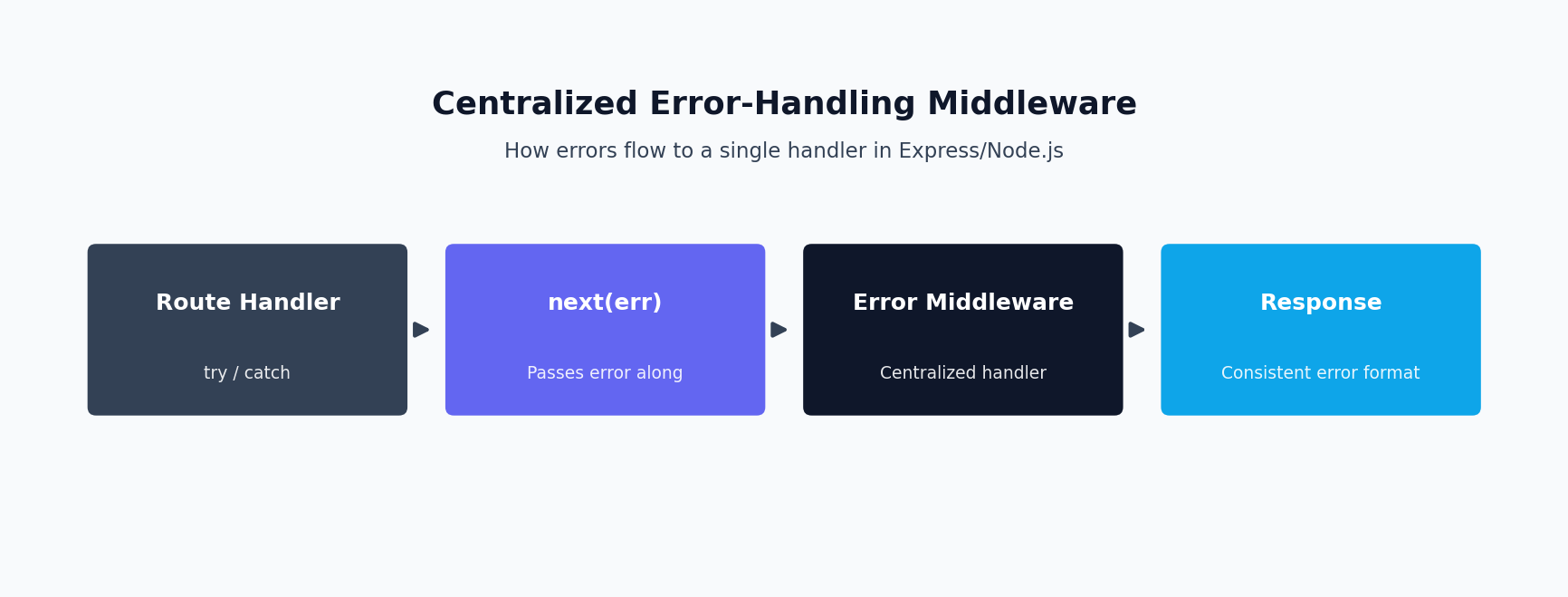
Why Queue-Based Error Handling Is Structurally Different
In a request/response cycle, an error has one natural home: the response. You catch it, log it, map it to a status code, and send it back. The transaction ends there. Queue processing breaks that model in a few important ways. First, there is no caller waiting synchronously — the “caller” is a scheduler that queued the job minutes, hours, or days ago and has since moved on. Second, a single worker process typically handles many jobs in sequence (or in parallel, depending on concurrency settings), so an error in one job’s handler can, if mishandled, take down the process that is also responsible for dozens of other in-flight jobs. Third, queues are built around the assumption that failure is normal and recoverable — that’s the entire point of having a retry mechanism and a persistence layer instead of just calling a function directly.
This changes what “handling” an error even means. In request/response code, handling an error usually means presenting it to the user. In queue processing, handling an error means deciding what happens to the job next: does it retry, does it go to a dead-letter queue, does it get discarded, or does it need a human? That decision is the actual substance of production-grade Node.js error handling for background systems, and it’s where most implementations are dangerously underspecified.
Retryable vs Permanent Failures: Classifying Errors Before You Retry
The single biggest structural mistake in queue error handling is treating all errors the same way. Not every failure deserves a retry, and blindly retrying everything is how you end up hammering a downstream service that’s already down, or endlessly reprocessing a job that will never succeed no matter how many times you run it.
Failures generally split into two categories:
- Retryable (transient) failures — network timeouts, connection resets, rate-limit responses (HTTP 429), temporary database unavailability, third-party API outages. These are conditions that are plausibly different on the next attempt.
- Permanent (poison-pill) failures — malformed job payloads, validation errors, missing required fields, references to records that don’t exist, business-logic violations. Retrying these wastes queue throughput because the outcome will be identical every time.
A poison-pill job that isn’t identified as such can be catastrophic in a naive retry setup: it consumes a worker slot, fails, gets requeued, consumes another slot, fails again, and repeats until it exhausts its retry budget — meanwhile healthy jobs behind it in a FIFO queue may be delayed. The fix is to classify the error at the point of catching it and make an explicit decision rather than a default one. A simple, effective approach is to throw distinguishable error types from your job logic so the processor (or the queue library’s retry logic) can branch on them.
class RetryableError extends Error {
  constructor(message, cause) {
    super(message);
    this.name = 'RetryableError';
    this.retryable = true;
    this.cause = cause;
  }
}

class PermanentError extends Error {
  constructor(message, cause) {
    super(message);
    this.name = 'PermanentError';
    this.retryable = false;
    this.cause = cause;
  }
}

function classifyError(err) {
  // Network-level failures are almost always worth retrying
  if (err.code === 'ECONNRESET' || err.code === 'ETIMEDOUT' || err.code === 'ECONNREFUSED') {
    return new RetryableError(`Transient network failure: ${err.message}`, err);
  }

  // HTTP 429 / 503 from an upstream API are transient by definition
  if (err.status === 429 || err.status === 503) {
    return new RetryableError(`Upstream rate limited or unavailable: ${err.message}`, err);
  }

  // Validation and schema errors will never succeed on retry
  if (err.name === 'ValidationError' || err.status === 400 || err.status === 422) {
    return new PermanentError(`Invalid job payload: ${err.message}`, err);
  }

  // Unknown errors are treated conservatively as retryable, capped by attempt count
  return new RetryableError(`Unclassified error: ${err.message}`, err);
}
Notice the fallback: unknown errors default to retryable rather than permanent. That’s a deliberate bias — discarding a job outright is a one-way door, while a bounded retry is cheap insurance against transient conditions you didn’t anticipate. The key is that the retry has to be bounded, which brings us to backoff strategy.
Exponential Backoff and Retry Strategies
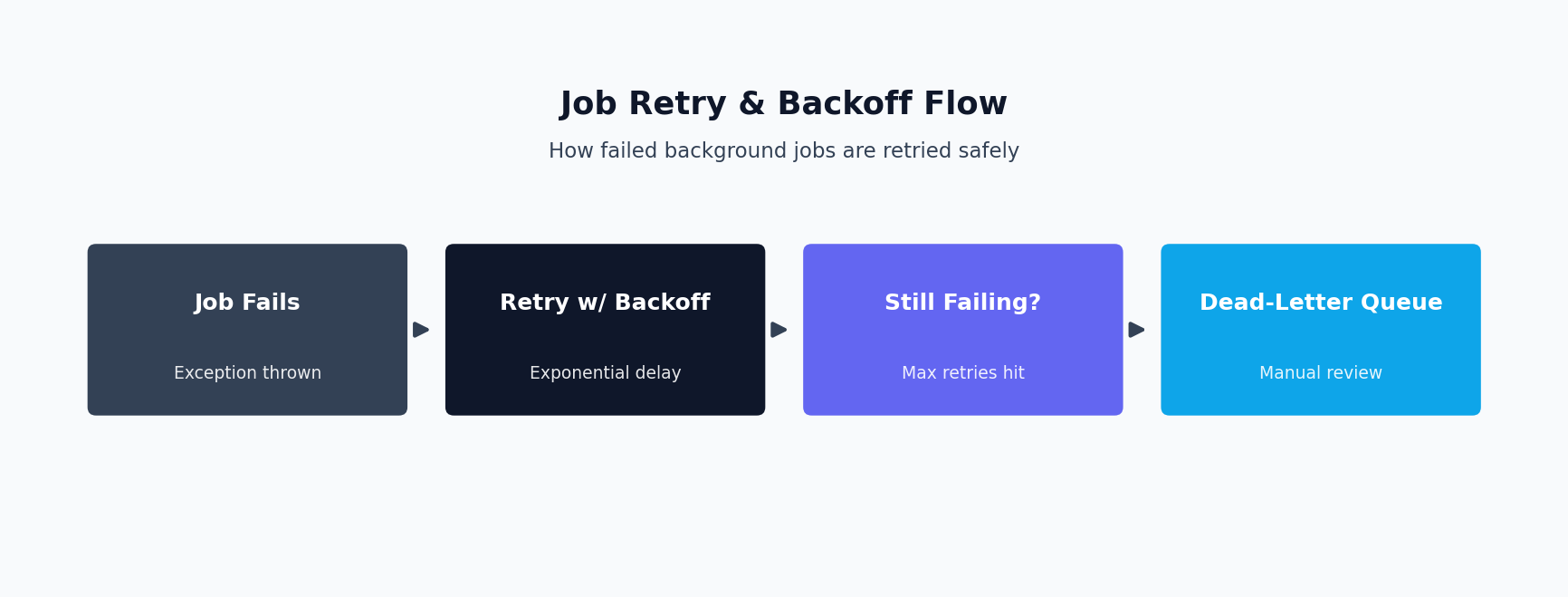
Retrying immediately after a failure is often worse than not retrying at all, especially when the failure is caused by an overloaded downstream dependency. If ten thousand jobs all fail because a database connection pool is exhausted, and all ten thousand retry instantly, you’ve just recreated the exact load spike that caused the outage. Exponential backoff — increasing the delay between each retry attempt — gives the failing dependency room to recover and spreads retry load out over time instead of concentrating it.
Most queue libraries, including BullMQ, support backoff configuration natively per job or per queue, but it’s worth understanding the pattern underneath so you can reason about edge cases like backoff caps and jitter. Jitter (adding a small random offset to each delay) matters because without it, many jobs that failed at the same instant will also retry at the same instant, producing synchronized “thundering herd” spikes even with exponential growth.
function computeBackoffDelay(attemptNumber, {
  baseDelayMs = 1000,
  maxDelayMs = 60_000,
  jitterRatio = 0.2,
} = {}) {
  const exponential = baseDelayMs * Math.pow(2, attemptNumber - 1);
  const capped = Math.min(exponential, maxDelayMs);
  const jitter = capped * jitterRatio * Math.random();
  return Math.floor(capped - (capped * jitterRatio) / 2 + jitter);
}

// BullMQ-style worker using custom classification plus backoff-aware retry
const { Worker } = require('bullmq');

const worker = new Worker('email-notifications', async (job) => {
  try {
    await sendTransactionalEmail(job.data);
  } catch (rawErr) {
    const err = classifyError(rawErr);

    if (!err.retryable) {
      // Permanent failure — do not let BullMQ retry this job
      job.discard();
      throw err;
    }

    // Let BullMQ's built-in attempts/backoff config handle the retry,
    // but log the computed delay for observability
    const nextDelay = computeBackoffDelay(job.attemptsMade + 1);
    job.log(`Retryable failure, next attempt in ~${nextDelay}ms`);
    throw err;
  }
}, { connection: redisConnection, concurrency: 5 });
In practice, you’ll usually configure BullMQ’s declarative attempts and backoff options on the job itself rather than computing delays by hand, but the manual version above is useful when you need custom logic — for example, different backoff curves for different error classes, or a shorter cap for time-sensitive jobs like payment webhooks versus a longer cap for batch reporting jobs. The important discipline is setting a maximum attempt count on every job. An unbounded retry loop on a queue is one of the most common causes of “why is this worker pegged at 100% CPU with nothing visibly wrong” incidents.
Dead-Letter Queues and Failed-Job Handling
Once a job exhausts its retry attempts, or is classified as a permanent failure up front, it needs somewhere to go that isn’t silent deletion. A dead-letter queue (DLQ) — a separate queue or storage location for jobs that could not be processed successfully — is the standard pattern, and it exists for a reason beyond tidiness: it preserves the job payload and failure context so a human can investigate, replay, or manually resolve it later.
BullMQ keeps failed jobs in the queue by default (subject to your removeOnFail configuration), which functions as a lightweight DLQ, but for production systems it’s usually worth moving genuinely dead jobs into a distinct queue or table with richer metadata attached — the original payload, the full error chain, the number of attempts, and timestamps for each attempt.
const { Queue, Worker } = require('bullmq');

const deadLetterQueue = new Queue('dead-letter', { connection: redisConnection });

const worker = new Worker('order-processing', async (job) => {
  try {
    await processOrder(job.data);
  } catch (rawErr) {
    throw classifyError(rawErr);
  }
}, { connection: redisConnection });

worker.on('failed', async (job, err) => {
  const isLastAttempt = job.attemptsMade >= job.opts.attempts;
  const isPermanent = err.name === 'PermanentError';

  if (isLastAttempt || isPermanent) {
    await deadLetterQueue.add('failed-order', {
      originalQueue: 'order-processing',
      originalJobId: job.id,
      payload: job.data,
      error: {
        name: err.name,
        message: err.message,
        stack: err.stack,
      },
      attemptsMade: job.attemptsMade,
      failedAt: new Date().toISOString(),
    });
  }
});
Treat the dead-letter queue as an operational surface, not a graveyard. Someone — a person or an automated triage process — should be looking at it regularly. A DLQ that nobody monitors is functionally identical to silently dropping jobs, just with extra storage cost. Many teams wire an alert off DLQ depth so a spike in permanent failures (which often signals a schema change, a broken integration, or a bad deploy) gets noticed within minutes rather than discovered by a customer complaint days later.
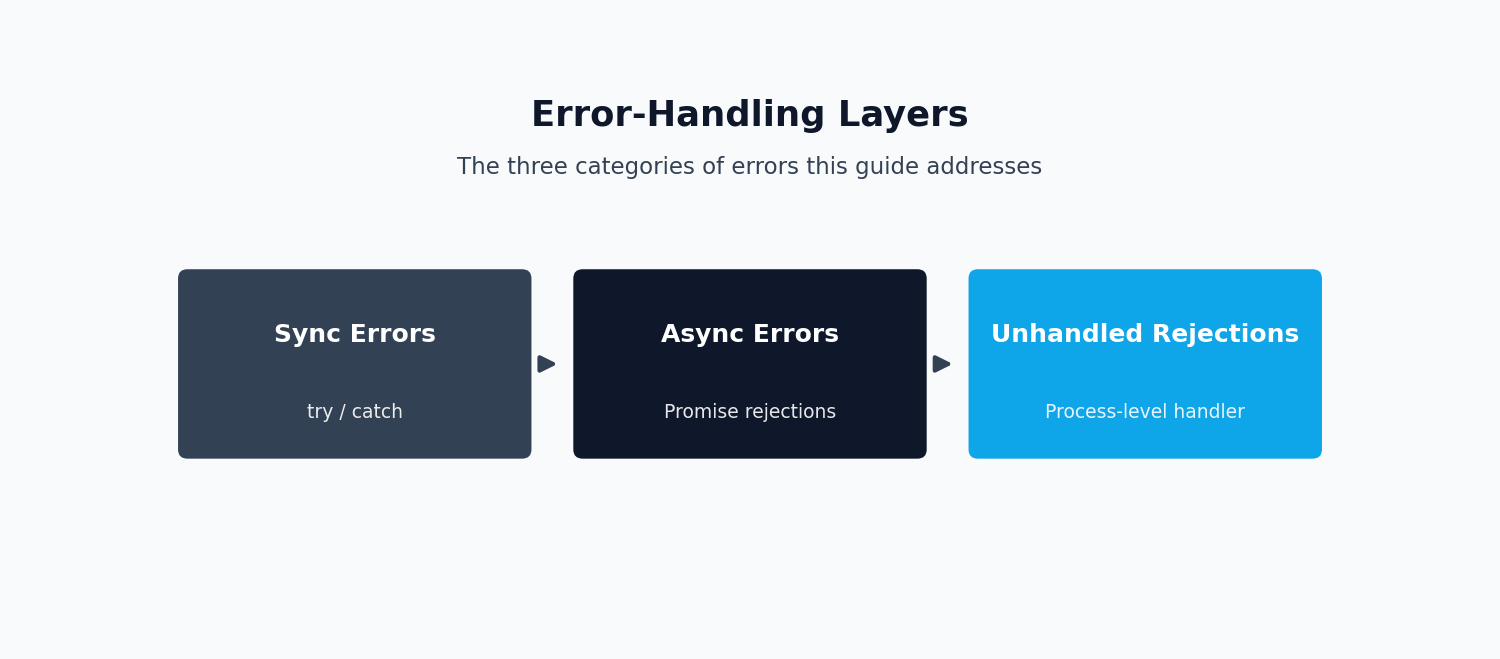
Idempotency: The Precondition for Safe Retries
None of the retry and backoff machinery above is safe unless the job handler is idempotent — meaning running it twice with the same input produces the same end state as running it once. This is easy to state and surprisingly easy to violate. A job that charges a credit card, sends an email, or increments a counter is not idempotent by default; if it fails after the side effect happens but before the queue records success, a retry will repeat the side effect.
Common idempotency techniques for queue jobs include:
- Using a unique idempotency key (often the job ID or a business-level identifier like an order number) recorded in the target system before or during the operation, checked before executing the side effect again.
- Preferring upserts over inserts, and conditional updates over unconditional writes.
- Making external API calls with an idempotency key header when the provider supports one — this pattern is common with payment processors.
- Separating “detect completion” from “perform action” — checking whether the desired end state already exists before doing the work at all.
async function sendWelcomeEmail(job) {
  const { userId, emailIdempotencyKey } = job.data;

  const alreadySent = await db.emailLog.findOne({
    where: { idempotencyKey: emailIdempotencyKey },
  });

  if (alreadySent) {
    // Safe no-op: this exact send was already completed on a prior attempt
    return { skipped: true, reason: 'already-sent' };
  }

  await emailProvider.send({
    to: (await db.users.findById(userId)).email,
    template: 'welcome',
    idempotencyKey: emailIdempotencyKey,
  });

  await db.emailLog.create({ idempotencyKey: emailIdempotencyKey, sentAt: new Date() });
}
Idempotency is not something you bolt on after the fact — it needs to be a design constraint from the moment a job type is created, because retrofitting it into a job handler that already has side effects scattered through it is much harder than building it in from the start. If you’re evaluating a Node.js developer to build or harden a queue-based system, idempotency discipline is one of the clearest signals of whether they’ve actually operated a production job pipeline versus only written one in a tutorial.
Catching and Classifying Errors: The Practical Core of Node.js Error Handling
Inside an individual job processor, error handling comes down to three questions asked in sequence: what kind of error is this, does it warrant a retry, and what context needs to be preserved regardless of the answer. Network errors, validation errors, and unexpected exceptions each deserve different treatment, and conflating them is where most queue systems go wrong.
Network errors — timeouts, DNS failures, connection resets — are usually retryable and usually not your application’s fault. Validation errors — a malformed payload, a missing field, a value that fails a business rule — are almost never retryable, because the input won’t change between attempts. Unexpected exceptions — a null pointer, an unhandled edge case, a bug — are the hardest category, because whether they’re retryable depends on whether they’re deterministic. A bug triggered by a specific data value will fail identically every time; a bug triggered by a race condition might succeed on retry. When in doubt, treat unexpected exceptions as retryable but capped at a low attempt count, and make sure they’re logged loudly, since they represent something your code doesn’t yet know how to categorize correctly.
async function processPayoutJob(job) {
  const context = { jobId: job.id, payoutId: job.data.payoutId };

  try {
    await validatePayoutPayload(job.data);
    await executePayout(job.data);
  } catch (rawErr) {
    if (rawErr instanceof ValidationError) {
      logger.warn('Payout job rejected: invalid payload', { ...context, error: rawErr.message });
      throw new PermanentError(rawErr.message, rawErr);
    }

    if (rawErr.code === 'ETIMEDOUT' || rawErr.code === 'ECONNRESET') {
      logger.warn('Payout job network failure, will retry', { ...context, error: rawErr.message });
      throw new RetryableError(rawErr.message, rawErr);
    }

    // Anything not explicitly recognized is an unexpected exception.
    // Log with full stack trace and treat conservatively.
    logger.error('Unclassified error in payout job', {
      ...context,
      error: rawErr.message,
      stack: rawErr.stack,
    });
    throw new RetryableError(`Unexpected error: ${rawErr.message}`, rawErr);
  }
}
The pattern above is deliberately explicit rather than clever. Production queue systems reward boring, predictable error classification over abstraction, because whoever is on call at 2 a.m. debugging a stalled queue needs to be able to read the classification logic and immediately understand why a job did or didn’t retry.
Unhandled Promise Rejections: The Silent Worker Killer
This is the failure mode that catches teams off guard most often, because it doesn’t look like a queue problem at all — it looks like a worker mysteriously dying, or ceasing to process jobs, with no obvious crash log. The cause is almost always an unhandled promise rejection somewhere inside asynchronous code that isn’t awaited or caught inside the job processor.
Node.js treats an unhandled promise rejection as a serious condition. Depending on your Node.js version and configuration, an unhandled rejection can trigger the process.on('unhandledRejection') event, and if that handler isn’t registered — or if it’s registered but doesn’t do anything meaningful — the default behavior in modern Node.js is to terminate the process. For a worker that’s supposed to process thousands of jobs over its lifetime, a single unhandled rejection buried in a rarely-hit code path (a forgotten .then() without a .catch(), a fire-and-forget async call inside a job handler, a promise returned from a callback that nothing awaits) can silently kill the entire process, taking every in-flight job down with it.
The defensive pattern has two layers. First, make sure every asynchronous operation inside a job processor is properly awaited inside a try/catch, with no stray fire-and-forget promises. Second, register process-level handlers as a safety net, not a primary strategy, and use them to fail loudly and restart cleanly rather than silently swallowing the problem.
process.on('unhandledRejection', (reason, promise) => {
  logger.error('Unhandled promise rejection detected', {
    reason: reason instanceof Error ? reason.stack : reason,
  });
  // Do not attempt to keep running with unknown internal state.
  // Let the process manager (PM2, Docker, Kubernetes) restart it cleanly.
  process.exit(1);
});

process.on('uncaughtException', (err) => {
  logger.error('Uncaught exception detected', { error: err.message, stack: err.stack });
  process.exit(1);
});
Exiting the process on an unhandled rejection feels aggressive, but it’s the correct choice for queue workers. A process whose internal state was corrupted by an unanticipated error path is not trustworthy to keep processing jobs — better to let it die fast, have your orchestration layer restart it, and rely on the queue’s persistence and retry mechanism to pick the interrupted job back up. Trying to “handle” an unhandled rejection by logging it and continuing is how you get workers that limp along in a half-broken state for hours, quietly corrupting data or dropping jobs in ways that are far harder to diagnose than a clean restart.
Structured Error Logging and Observability for Queue Jobs
A stack trace with no context is close to useless in a queue system, because by the time someone looks at it, the job that produced it may have already been retried, moved to a dead-letter queue, or deleted. Effective observability for background processing means attaching structured context to every log line: a correlation ID that ties a job back to the request or event that originally created it, the job ID and queue name, the attempt number, and any business-relevant identifiers (order ID, user ID, payout ID) that let someone search logs without needing to reconstruct the job’s history from scratch.
A correlation ID is especially valuable when a single user action fans out into multiple queued jobs — for example, an order creation event that triggers inventory reservation, payment capture, and notification jobs. Without a shared correlation ID threaded through all three, diagnosing “why didn’t this customer get their confirmation email” means manually cross-referencing timestamps across three different queues.
function buildJobLogger(job) {
  const context = {
    correlationId: job.data.correlationId || job.id,
    jobId: job.id,
    jobName: job.name,
    queueName: job.queueName,
    attemptsMade: job.attemptsMade,
  };

  return {
    info: (msg, extra = {}) => logger.info(msg, { ...context, ...extra }),
    warn: (msg, extra = {}) => logger.warn(msg, { ...context, ...extra }),
    error: (msg, extra = {}) => logger.error(msg, { ...context, ...extra }),
  };
}
Pair structured logs with queue-level metrics: failure rate per job type, average time-to-completion, retry counts, and dead-letter queue depth. Most of this is exposed directly by BullMQ’s events and can be forwarded to whatever metrics stack you already run. The goal is that a spike in a specific error classification — say, a sudden jump in PermanentError from one job type — is visible on a dashboard within minutes, not discovered three days later when someone asks why a batch of records is missing.
Graceful Worker Shutdown During In-Flight Job Failures
Deploys, autoscaling events, and container orchestration restarts all mean that workers get shut down while jobs are actively processing. Handling this badly produces a specific and nasty failure mode: a job gets marked as “active” in the queue, the worker process is killed before it can either complete the job or release the lock, and the job sits in limbo until a stall-detection mechanism eventually notices and requeues it — assuming one is configured at all. The fix is to listen for termination signals and drain in-flight work before exiting, rather than exiting immediately.
const worker = new Worker('order-processing', jobProcessor, {
  connection: redisConnection,
  concurrency: 10,
});

async function gracefulShutdown(signal) {
  logger.info(`Received ${signal}, closing worker gracefully`);
  try {
    // Stops accepting new jobs and waits for active jobs to finish
    // (or hit their configured lock/stall timeout)
    await worker.close();
    logger.info('Worker closed cleanly, no jobs left in an ambiguous state');
  } catch (err) {
    logger.error('Error during worker shutdown', { error: err.message });
  } finally {
    process.exit(0);
  }
}

process.on('SIGTERM', () => gracefulShutdown('SIGTERM'));
process.on('SIGINT', () => gracefulShutdown('SIGINT'));
The other half of graceful shutdown is making sure your orchestration layer gives the process enough time to actually drain — a Kubernetes pod with a five-second termination grace period isn’t going to let a job that takes twenty seconds finish cleanly no matter how well your shutdown handler is written. Match your grace period to the realistic upper bound of your longest job, or design long jobs to checkpoint their progress so a forced interruption doesn’t mean starting over from zero.
A Practical Checklist
Bringing the patterns above together, a production-ready approach to Node.js error handling in queue systems should cover:
- Every thrown error is classified as retryable or permanent before the queue decides what to do with it.
- Retries use exponential backoff with jitter and a hard cap on attempts — no unbounded retry loops.
- Permanently failed and retry-exhausted jobs land in a monitored dead-letter queue with full context, not silent deletion.
- Every job handler is idempotent, verified against the specific failure modes of the side effects it performs.
- Network errors, validation errors, and unexpected exceptions are handled through distinct, explicit code paths.
process.on('unhandledRejection')andprocess.on('uncaughtException')handlers are registered and configured to exit the process rather than limp along.- Every log line tied to a job includes a correlation ID, job ID, queue name, and attempt count.
- Workers listen for termination signals and drain in-flight jobs before exiting, with orchestration grace periods matched to realistic job durations.
- Dead-letter queue depth and per-error-type failure rates are wired into alerting, not just dashboards nobody checks.
None of these patterns are exotic — they’re the accumulated lessons of teams who ran queue systems in production long enough to get burned by each failure mode at least once. The common thread is treating error handling as a first-class design decision for background processing rather than an afterthought copied from request/response code. Solid Node.js error handling in a queue context isn’t about catching more exceptions; it’s about making deliberate, visible decisions — retry or don’t, alert or don’t, kill the process or don’t — every time something goes wrong, so that failures become manageable operational events instead of mysteries someone has to reconstruct from fragments of logs after the fact.
Frequently Asked Questions
What’s the difference between retryable and permanent errors in a queue system?
A retryable error is transient, a database connection timeout, a rate-limited API call, a momentary network blip, where trying the same job again has a real chance of succeeding. A permanent error is one where retrying changes nothing: malformed input data, a missing required field, or a business rule violation. Classifying errors correctly before deciding to retry is the first decision point in production queue error handling; retrying a permanent failure just wastes worker cycles and delays the inevitable failure.
Why does exponential backoff matter for retrying failed jobs?
Retrying immediately after a failure often hits the same overloaded dependency again, and doing that across thousands of queued jobs can turn a brief outage into a self-inflicted denial-of-service against your own database or API. Exponential backoff spaces retries out with increasing delay, giving the failing dependency room to recover, and is standard practice in BullMQ, Bull, and most production-grade job runners.
What is a dead-letter queue and do I need one?
A dead-letter queue is where jobs land after they’ve exhausted their retry attempts, instead of disappearing silently or looping forever. If you’re running any queue system in production, yes, you need one: without it, permanently failing jobs either vanish with no record or clog the main queue, and you lose the ability to inspect, replay, or alert on jobs that never succeeded.
Why does idempotency matter for job retries?
Idempotency is what makes retrying safe in the first place. If a job charges a customer or sends an email and then fails partway through, a naive retry can charge them twice or send the email twice. An idempotent job checks whether its work already happened before doing it again, usually via a unique key tied to the job’s payload, so retries are safe by construction rather than by luck.
Why do unhandled promise rejections crash Node.js queue workers?
An unhandled promise rejection inside a job handler doesn’t stay contained to that one job. If it isn’t caught, Node.js treats it as a process-level event, and by default that can crash the entire worker process, taking down every other in-flight job with it. This is a common, hard-to-notice failure mode because it works fine in testing and only surfaces under production load when an edge case slips through an uncaught async path.
How do I shut down a Node.js worker gracefully without losing in-flight jobs?
Graceful shutdown means catching termination signals like SIGTERM, telling the worker to stop pulling new jobs, and giving in-flight jobs a bounded window to finish before the process exits. Without this, a deploy or a container restart can kill a worker mid-job, leaving it in an inconsistent state that your retry and idempotency logic then has to clean up.
Need this built or reviewed in production? Hire a senior full-stack developer or explore my AI integration services.
