If you want to hire a WordPress developer who can write a custom plugin, wire it to a Vue.js or React frontend, and keep it working through every core update for the next three years, here’s exactly what that looks like.
It looks like someone who reads the WordPress Plugin Developer Handbook before they write a single hook, not after something breaks. It looks like someone who treats wp_enqueue_script and REST API namespaces as seriously as they’d treat an API contract in any other language. And it looks like someone who has actually shipped a plugin to a site the size of Samsung’s careers page — not just installed Elementor and called it a build.
I’m Faisal Nadeem. I’ve spent 6+ years building full-stack and AI-integrated systems, and a meaningful chunk of that work has been WordPress — specifically the part of WordPress that page builders and template shops don’t touch: custom plugin architecture, REST API integrations, and connecting WordPress to modern JavaScript frontends and Laravel backends.
Three Ways WordPress Projects Actually Break
Before I pitch you anything, here’s what I’ve seen go wrong on real WordPress projects — the failure modes that show up months after launch, not on demo day:
- A page builder plugin conflict silently breaks checkout. An e-commerce site is running WooCommerce alongside two page builder plugins and a caching plugin. A routine plugin update changes a JavaScript hook priority. Nobody notices until a customer reports that the “Add to Cart” button does nothing on mobile. The root cause is three plugins fighting over the same DOM event, and no one on the team wrote any of the conflicting code, so no one can debug it quickly.
- A custom plugin with no update path breaks on a core WordPress update. Someone hard-coded a call to a deprecated function, or hooked into an action that changed signature in WordPress 6.x. It worked fine for two years. Then a security update goes out (correctly, automatically), and the custom plugin throws a fatal error that takes the whole site down until someone who understands the original code — often no longer available — can patch it.
- An agency hands over undocumented custom code. The site “works,” but there’s a custom plugin with no readme, no changelog, inline styles fighting the theme’s CSS, and API keys hard-coded directly into PHP files instead of stored as options or environment variables. The next developer inherits a black box and has to reverse-engineer it before they can safely touch anything.
All three of these are avoidable. They come from treating WordPress development as a configuration task instead of an engineering task. If you’re going to hire a WordPress developer for anything beyond a brochure site, the difference between “configured” and “engineered” is exactly where your budget should go.
What a WordPress Developer Should Actually Build
When people search “hire a wordpress developer,” they’re usually picturing a theme customizer. What most growing businesses actually need is closer to a backend engineer who happens to work inside WordPress. Here’s the real scope.
Clients who hire a WordPress developer for custom plugin work get bespoke functionality that survives core updates, unlike stacking generic plugins to approximate one feature.
Custom Plugin Development
Not a page builder plugin. A purpose-built plugin with its own custom post types, taxonomies, admin settings pages, and — critically — a defined update path so it survives WordPress core and PHP version upgrades. This is the part of the job most WordPress “developers” skip, because it requires understanding WordPress’s action/filter hook system and the plugin lifecycle, not just its visual editor.
WordPress + Modern Frontend Integration (Vue.js / React)
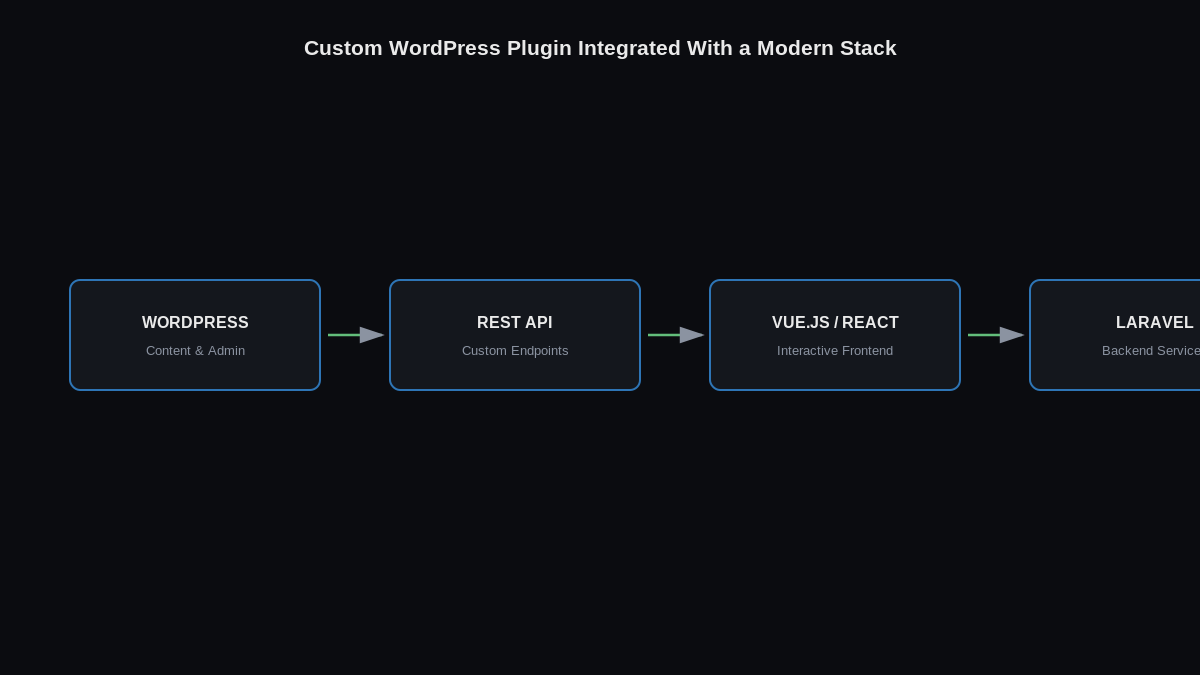
A growing number of WordPress projects need an interactive interface that a shortcode or Gutenberg block can’t deliver on its own — real-time filtering, dynamic forms, live application status, product configurators. That means mounting a Vue.js or React application inside WordPress, exposing the right data through the REST API or GraphQL, and keeping the WordPress admin as the source of truth for content while the frontend framework handles interactivity. Vue.js development
API Integrations & Data Sync
WordPress rarely lives alone. It needs to talk to an ATS, a CRM, a payment processor, an inventory system, or a Laravel-based internal application. That means building custom REST endpoints, authenticating securely, handling webhook payloads, and making sure data sync doesn’t silently fail when the third-party API changes its schema. Laravel API development
Performance & Security Hardening
Query optimization for custom post type archives, object caching, image and asset pipeline cleanup, and a security posture that goes past “install a security plugin” — proper file permissions, sanitized and escaped output on every custom field, nonce verification on every custom form, and a patching process for when a vulnerability is disclosed in a plugin you don’t control.
E-commerce / WooCommerce
Custom product types, configurator logic, checkout flow changes, and integration with external inventory or fulfillment systems — the kind of WooCommerce work that goes past picking a theme and installing an extension, because the store needs behavior no extension provides out of the box.
Why Hire an Engineer for WordPress Instead of a Theme Customizer
Most people who advertise as WordPress developers are theme customizers: they install a theme, configure a page builder, add some plugins from the WordPress.org repository, and call it done. That’s a legitimate service for a small brochure site. It is not the same job as what I do, and the difference matters once your WordPress site needs to do something a plugin from the repository doesn’t already do.
If any of the following is true, you need an engineer, not a customizer:
- You’ve outgrown page-builder WordPress — every new feature request means fighting the builder’s limitations instead of building the feature.
- You need custom functionality no existing plugin provides, and combining five plugins to fake it is creating more conflicts than it solves.
- Your WordPress site needs to talk to a larger application — a Laravel backend, a mobile app, an internal dashboard, a third-party SaaS.
- You need a genuinely interactive frontend (real-time filtering, dynamic forms, a configurator) that Gutenberg blocks can’t deliver.
- You’ve been burned by an agency handover with no documentation, and you need someone who can read existing code, document it, and take ownership going forward.
Hiring an engineer costs more per hour than hiring a theme customizer. It also means you stop paying, project after project, for workarounds to problems that a properly built custom plugin would have solved once.
Businesses that hire a WordPress developer for anything beyond a brochure site need someone who treats custom plugin architecture as core scope, not an afterthought.
Tech Stack
| Layer | Technology | Where I Use It |
|---|---|---|
| CMS Core | WordPress (custom plugin & theme development) | Custom post types, hooks, admin UI, REST API |
| Frontend Frameworks | Vue.js, React | Embedded interactive components inside WordPress pages/admin |
| Backend / API | Laravel, PHP | External services WordPress talks to via REST |
| E-commerce | WooCommerce | Custom product logic, checkout customization |
| Hosting / Infra | AWS | Deployment, scaling, backups for larger WordPress builds |
| Data | MySQL, REST/GraphQL APIs | Custom queries, third-party data sync |
| Version Control & QA | Git, staging environments | Safe deployment path for custom plugin updates |
If you’re comparing candidates to hire a WordPress developer for a complex build, ask each one how they’d handle a plugin conflict silently breaking checkout — the answer reveals real production experience.
Proof
Samsung Careers — Custom Vue.js Plugin
Samsung needed dynamic job listings on their WordPress-powered careers site — something the default post-and-page model couldn’t handle well: real-time filtering by department, location, and job type, plus a smoother application management flow, all without ripping out their existing WordPress backend.
I built a custom Vue.js-based Careers plugin that plugs directly into WordPress. Content editors keep managing job postings through the familiar WordPress admin; the Vue.js layer handles the interactive parts — live filtering, responsive rendering, and a cleaner application experience — pulling data through the WordPress REST API rather than a separate system editors would have to learn. The result: a careers page that feels like a modern web app, backed by a CMS the existing team already knew how to use.
Romario Sportswear — Custom E-commerce Build
Romario Sportswear needed an online store for sports apparel with product customization options — the kind of configurator logic that off-the-shelf WooCommerce themes don’t provide. I built this using Laravel, WordPress, Vue.js, and React together: WordPress and WooCommerce handled the catalog and content side, while Laravel and the JavaScript frontend handled the customization logic and a smoother browsing experience than a default WooCommerce theme delivers.
Seers (GDPR Compliance SaaS) — WordPress Plugin Development
Early in my career, at Seers — a GDPR compliance SaaS platform — I worked directly on the WordPress plugin that let site owners implement Seers’ compliance tooling on their own WordPress sites. The broader Seers platform ran on Laravel, Vue.js, WordPress, React, and AWS, and the plugin had to work reliably across an enormous variety of third-party WordPress setups it had no control over — exactly the kind of compatibility discipline that custom plugin development demands.
This is the checklist I use whenever a client wants to hire a WordPress developer for custom plugin work: hook/filter architecture, update-path planning, REST API design, and frontend framework integration, all owned by one engineer.
How Engagements Work
- Scope call. We talk through what the WordPress site needs to do, what’s breaking or missing today, and whether the job is really a plugin/integration build or a simpler configuration task (I’ll tell you honestly if it’s the latter).
- Technical assessment. If there’s existing code, I review it before quoting anything — I don’t estimate blind on top of code I haven’t read.
- Proposal & timeline. A written scope, a fixed quote or hourly estimate depending on the project shape, and a realistic timeline.
- Build in staging. Development happens on a staging environment, never directly on production, with version control from day one.
- Review & handoff. You test on staging before anything ships. Every custom plugin comes with documentation — what it does, how it’s configured, and how to update it safely.
- Post-launch support. A support window after launch to handle anything that surfaces under real traffic, plus optional ongoing maintenance for core/plugin updates.
When you hire a WordPress developer for a fixed-scope custom plugin, get the update path, hook architecture, and API integrations named in the written scope up front.
What It Costs to Hire a WordPress Developer
Rates vary a lot depending on whether you need theme configuration or custom engineering. Here’s a realistic breakdown for 2026:
| Type of Work | Typical Rate (2026) | Notes |
|---|---|---|
| Theme setup / page-builder site | $20–$45/hr | Configuration work, minimal custom code |
| WooCommerce store, standard | $35–$65/hr | Extension-based, no custom logic |
| Custom plugin development | $60–$100/hr | Bespoke functionality, hook architecture, update path |
| WordPress + Vue.js/React integration | $70–$110/hr | Requires both WordPress and modern JS framework expertise |
| API integrations / data sync builds | $70–$120/hr | Third-party auth, webhook handling, error recovery |
| Full custom project (fixed-price) | $3,000–$25,000+ | Scope-dependent; small custom plugin vs. full platform integration |
Custom plugin and integration work commands more per hour than templated builds because the work is closer to backend software engineering than to site configuration — you’re paying for correctness and maintainability, not just for something that looks right on launch day.
Most businesses that hire a WordPress developer only think about themes; the ones that also plan plugin architecture from day one avoid the post-launch fire drills described above. Ready to hire a WordPress developer for your next build? The discovery call below maps your actual requirements.
Frequently Asked Questions
Do I need to hire a WordPress developer or can I just use a page builder?
If your needs stop at layout and content, a page builder is fine. Once you need custom functionality, an API integration, or a frontend interaction a page builder can’t produce, you need to hire a WordPress developer who writes custom code.
What does it cost to hire a dedicated WordPress developer?
For custom plugin or integration work in 2026, expect $60–$120/hr depending on complexity, or a fixed project quote once scope is defined. Simple theme configuration is cheaper but doesn’t cover custom functionality.
Why hire a dedicated WordPress developer instead of a marketplace freelancer for a one-off task?
A dedicated developer understands your codebase over time — updates, plugin conflicts, and future features get handled by someone who already knows the system, instead of you re-explaining the site to a new freelancer every time something breaks.
Can you fix a WordPress site broken by a plugin conflict?
Yes. I diagnose which plugins or theme code are fighting over the same hooks, DOM events, or database queries, and either resolve the conflict or replace the conflicting plugin with custom code that does exactly what you need without the side effects.
Do you build custom WordPress plugins from scratch?
Yes — custom post types, admin settings pages, REST endpoints, and hook-based architecture that follows the official WordPress Plugin Developer Handbook conventions so the plugin survives core updates.
Can you integrate Vue.js or React into an existing WordPress site?
Yes. I’ve done this in production — the Samsung Careers plugin is a Vue.js application mounted inside WordPress, pulling data through the REST API while WordPress remains the content backend.
Do you work with WooCommerce?
Yes, including custom product types and configurator logic, as with the Romario Sportswear build, which combined WooCommerce with Laravel and a React/Vue.js frontend for product customization.
Can you connect my WordPress site to a Laravel application?
Yes — building the REST endpoints and authentication needed for WordPress and a Laravel backend to exchange data reliably is a core part of what I do. Laravel API development
What happens if I hire a WordPress developer and they hand over undocumented code?
That’s the failure mode I build against directly — every custom plugin I deliver includes documentation and a changelog, so the next person (or future me) isn’t reverse-engineering a black box.
Do you handle WordPress core and PHP version upgrades?
Yes. Custom plugins are built with deprecated-function checks and a tested upgrade path, specifically so a core update doesn’t take the site down.
How is hiring you different from hiring a WordPress agency?
You work directly with the engineer who writes the code — no account manager layer, no handoff between a salesperson and a junior developer. Scoping, building, and support all go through me.
Do you offer ongoing maintenance after the initial build?
Yes, optional ongoing maintenance covers core/plugin updates, security patching, and monitoring for the custom plugin logic specifically, since that’s the part generic maintenance plans usually don’t cover.
Can you audit an existing WordPress site before I decide what to build?
Yes — a technical review of existing plugins, custom code, and performance/security posture, so any quote for new work is based on what’s actually there, not guesswork.
Do you build API integrations between WordPress and third-party tools (CRM, ATS, payment processors)?
Yes — this is one of the most common reasons companies hire a WordPress developer with backend engineering experience instead of a theme specialist. Webhook handling, authentication, and error recovery are all part of the scope.
Is a custom WordPress plugin more expensive than using existing plugins?
Upfront, yes. Over time, often cheaper — you’re not stacking five plugins to approximate one feature, and you’re not paying repeatedly to patch conflicts between plugins you don’t control.
Do you work with clients outside Pakistan?
Yes — I work remotely from Lahore with EU and US clients, with overlapping-hours communication built into the engagement process.
How do I get started?
Book a scope call. We’ll talk through what your WordPress site needs to do, and I’ll tell you honestly whether it needs custom engineering or just configuration.
To hire a WordPress developer who fits your project, match the engagement type (custom plugin, API integration, or frontend framework work) to your actual technical requirements rather than defaulting to theme configuration.
Ready to Hire a WordPress Developer Who Builds, Not Just Configures?
If part of this project also needs a custom React-powered interactive layer on top of WordPress, hiring a React developer covers that side. And if hiring across time zones is part of the decision, hiring remote developers covers how the engagement and overlap-hours model works.
If your WordPress site has outgrown what a page builder or a stack of plugins can do — or you’ve inherited undocumented custom code and need someone to take real ownership of it — let’s talk through the scope.
Book a 30-minute call: Book a Free 30-Minute Call
