Claude Opus vs Sonnet: The Decision Framework Nobody Writes Down
Every team building on Anthropic’s models eventually hits the same fork in the road: Claude Opus vs Sonnet. The blog posts that rank for this today mostly repeat the same three facts — Opus is smarter, Sonnet is faster, Opus costs more — and stop there. That’s not a decision framework, it’s a marketing slide.
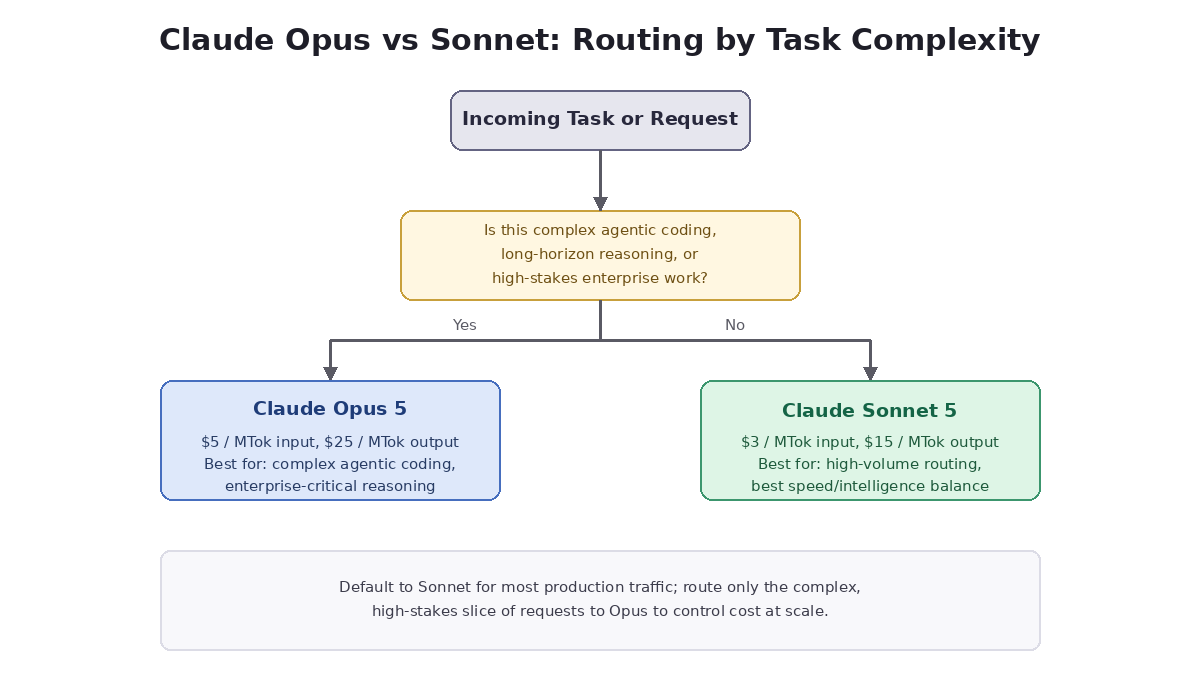
Table of Contents
If you’re an engineer deciding which model to wire into a production feature, “Opus is smarter” doesn’t tell you whether the accuracy gap is worth 5x the per-token cost on your specific workload, and it definitely doesn’t tell you how to avoid re-architecting your prompt layer every time Anthropic ships a new version.
This post is written for people who have to answer for the API bill next quarter, not for people comparing chatbot vibes. We’ll walk through the actual cost math, where the capability gap matters and where it doesn’t, how to build a routing layer that picks the right model per request instead of hard-coding one, and the migration mistakes that show up in production six weeks after launch.
Claude Opus vs Sonnet: What Actually Differs
Strip away the marketing copy and there are really three axes that matter for a production decision: raw task accuracy on your workload, latency under real traffic, and cost per successful outcome (not cost per token — those are different numbers, and conflating them is the most common mistake teams make).
Reasoning depth
Opus is built for sustained, multi-step reasoning: large codebase comprehension, long document synthesis, architecture decisions where a wrong answer has real downstream cost. Sonnet is tuned to get most of that same reasoning quality on shorter tasks, at a fraction of the latency. The gap is real but it is not uniform — on straightforward extraction, classification, summarization, and boilerplate code generation, Sonnet’s outputs are frequently indistinguishable from Opus’s in blind evaluation. The gap widens specifically on tasks with long dependency chains: a 40-file refactor, a multi-hop research question, a security review that requires holding five different invariants in mind at once.
Latency and throughput
This is the axis the “which model is smarter” articles skip entirely, and it’s often the one that decides the architecture. Sonnet’s lower time-to-first-token and lower total generation time make it the only realistic choice for anything user-facing and synchronous — autocomplete, live chat, inline suggestions. Opus’s latency profile is fine for background jobs, batch analysis, and anything where a user is not staring at a spinner waiting for the response.
Cost per token vs. cost per outcome
Opus costs meaningfully more per input and output token than Sonnet. That’s the number everyone quotes. The number that actually matters for your budget is cost per correct outcome, which depends on your task’s error tolerance. If a wrong answer means a support ticket, a failed build, or a compliance problem, the “cheaper” model can easily cost more once you account for retries, human review, and the incidents it causes. If a wrong answer means a slightly worse autocomplete suggestion that the user ignores, the token price is close to the whole story.
A Practical Cost Model for Claude Opus vs Sonnet
Instead of comparing sticker prices, run this back-of-envelope model against your own workload before committing to either model:
- Estimate your error cost. What does one wrong output cost you — in support time, re-generation, or user trust? For a code-review bot embedded in CI, a missed vulnerability might cost hours of incident response. For a marketing copy generator, a bad paragraph costs someone thirty seconds.
- Estimate your volume and token footprint per request. Long-context tasks (large codebases, long documents) amplify the token-cost gap between the two models much faster than short, high-frequency requests do.
- Multiply through. (Sonnet error rate × error cost) vs. (Opus token premium). Whichever side is smaller for your specific workload is your default model. This is workload-specific — there is no universal answer, which is exactly why so much of the existing content on this topic is generic and not actionable.
In practice, most SaaS teams land on a hybrid: Sonnet as the default for interactive, high-volume paths, with Opus reserved for a narrower set of high-stakes or long-context calls. That hybrid is worth designing for from day one rather than retrofitting later.
A Worked Example: Claude Opus vs Sonnet on a Real Feature
Numbers make this concrete faster than any framework. Say you’re building an AI-assisted code review feature that runs on every pull request. Average input is 6,000 tokens of diff and surrounding context, average output is 400 tokens of review comments, and you process 50,000 pull requests a month.
On Sonnet, that volume lands solidly in the “cheap enough to not think about” category — the monthly inference bill is a rounding error next to your infrastructure costs. Run the same volume through Opus and the bill moves into “someone in finance is going to ask about this” territory, roughly five times higher for the token cost alone. The question the generic comparison articles never answer is: does that 5x buy you anything on this specific task?
For code review, it often does, partially. Opus’s edge shows up on the pull requests that matter most — the ones touching authentication, payment logic, or database migrations, where a missed issue is expensive.
It does not show up meaningfully on formatting nits, unused imports, or straightforward logic errors, which make up the bulk of review comments by volume. This is exactly the shape of workload where routing beats a single global choice: send the 90% of low-risk diffs to Sonnet, flag the file paths that touch sensitive code, and route only those through Opus. You end up paying the Opus premium on maybe 8-10% of your volume instead of 100% of it, while still catching the class of error that actually justifies the cost.
Run this same exercise against your own feature before picking a model. The answer is almost never “always Opus” or “always Sonnet” — it’s “Sonnet by default, Opus on a well-defined slice,” and the size of that slice is the number that actually determines your bill.
Migrating an Existing Product Between the Two Models
If you already shipped a feature on one model and are considering a Claude Opus vs Sonnet switch — in either direction — treat it as a real migration, not a config flag flip. The failure mode here isn’t usually “the new model performs worse,” it’s “nobody noticed it performed differently until a customer complained.”
- Build an eval set before you touch production traffic. Pull 100-200 real requests from your logs, run them through both models, and have a human (or a second, independent model call) score the outputs against your actual acceptance criteria — not a generic rubric.
- Watch prompt sensitivity. Prompts tuned against one model’s quirks sometimes need small adjustments to get equivalent quality from the other — system prompt phrasing, formatting instructions, and few-shot examples don’t always transfer one-to-one.
- Roll out on a traffic percentage, not a full cutover. Route 5-10% of production traffic to the new model, compare error rates and downstream signals (retries, support tickets, user edits to the output) against the control group, and only widen the rollout once those numbers hold up.
- Keep the old path available for a rollback window. Model behavior changes can surface on edge cases that don’t show up in your eval set for days or weeks. Don’t delete the old code path until you’ve seen a full billing cycle of stable metrics on the new one.
Teams that skip the staged rollout and cut over 100% of traffic in one deploy are the ones who end up writing a postmortem three weeks later about a regression nobody caught until a customer escalated it.
Building a Model Router Instead of Hard-Coding One Model
The teams that get the most value out of the Claude Opus vs Sonnet decision don’t actually make it once — they make it per request, automatically. A thin routing layer in front of the Anthropic API gives you this without much complexity:
function chooseModel(request) {
  const isHighStakes = request.taskType in ['security_review', 'architecture_decision', 'legal_summary'];
  const isLongContext = request.estimatedTokens > 8000;
  const isInteractive = request.mode === 'sync_user_facing';

  if (isHighStakes || isLongContext) return 'claude-opus';
  if (isInteractive) return 'claude-sonnet';
  return 'claude-sonnet'; // safe default
}
Three things make this pay off in production:
- Fallback on low confidence. If Sonnet’s response includes hedging language, low self-reported confidence, or fails a validation check, re-run the same request on Opus before returning an answer to the user. This gets you Sonnet’s latency on the common path and Opus’s accuracy on the tail, without paying Opus pricing on every request.
- Log the routing decision. You need this data to tune the thresholds later — without it, you’re guessing at the split between the two models the same way the SERP articles are guessing at “when to use which.”
- Version-pin, don’t chase the newest release blindly. Anthropic ships new Sonnet and Opus versions on a regular cadence, and each one shifts the accuracy/cost curve slightly. Treat a model upgrade like a dependency bump: test against your eval set before flipping production traffic.
Where Teams Get the Claude Opus vs Sonnet Decision Wrong
Defaulting to Opus everywhere “to be safe.” This is the single most expensive mistake we see. Most requests in a typical SaaS product are not high-stakes, long-context, or reasoning-heavy — they’re short, repetitive, and well within Sonnet’s accuracy envelope. Routing all of them through Opus multiplies your API bill for accuracy gains you can’t detect in your own evals.
Never re-testing the split after a model update. Sonnet’s capability ceiling has moved up significantly release over release; a routing threshold tuned six months ago is very likely too conservative today, sending traffic to Opus that Sonnet now handles fine.
Comparing the models on a generic benchmark instead of your own eval set. Public benchmarks tell you about aggregate performance across a wide task distribution. Your product almost certainly does not have that distribution — a customer-support summarizer and a code-generation assistant will get completely different answers to “is the accuracy gap worth it.”
Ignoring context window and prompt-caching interactions. Both models support prompt caching, but the economics of caching a large system prompt scale differently depending on your request volume and token pricing tier. Skipping this analysis means leaving real savings on the table regardless of which model you pick.
How This Fits Into a Broader Model Strategy
The Claude Opus vs Sonnet decision doesn’t happen in isolation — most production teams are also weighing Anthropic’s models against other providers for at least some workloads. We covered that broader comparison, including where a multi-provider setup makes sense, in OpenAI vs Anthropic API for Production SaaS Features.
The short version: pick your provider architecture first (single-vendor vs. multi-vendor fallback), then treat the Opus-vs-Sonnet choice as the second-level decision inside whichever provider you land on. Anthropic documents current pricing and context-window limits for both models in the official model overview, which is worth checking before finalizing your cost model since token pricing does change between releases.
If your product also routes tool calls or long-running agent workflows through either model, the same routing logic extends naturally — the boundaries you set for which tasks are “high-stakes enough for Opus” tend to overlap heavily with the boundaries you’d set for which tool calls need tighter safety review, a topic we go deeper on in our piece on designing safe boundaries for production agent automation.
Claude Opus vs Sonnet by Team Size
The right starting point for this decision also depends on how much engineering time you can spend building the routing layer described above, which varies a lot by team size.
Solo developers and small teams usually don’t have the bandwidth to build and maintain a routing layer on day one. Start with Sonnet as a flat default across the product, and only introduce a second model path once you have a specific, named feature where you’ve observed Sonnet failing — not as a precaution, but as a response to a real gap.
Mid-size product teams shipping AI features across multiple parts of a product are the group that benefits most from the router pattern described earlier. You likely already have enough request volume and enough task diversity that a flat single-model choice is leaving real savings or real accuracy on the table in different places.
Larger engineering organizations running AI across many teams should treat the Claude Opus vs Sonnet split as a platform decision, not a per-feature one — a shared internal routing service that every team calls, with centralized logging of which requests go where, prevents five different teams from independently re-solving the same cost/accuracy tradeoff with five different answers.
Claude Opus vs Sonnet: Quick Reference
| Scenario | Better default |
|---|---|
| User-facing chat, autocomplete, inline suggestions | Sonnet |
| Background jobs, batch document analysis | Opus (if accuracy-critical) or Sonnet (if cost-sensitive) |
| Security review, architecture decisions, legal/compliance summaries | Opus |
| High-volume, short, low-stakes requests | Sonnet |
| Long-context synthesis (large codebases, long documents) | Opus |
Frequently Asked Questions
Is Opus always more accurate than Sonnet?
On aggregate benchmarks, yes, generally. On your specific workload, not necessarily — for short, well-scoped tasks the practical difference is frequently too small to detect without a rigorous eval set.
Can I switch between Opus and Sonnet mid-conversation?
Yes. Because both models share the same API shape and message format, you can route different turns of the same conversation to different models based on the complexity of each individual request.
Does prompt caching work the same way on both models?
Both support prompt caching for repeated system prompts and context, though the cost savings compound faster on Opus given its higher base token price — which is one more reason to model your actual cost per outcome rather than comparing list prices.
What’s the safest default if I don’t have time to build a router yet?
Start with Sonnet as the default for everything, instrument your failure cases, and add a narrow, explicit Opus path only for the request types where you can point to a concrete accuracy or reasoning failure. That order of operations avoids over-provisioning cost before you have evidence you need it.
How often should we re-evaluate our Claude Opus vs Sonnet routing thresholds?
Treat it the same as any other dependency: re-run your eval set whenever Anthropic ships a new Sonnet or Opus version, and again on a fixed quarterly cadence even if no new version has shipped, since your own product’s request mix shifts over time too.
The Bottom Line
The Claude Opus vs Sonnet decision isn’t a one-time choice you make in a planning doc — it’s an ongoing routing problem that should live in your code, get re-evaluated every time Anthropic ships a new model version, and get measured against your own error costs instead of a generic benchmark. Teams that treat it that way spend meaningfully less on inference without giving up the accuracy they actually need.
