If you want to hire a react developer who can keep authentication state, form data, and API responses consistent across a multi-step booking flow — search, sign-in, confirmation, all synced across two backend systems without a race condition dropping a user’s session — here’s exactly what that looks like.
Most React projects don’t fail because a component won’t render. They fail six weeks after launch, when a support ticket says a customer got double-charged, or a booking confirmed on the backend but the UI still shows a spinner, or a “logged in” user suddenly isn’t after a token refresh nobody tested. Those are state-management bugs wearing a UI costume, and they are exactly what a React developer is paid to prevent.
I’m Faisal Nadeem, a full-stack and AI integration engineer with 6+ years of experience and 50+ delivered projects, working remotely from Lahore, Pakistan for clients across the EU and US. I hold an MCS from the University of Management and Technology (UMT) Lahore and a BSc from the University of the Punjab. I’ve been a senior/lead developer at Tech Scale since 2022, after earlier roles at Cityscape Technology Corporation (2021-2022) and the GDPR compliance SaaS platform Seers (2020-2021). This page is what I’d tell you if you called me about a React build today.
Below is what a React engagement should actually cover, why full-stack range changes the outcome, what I’ve shipped, what it costs in 2026, and the honest tradeoffs — including when you should hire a react native developer instead of, or alongside, a web-only specialist.
Quick summary: whether you need to hire a react developer for a performance audit, hire a react developer to own state architecture end to end, or hire a react developer who also handles the backend, this page covers what that engagement actually looks like.
What a React Developer Should Actually Build
“React developer” is a job title that hides four separate skill sets. A generalist can usually do one of them well. Here’s what all four look like when they’re done properly.
Component Architecture & State Management
Component architecture is the decision layer that determines whether your codebase is still maintainable at month 18. Bad architecture looks fine in a demo and then falls apart the moment two features need to share the same piece of state.
- Deciding what lives in local component state versus a global store (Redux, Zustand, Context) before the prop-drilling gets three levels deep
- Designing data flow so a booking, order, or customization session survives a page refresh or a lost network connection
- Structuring components so a designer’s inevitable “just move this section” request doesn’t require touching business logic
- Avoiding the class of bugs where two components hold two different copies of what should be one source of truth
Performance Optimization
Performance problems in React are rarely about React itself — they’re about re-renders that nobody profiled. A list that re-renders on every keystroke, a context provider that re-renders the entire tree on an unrelated state change, a bundle that ships 400KB of unused component library.
- Memoization (useMemo, useCallback, React.memo) applied where it actually matters, not sprinkled everywhere out of superstition
- Code-splitting and lazy loading so first paint isn’t blocked by routes the user hasn’t visited yet
- Virtualization for long lists and tables instead of rendering 2,000 DOM nodes at once
- Profiling with React DevTools and browser performance tools before optimizing, not after guessing
React Native Cross-Platform
If you’re deciding whether to hire a react native developer for a mobile build, the honest answer is: it depends on how much of your React web logic can carry over. React and React Native share a component model, state-management patterns, and — with the right architecture — a meaningful chunk of business logic between web and mobile.
I don’t have a standalone React Native consumer-app case study to point to, and I’d rather tell you that directly than dress up something I haven’t done. What I do have is direct experience building mobile-facing backend APIs — including the Minplan mobile app’s API layer and other Node.js mobile backend work — plus the same component-thinking and state-management discipline that transfers directly from React web work.
If your priority is a lean cross-platform app that shares logic with an existing React web product, that combination is a legitimate starting point. If your priority is deep native-module work (custom camera pipelines, background processing, hardware integrations), you want a specialist whose primary stack is React Native, and I’ll tell you that upfront rather than take the project anyway.
Integration with Backend APIs
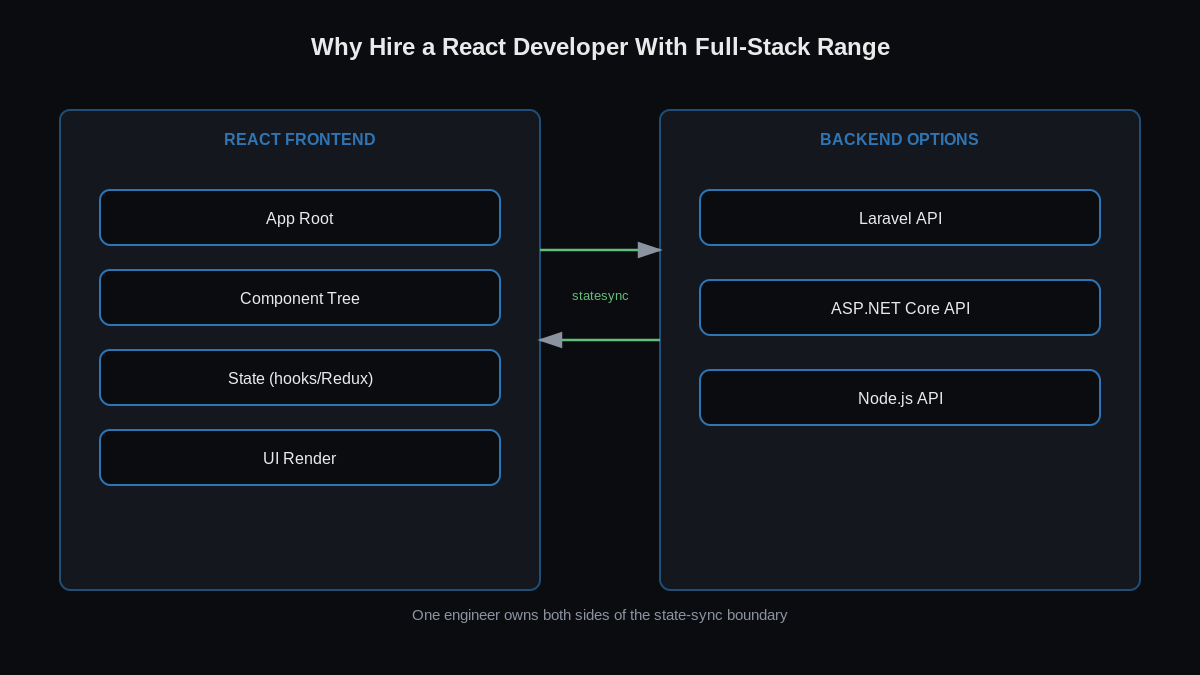
A React frontend is only as reliable as its contract with the backend. This is where most “frontend-only” engagements quietly fail — nobody owns the seam between the UI and the API.
- Handling auth token expiry and refresh without silently logging a user out mid-task
- Designing loading, error, and retry states for every network call, not just the happy path
- Keeping the frontend’s data model in sync with backend schema changes without a deploy-day scramble
- Coordinating with authentication providers like Azure Active Directory, OAuth, or custom JWT flows
Why Hire a Full-Stack Engineer for React Instead of a Frontend-Only Specialist
This is the contrarian part, and I’ll make the case against my own narrower job title. A pure frontend specialist can build a beautiful component. They usually can’t tell you why it’s slow, because the answer is on the backend — an unindexed query, a payload that’s ten times larger than it needs to be, an API that returns the whole object graph when the UI needs three fields.
When the same engineer owns both sides, debugging a “React is slow” ticket takes an afternoon instead of a week of ping-pong between a frontend contractor and a backend team who don’t share context. I’ve worked across Laravel, ASP.NET Core, Node.js, and Vue.js as well as React, which means I can trace a bug from a re-render straight down to the SQL query causing it, instead of stopping at “not my layer.”
Full-stack range also matters when requirements change mid-project — and they always do. If a client needs the booking confirmation logic moved from the frontend to the backend for security reasons, a React-only developer has to wait on someone else. A full-stack engineer just does it.
This is the stack you should expect when you hire a react developer for a production build, not a marketing keyword list.
Tech Stack
Here’s what I actually build with, not a keyword list assembled for SEO:
| Layer | Technologies |
|---|---|
| Frontend | React, React Native, Vue.js, TypeScript, JavaScript (ES6+) |
| State Management | Redux, Context API, Zustand |
| Backend | Laravel, ASP.NET Core, Node.js |
| Auth | Azure Active Directory, OAuth 2.0, JWT |
| Commerce & Media | Stripe, Fabric.js, Three.js |
| Infrastructure | AWS, WordPress (headless and hybrid builds) |
| AI Integration | AI-assisted valuation models, LLM-backed search and insights features |
For AI-driven frontend features — recommendation UIs, AI-assisted search, or LLM-backed dashboards layered on top of a React app — see the AI integration services page for that side of the work.
These are the kinds of results you should expect when you hire a react developer for production work, not a portfolio demo.
Proof: React Projects I’ve Actually Shipped
No invented client logos, no round numbers. These are the real engagements.
Specsavers — “Lonely Planet App”
A booking application with a React frontend and an ASP.NET Core backend, authenticated through Azure Active Directory. The hard part wasn’t the UI — it was keeping state consistent across a multi-step journey (search, authenticate, collection confirmation) that touched multiple backend systems, where a dropped or stale piece of state at any step meant a broken booking. This is the exact class of problem I described at the top of this page, and it’s the reason state architecture gets its own section above rather than being an afterthought.
Cityscape Technology Corporation — CityscapeOne
A tech-enabled real estate brokerage platform built on Laravel, Vue.js, React, and ASP.NET Core, with AI-powered property valuation, market insights, and advanced search tooling. I worked across the stack here, which is exactly the full-stack range argument above in practice: valuation logic, search performance, and UI all had to stay coordinated.
Custimoo — Sports-Apparel Customization SaaS
A real-time product customization platform (Laravel, Vue.js, React, Fabric.js, Three.js, Stripe, AWS) where the UI has to reflect canvas and 3D-rendering state instantly as a customer edits a design — a hard real-time state-synchronization problem, not a simple form.
Romario Sportswear — Ecommerce Store
An ecommerce build combining Laravel, WordPress, Vue.js, and React — a common real-world pattern where React handles interactive storefront components inside a broader WordPress/Laravel system rather than a from-scratch single-page app.
Seers — GDPR Compliance SaaS
A compliance SaaS platform (Laravel, Vue.js, WordPress, React, AWS) where I worked in-house from 2020-2021, before Cityscape Technology Corporation and my current role at Tech Scale.
Here is what to expect once you hire a react developer through this process.
How Engagements Work
- Scope call. We talk through what you’re building, what’s broken, or what needs to be rebuilt — including whether the right fit is a React developer, a react native developer, or both.
- Technical assessment. I review your existing codebase (if there is one) and flag the state-management, performance, or integration risks before writing a proposal, not after.
- Scoped proposal. You get a written scope, timeline, and cost — hourly, fixed-price, or ongoing retainer, depending on what fits the work.
- Build in milestones. Work ships in reviewable chunks, not one large reveal at the end.
- Handover or ongoing support. You get documented code and a clean handover, or I stay on as an ongoing full-stack resource — your call.
Before the numbers: rates below assume you actually hire a react developer with production experience, not just someone with the job title on a resume.
What It Costs to Hire a React Developer
Marketplace rates in 2026 vary widely by experience level and region. Here’s a realistic range so you’re not negotiating blind:
| Experience Level | Typical Hourly Rate (USD) |
|---|---|
| Junior (0-2 years) | $25-40/hr |
| Mid-level (2-5 years) | $45-75/hr |
| Senior / full-stack (5+ years) | $75-130/hr |
| Specialized / niche (10+ years, deep domain) | $130-200+/hr |
Regionally, US-based React developers tend to run $80-150/hr, Western Europe $50-120/hr, and South Asia (including Pakistan) $25-70/hr for comparable senior-level work — which is part of why EU and US clients hire a react developer remotely from Lahore rather than staffing locally at two to three times the cost for the same output. React Native rates track closely with React web rates, sometimes 10-20% higher for developers with deep native-module experience.
Rate isn’t the full picture. A cheaper developer who takes twice as long, or ships bugs a senior would have caught in code review, usually costs more once you count the rework. When you hire a react developer, you’re pricing in how fast the state-consistency and performance problems above get caught — before or after they reach production.
React vs Vue — Which Should You Choose
I work in both, so I have no incentive to oversell React. Here’s the honest comparison.
| Factor | React | Vue |
|---|---|---|
| Hiring pool | Larger talent pool, easier to backfill a role later | Smaller pool, but often more consistent code style across hires |
| Ecosystem | Larger third-party library ecosystem, more enterprise tooling | More opinionated defaults, less decision fatigue for smaller teams |
| Learning curve | Steeper — you assemble your own state/routing stack | Gentler — router and state management ship closer to “batteries included” |
| Mobile path | React Native gives a direct cross-platform path if you’ll need a mobile app | No equivalent first-party mobile framework |
| Best fit | Larger teams, complex state, plans for a companion mobile app | Smaller teams, faster initial build, simpler state needs |
If a mobile app is anywhere on your two-year roadmap, that alone is often reason enough to hire a react developer over a Vue specialist today, since the component logic and state patterns carry into React Native later. If you’re not sure, that’s a fifteen-minute conversation, not a guess.
For the deeper architectural reference on component design and state, the official React documentation is the most reliable source — I use it as a working reference myself, not just an onboarding link for junior hires.
Still deciding whether to hire a react developer directly or bring on a broader team? The FAQs below cover the practical questions people ask before they hire a react developer for state management, performance, or full-stack work.
Frequently Asked Questions
What does it actually cost to hire a react developer for a small project?
For a scoped feature or MVP (roughly 80-150 hours), expect $6,000-$15,000 at senior full-stack rates, depending on backend complexity. A fixed-price quote after a scope call is more reliable than an hourly estimate for small, well-defined work.
How is hiring a react native developer different from hiring a React web developer?
The component model and state-management thinking overlap heavily, but React Native adds native-module concerns — camera access, push notifications, background tasks, app-store submission — that a web-only React developer won’t have hands-on experience with. If your app needs deep native functionality, confirm that experience specifically before you hire a react native developer.
Can one person really hire a react developer who also handles the backend?
Yes, and it’s often the better default for small-to-mid projects. Full-stack engineers cost roughly the same hourly rate as frontend specialists but eliminate the handoff delay between frontend and backend fixes.
Do I need a react native developer if my product is web-only today but might go mobile later?
Not immediately, but it changes how you’d want the web app architected. Sharing business logic and state patterns between React and a future React Native app is far easier if that’s planned from day one rather than retrofitted.
What’s the biggest mistake companies make when staffing a React project?
Hiring purely on component-building speed and skipping the state-architecture and performance conversation. A fast developer who builds three screens a day but doesn’t think about shared state will cost you more in month four than a slightly slower one who gets the architecture right first.
How long does it take to start work after reaching out?
After an initial scope call, I can usually start within a week, depending on current commitments. Fixed-price proposals typically go out within two to three business days of the call.
Do you work with US and EU companies remotely from Pakistan?
Yes — this is a fully remote engagement model. I work US and EU business hours overlap as needed and have delivered 50+ projects this way for clients in both regions.
Should I hire a react developer or a no-code platform for my MVP?
If your MVP is a simple form-and-list app with no custom logic, a no-code tool may genuinely be faster. If it involves custom state, real-time features, payment logic, or anything that will need to scale past a demo, custom React work pays for itself quickly.
What does “state consistency” actually mean, and why does it matter so much?
It means every part of your app agrees on the current truth — is the user logged in, is the booking confirmed, has the payment cleared — even across page refreshes, slow networks, and multiple backend systems. The Specsavers booking flow I built is a direct example: search, authentication, and confirmation all had to stay in sync across two systems without losing a user’s place.
Can you fix an existing React app instead of building a new one?
Yes. A large share of the work I do is diagnosing and fixing performance and state bugs in apps someone else built — auditing re-renders, untangling prop drilling, and rebuilding the data layer without a full rewrite.
Do you use TypeScript?
Yes, by default on any project of meaningful size. TypeScript catches an entire category of integration bugs — mismatched API response shapes, wrong prop types — before they reach a browser.
What backend do you pair with React most often?
Laravel, ASP.NET Core, and Node.js, depending on the client’s existing infrastructure and team. I don’t push a single backend on every project — the case studies above use different stacks for that reason.
Is Redux still worth using in 2026?
For large apps with complex, shared state across many components, yes. For smaller apps, Context API or a lighter library like Zustand is usually the better call — part of what you’re paying for when you hire a react developer is that judgment call, not a default reach for the heaviest tool.
Do you build the AI features inside the React app, or just the UI?
Both, depending on scope. I’ve built AI-powered valuation and search features (CityscapeOne) end-to-end, and I also do dedicated AI integration work — see the AI integration services page for that scope specifically.
What if I need a broader team, not just one react developer?
If the project needs a lead who can also own architecture decisions across a small team, the hire a senior full-stack developer page covers that engagement model in more depth.
How do you handle authentication integrations like Azure AD or OAuth?
Directly — the Specsavers booking app used Azure Active Directory for authentication, and I’ve implemented OAuth and custom JWT flows on other projects. This is usually one of the riskier integration points in a React app, so I scope it explicitly rather than treating it as a footnote.
Do you sign NDAs and work under a fixed contract?
Yes, standard practice for every client engagement, whether hourly or fixed-price.
What industries have you built React apps for?
Travel and booking (Specsavers’ Lonely Planet app), real estate (CityscapeOne), sports apparel and ecommerce (Custimoo, Romario Sportswear), and SaaS compliance tooling (Seers).
How do I get started?
Book a call, describe what you’re building or what’s broken, and you’ll get a straight answer on scope, timeline, and cost — including whether you actually need to hire a react developer, a react native developer, or both.
If your project also needs native mobile screens, mobile app development covers the React Native side of this same stack. If you’re building out a WordPress site with a React-powered interactive layer, see WordPress development. And if hiring across time zones is part of the decision, hiring remote developers covers how the engagement and overlap-hours model works.
If you’ve read this far, you already know whether your project needs someone who treats state, performance, and backend integration as one connected problem instead of three separate tickets. Book a call and we’ll scope it properly before either of us commits to anything. Book a Free 30-Minute Call
